Episode #488: STOP Rushing Math Improvement: Lessons From This School District
LISTEN NOW HERE...




WATCH NOW...
School and district leaders often feel pressure to create widespread change as quickly as possible. But sustainable math improvement doesn't happen by trying to reach everyone at once—it starts by building the capacity of the people who will eventually lead the work.
In this episode, we share the first year of one district's mathematics improvement journey. Rather than launching a system-wide initiative immediately, they focused on developing a small team of instructional leaders who first deepened their own understanding of computational fluency before supporting others. Through a summer leadership boot camp, monthly "book do" sessions, classroom implementation, and facilitator practice, they created a strong foundation for long-term success. Their story illustrates how learning fast, implementing slowly, and investing in leadership capacity can create momentum that lasts well beyond a single school year.
In this episode, you'll explore:
- How one district launched a sustainable mathematics improvement journey
- Why building leadership capacity should come before large-scale implementation
- The value of a summer leadership boot camp for establishing vision and focus
- How "book do" sessions moved professional learning from discussion to action
- Why facilitator development is essential for scaling improvement
- How grade-band leadership structures support distributed leadership
- Lessons leaders can apply when planning multi-year mathematics improvement
If you're leading mathematics improvement in a school or district, this episode offers a practical example of how to build leadership capacity, create momentum, and lay the foundation for sustainable change—one intentional step at a time.
Attention District Math Leaders:
K-12 Math Leaders: Download our free Math Coherence Compass to help your teammates, system leaders, and educators create aligned instructional practices—without adding another initiative.
K-12 Math Leaders: Not sure what matters most when designing math improvement plans? Take this assessment and get a free customized report: https://makemathmoments.com/grow/
K-12 Math Leaders: Ready to design your math improvement plan with guidance, support and using structure? Learn how to partner with us and follow our 4 stage process. https://growyourmathprogram.com
Looking to supplement your curriculum with problem based lessons and units? Make Math Moments Problem Based Lessons & Units
Be Our Next Podcast Guest!
Join as an Interview Guest or on a Mentoring Moment Call
Apply to be a Featured Interview Guest
It will take less than two (2) minutes to book your Math Mentoring Moment call.
Book a Mentoring Moment Coaching Call
Take two (2) minutes to book your Math Mentoring Moment call and let's work together to shake that math pebble out of your shoe!
Are You an Official Math Moment Maker?
Ensure that you follow, rate and review on Apple Podcasts, Spotify and other platforms to show your support and ensure other math educators can find the show.



FULL TRANSCRIPT
Yvette Lehman: Beth, on today's episode, we are going to share the journey of one of our district partners, the work that they've done over the past year. It's been a year since this team started with us. And so we wanted to share some of their milestones that they've hit.
Beth Curran: They have. I feel really excited about the momentum that they've built this year and where they plan to go next year. And excited to share their path too, because I think it's a really good example of how we need to just really focus on building that system and building the capacity of everyone within the system.
Yvette Lehman: The idea of getting focused and getting real. You know, like what are we actually capable of achieving in a single year? In something that's scalable, you know, it has legs, it can go somewhere.
Yvette Lehman: So let's give a little bit of context. So this team, as I mentioned, they started on their Make Math Moments journey last summer and they kicked things off with essentially a summer boot camp. And you know, because of the dynamic of this team, they actually hosted it at someone's house around the pool. So it really felt, you know, people were excited to be there and they spent about a week together, you know, not full days, but time throughout the week, working through the first phase of our roadmap, which is essentially the design and measure stage. And so at the end of that week together, you know, their summer boot camp, they had developed a vision, an objective, and a key result for the year.
Beth Curran: I love that they brought everyone together to kind of knock that out, right? We're just gonna dedicate our time to doing this. To give a little bit of context too, this team — would you equate it to a small district?
Yvette Lehman: For sure. But geographically, a lot of space between sites. So they're a more rural area. They span a large square mile area. And so interaction between teachers can be challenging because you really need to bring people together to a central location. But yes, they are a small district.
Beth Curran: So again, just to say what a wonderful idea to bring them all together over the summer to have that boot camp to get everyone excited about it, because they probably don't see each other very often throughout the school year.
Yvette Lehman: That's right. And there were about 12 people on this leadership team and they were coming from different roles. So there was, you know, a coordinator or a director, then there were some principals and some lead teachers. And they knew that the lead teachers were going to need to be well positioned to carry this work forward because they don't have coaches within the system. So at the end of their summer boot camp, they had a beautiful vision drafted. I'm going to share it with all of our listeners. Teachers cultivate fluent and confident mathematicians who approach problem solving with accuracy, efficiency, and flexibility, applying logical reasoning and clear communication to confidently navigate academic and real world challenges.
Beth Curran: Love it.
Yvette Lehman: Yeah, so through the magic wand wish list and through this is their aspiration for what they want their math students' math experience to be. And then they ask themselves, of course, okay, if that's what we want, if that's the big vision, the long term, how we're defining ambitious and equitable teaching in a big picture way, what do we need to target? Where is the area, the zone that we're going to prioritize? And of course, I think it's obvious from the wording of their vision. Fluency was already on their mind. You know, they're using the pillars of fluency as defined by Jennifer Bay Williams and John Sangiovanni. And they're talking about flexibility, efficiency, and accuracy. So that's really what emerged as their student learning objective. Students will demonstrate fluency when performing computations. So computational fluency was the target with flexibility, efficiency, accuracy, and they're able to explain their strategy.
Yvette Lehman: I really loved though that this team was super vulnerable and they were willing to say, I believe this is the right work. I'm willing to commit to it, but I'm not ready to translate it to others. I need time myself as a core leadership team to really know what this means and to try to implement these practices in my classroom first before I can bring others on board.
Beth Curran: That was a big realization. And like you said, to be vulnerable enough to say, I don't know it all right now. What do I need to get me to that point where I can feel confident?
Yvette Lehman: So that became essentially their key result. It was by the end of this year, they wanted the teacher leaders that were part of this team to be confident to implement some of these fluency strategies in their own classrooms. So like, we're not going to go out and share them with others if we're not doing them routinely with our own students. And so that was kind of the goal that they set — that key milestone by the end of this year, could they build up their own capacity so that they could be models for their colleagues.
Beth Curran: Something you often say that I'm probably gonna completely butcher, but something about learning and implementing — is it learn slow to implement fast, or did I say it the wrong way?
Yvette Lehman: Yeah. Opposite. Yeah, learn fast. So it's like go out and do it and try it and practice it. Learn fast to understand under what conditions it works and then implement slow based on that learning.
Beth Curran: Yeah, and that's exactly what they did, right? They decided we're going to learn fast. We're going to dedicate this year to learning everything that we can. We're going to try it in our classroom. We're going to build our confidence. So that then when it comes time to implement that, they can do that slow and intentional and make sure that they will be effective in that.
Yvette Lehman: So let's share what they actually did, their action plan to build this capacity amongst their team. So I know that one of the resources that they leveraged was Jennifer Bay Williams and John Sangiovanni's Figuring Out Fluency. So the first thing they did was they purchased the book for not only all of their educators on the team, but for the whole system so that they would be ready to scale. So they made an investment in putting that resource in the hands of their team as well as their schools moving forward. And they built a book talk schedule for the core team. So let's go ahead, Beth, and talk a little bit about what that looked like, this book talk team that they put together.
Beth Curran: Yeah. So I jumped in a little bit mid year with this team, but what I jumped into was they had established a routine where they would meet monthly, they would talk through some chapters that they had determined the month prior that they would all read. They also agreed that they would try some of the strategies or the games in their classrooms and then they would come back together and they'd talk about that. And they developed a spreadsheet where they could gather information and add their thoughts on what went well and what didn't and what they learned from that whole process. So that everybody, even though geographically they were very far apart, they created a way for them to feel connected through these Google Sheets, just where everyone could add their thoughts to that.
Beth Curran: And then something that — when I kind of jumped in — something that Yvette, that you said that you kind of reframed this idea of a book talk. Instead of let's just, you know, talk about it, let's actually now start doing. Let's make sure that we send everyone off with a task. You're going to do this before we meet next time. And you also encouraged them to start using the book talk to practice what this would feel like.
Beth Curran: You know, so they were about halfway through the school year. They had been meeting and one facilitator was leading the book talk every time. But knowing that they were preparing to move into a phase where they were going to be hosting book talks for a team of teachers or schools, you encouraged them to start using their remaining book talk time to really practice facilitating that. So it kind of gets back to something, you know, we talk about this often — is that we want to make sure that our facilitators are well positioned to carry this information on down to the next level. And so that's exactly what this team did. And by encouraging them to then use that remaining time, it again is going to continue to build their confidence. They're going to get practice. They're going to be able to, you know, work with the team that they've developed this comfort with, you know, the ability to feel vulnerable and to talk to each other, talk through problems that they might be experiencing. So that was kind of how they organized these book talks.
Yvette Lehman: I think it's so important to make that shift from a book talk to a book do. Like I just think that, and I think the team realized that. It's like when we come together, let's actually do a strategy from that chapter. You know, let's do the math. So, you know, let's say we just finished a chapter and we emerged a strategy, or we even emerged an assessment recommendation for how to assess fluency. It's like, well, then let's bring student work to the session. Let's moderate it together. Let's talk about it. If the strategy emerged, let's do the strategy. I just think it's such a critical shift because virtual sessions are difficult to engage people.
Yvette Lehman: And so if we make it more — where again, like who is doing the thinking? So if we're, you know, getting into a virtual whiteboard platform where people are modeling their thinking, and we're using PolyPad or something to really actually interact with the content in a more meaningful way. I think we get more from that experience. So that was a shift the team made. It's like we're not just going to talk about the book. We're going to actually live and do the recommendations from those chapters during our time together on the call.
Yvette Lehman: And to your point, it's like the team had to build up the confidence to not only do that on the call, but facilitate it. So that was a really critical shift as you highlighted. It's like, you know, about just over halfway through the year, it's like, okay, maybe that one person shouldn't lead every session anymore. Maybe we should make a schedule, and everybody on the team is gonna have a turn to be the facilitator.
Yvette Lehman: It goes back to, you know, a while ago. We probably recorded an episode on this idea of like the double helix, which essentially is the interwoven capacity building that's necessary for our bridges, our instructional leaders. And I see it as, you know, they need the content knowledge, so the mathematical proficiency connected to the practices that we're trying to implement. But they also need that coaching, instructional leader, facilitator capacity building as well. You know, how do you facilitate a session? How do you not just deliver information but engage your audience in an adult learning model? So that's what we really tried to address through the second half of the year is not only the content knowledge of the teacher leaders on the team, but also their facilitation skills when leading professional learning for other educators.
Yvette Lehman: So Beth, where are they going from here? What's the next? So we talk about this is a multi-year process. You know, we're building a flywheel, we're creating momentum, and every year we're going deeper and we're scaling broader. So where do they go from here, this team?
Beth Curran: So I think that their plan moving forward is to this upcoming year, each of those on the team — so they had a core team of about four facilitators who were now going to be responsible for replicating the work that they did as that core team. So taking it to their schools, having their book talks with their school. So sort of walking through that again, but now as the facilitator of that. And within that process, you know, again, as they go through this, they'll start identifying teachers who could be leaders within the schools who could potentially then take what they've learned and go with that. So bring that to their PLCs. So it's all about building those systems, right? These facilitators will now go in and work with the teachers and then identify teachers who are bright spots who can then take over their role in the upcoming years for new teachers that might come on board and just to keep this ideal fluency moving forward. They'll probably need to define some new key results for the year and maybe even modify their objective a little bit.
Yvette Lehman: For sure. I like the structure that they're using, which is essentially — because again, they're geographically vast and they're trying to bring people on to this work. And right now it's like they're bringing on the willing. And the way that they're designing the actual virtual time is it's like we come together whole group, but then they're going to do breakout rooms by grade band, and they have their key grade level facilitators from this year's team who are going to lead that work. So, you know, the one lead teacher will always meet with grade five and six teachers. Another lead teacher will always meet with K1 teachers. That's their content area of expertise. And so then they're creating almost these little collaborative learning communities by grade band with a skilled facilitator positioned to lead that work into next year.
Beth Curran: Yeah, and I like that. Thanks for reminding me of that, Yvette. I like that plan. And here's why — because it's like baby steps, right? They developed this bond as a team. They're still gonna be working as a team, but they're going to now sort of branch out into their smaller grade level bands, but they can always come back together as a team and feel that support of that team and the relationships that they built. So that's still gonna be there. So they're not just now off on their own island having to do this work in a silo. They are still working with the team, but they're going to now start honing in on grade level bands.
Yvette Lehman: And my understanding is that they've also purchased the supplemental Figuring Out Fluency books by operation, you know, so that they can dig in a little bit further and go deeper when they're ready to. So they started with the Figuring Out Fluency main book first, but they also have created access to the additional supplemental resources as well for schools who are ready to implement them.
Yvette Lehman: So let's summarize for our listeners, what were some of the wins for this team? So if I think back, what did they do really well — that boot camp idea of setting the direction and not taking necessarily five months to do it. They took five days.
Beth Curran: Right. By bringing everyone together and spending a day together, they were able to knock that out.
Yvette Lehman: Right. And yeah, it accelerates this journey for sure. So anybody listening who's thinking, like, I'd like to go down this path but I'm not sure how long it's going to take, we're gonna tell you that some people take a year to get to that point where they have their vision, their objective, and their key result. Through this leadership team with a variety of stakeholder voices, they got that phase done in a week.
Yvette Lehman: So I think that's something that they did well. Another thing that they did well was they didn't go fast, like in the sense of like we're just going to implement fast. They did that opposite, where our team is going to learn fast and we're going to be relentless. And I really appreciated that they blocked those dates for the book talk for the whole year up front. So people could lock them in their calendars and they could protect the time. And those are all moves that matter. Because when we don't lock in the time and we don't protect the time, it's very easy to make excuses for why we're not meeting this month.
Beth Curran: Right. And it's so easy to let other things take priority on your calendar. So they committed early, they locked in and people showed up and they did the work in between and they were super clear because they made a decision around their key result that they could all commit to.
Yvette Lehman: They couldn't all commit to scaling this or bringing others on board or going out and running staff meetings or running PLCs. They couldn't commit to that because they didn't feel that they had what they needed to be well positioned. What they could commit to this year was their own learning and capacity building. And that became enough. You know, they set a target that was realistic. And the director was on board and supported that. The director knew, okay, our impact isn't gonna be broad this year. It's only gonna be on this group of educators and their classrooms and their students. But we have a multi year plan here. And we're going to scale.
Beth Curran: And I was just gonna say to any leaders out there, any district leaders listening — just you know, make sure that, you know, that was a big move, right? That this district leader decided that it's okay that we go slow this year. We're maybe not gonna have direct impact in the classroom this year, but in the long run, this is gonna set us up for success. And so recognizing that we are playing the long game here. We're not gonna make change in one year. It's going to take a few years. And one of the big pieces is making sure that everybody feels confident and has the capacity in order to translate this information.
Yvette Lehman: If you are listening and you're thinking to yourself, I feel like some of these big lessons this district learned apply to me and the work that I'm doing, and you want to jump on a call with our team and dig into your particular context and the system that you support, you can hop on over to makemathmoments.com forward slash discovery and book a call with us. We look forward to connecting with you and we will see you on the next episode. Thanks, Beth.
Beth Curran: Right, bye.
Your Customized Improvement Plan For Your Math Classroom.
Take the 12 minute assessment and you'll get a free, customized plan to shape and grow the 6 parts of any strong mathematics classroom program.
District leader/math coach? Take the District Assessment
Thanks For Listening
- Book a Math Mentoring Moment
- Apply to be a Featured Interview Guest
- Leave a note in the comment section below.
- Share this show on Twitter, or Facebook.
To help out the show:
- Leave an honest review on iTunes. Your ratings and reviews really help and we read each one.
- Subscribe on iTunes, Google Play, and Spotify.
The Making Math Moments That Matter Podcast with Kyle Pearce & Jon Orr
Weekly interviews, strategy, and advice for building a math classroom that you wish you were in.
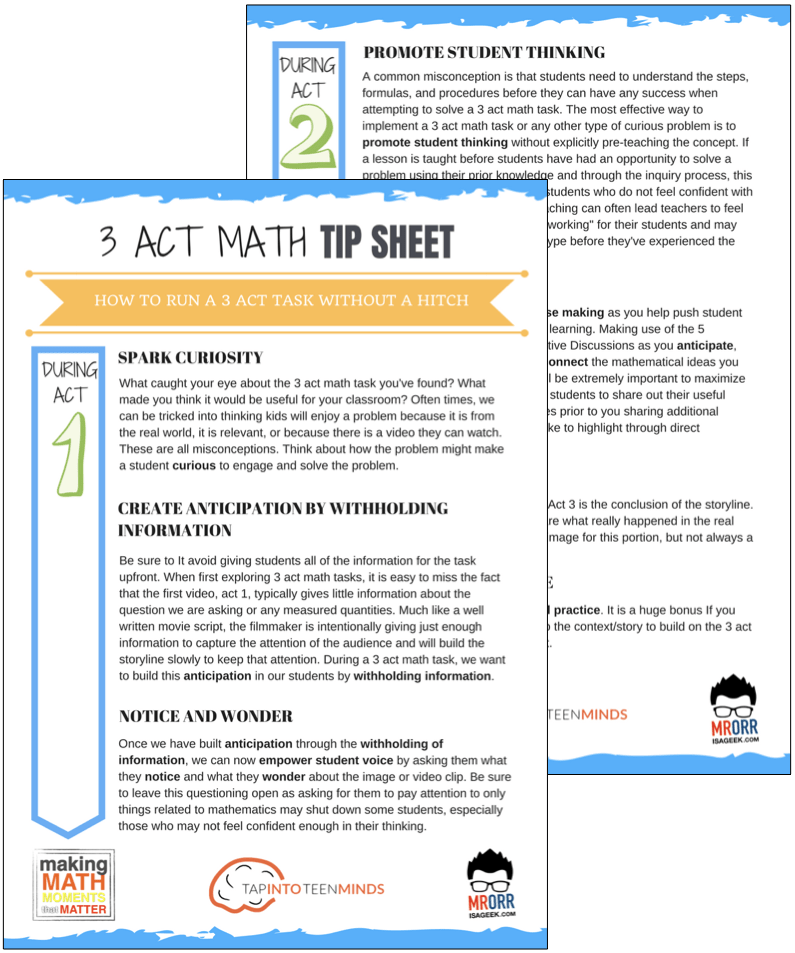
DOWNLOAD THE 3 ACT MATH TASK TIP SHEET SO THEY RUN WITHOUT A HITCH!
Download the 2-page printable 3 Act Math Tip Sheet to ensure that you have the best start to your journey using 3 Act math Tasks to spark curiosity and fuel sense making in your math classroom!
LESSONS TO MAKE MATH MOMENTS
Each lesson consists of:
Each Make Math Moments Problem Based Lesson consists of a Teacher Guide to lead you step-by-step through the planning process to ensure your lesson runs without a hitch!
Each Teacher Guide consists of:
- Intentionality of the lesson;
- A step-by-step walk through of each phase of the lesson;
- Visuals, animations, and videos unpacking big ideas, strategies, and models we intend to emerge during the lesson;
- Sample student approaches to assist in anticipating what your students might do;
- Resources and downloads including Keynote, Powerpoint, Media Files, and Teacher Guide printable PDF; and,
- Much more!
Each Make Math Moments Problem Based Lesson begins with a story, visual, video, or other method to Spark Curiosity through context.
Students will often Notice and Wonder before making an estimate to draw them in and invest in the problem.
After student voice has been heard and acknowledged, we will set students off on a Productive Struggle via a prompt related to the Spark context.
These prompts are given each lesson with the following conditions:
- No calculators are to be used; and,
- Students are to focus on how they can convince their math community that their solution is valid.
Students are left to engage in a productive struggle as the facilitator circulates to observe and engage in conversation as a means of assessing formatively.
The facilitator is instructed through the Teacher Guide on what specific strategies and models could be used to make connections and consolidate the learning from the lesson.
Often times, animations and walk through videos are provided in the Teacher Guide to assist with planning and delivering the consolidation.
A review image, video, or animation is provided as a conclusion to the task from the lesson.
While this might feel like a natural ending to the context students have been exploring, it is just the beginning as we look to leverage this context via extensions and additional lessons to dig deeper.
At the end of each lesson, consolidation prompts and/or extensions are crafted for students to purposefully practice and demonstrate their current understanding.
Facilitators are encouraged to collect these consolidation prompts as a means to engage in the assessment process and inform next moves for instruction.
In multi-day units of study, Math Talks are crafted to help build on the thinking from the previous day and build towards the next step in the developmental progression of the concept(s) we are exploring.
Each Math Talk is constructed as a string of related problems that build with intentionality to emerge specific big ideas, strategies, and mathematical models.
Make Math Moments Problem Based Lessons and Day 1 Teacher Guides are openly available for you to leverage and use with your students without becoming a Make Math Moments Academy Member.
Use our OPEN ACCESS multi-day problem based units!
Make Math Moments Problem Based Lessons and Day 1 Teacher Guides are openly available for you to leverage and use with your students without becoming a Make Math Moments Academy Member.

Partitive Division Resulting in a Fraction

Equivalence and Algebraic Substitution

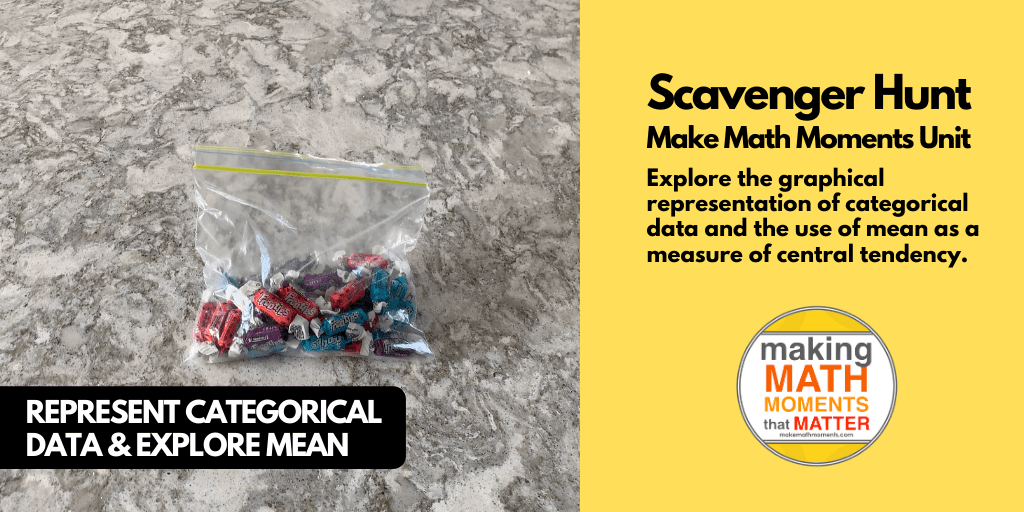
Represent Categorical Data & Explore Mean
Downloadable resources including blackline masters, handouts, printable Tips Sheets, slide shows, and media files do require a Make Math Moments Academy Membership.
ONLINE WORKSHOP REGISTRATION
Pedagogically aligned for teachers of K through Grade 12 with content specific examples from Grades 3 through Grade 10.
In our self-paced, 12-week Online Workshop, you'll learn how to craft new and transform your current lessons to Spark Curiosity, Fuel Sense Making, and Ignite Your Teacher Moves to promote resilient problem solvers.
0 Comments