Episode #492: How Strong Math Teams Turn Decisions Into Action
LISTEN NOW HERE…
WATCH NOW…
Your math team meets regularly. You strategize, make decisions, and talk about improving mathematics. But when everyone leaves the meeting, does the work actually move forward? Too often, teams spend more energy making decisions than putting those decisions into action.
In this episode, Jon Orr and Yvette Lehman explore why strong teams can still get stuck in cycles of discussion and consensus. They unpack how clear ownership, predictable structures, shared direction, and psychological safety can create the right balance of autonomy and accountability—so people feel confident leaving the meeting and getting to work.
In this episode, you’ll explore:
- Why consensus can sometimes slow down math improvement
- How to create greater clarity around roles, responsibilities, and ownership
- The difference between seeking input and asking permission
- Why predictable meeting structures create greater accountability between meetings
- How a Math Coherence Compass can become a filter for everyday decision-making
- What high autonomy and high accountability can look like on a leadership team
- Why psychological safety matters when we want people to take action
- How leaders can determine whether their team has a clarity problem or a confidence problem
If your team is spending more energy deciding what to do than actually doing the work, take a look at the conditions surrounding the team itself. Ask whether people know what they own, whether they have a clear framework for making decisions, and whether they feel safe enough to act without knowing they’ll get everything right the first time. The goal isn’t less collaboration. It’s creating the clarity, autonomy, accountability, and trust that allow collaboration to lead to action.
Attention District Math Leaders:
K-12 Math Leaders: Download our free Math Coherence Compass to help your teammates, system leaders, and educators create aligned instructional practices—without adding another initiative.
K-12 Math Leaders: Not sure what matters most when designing math improvement plans? Take this assessment and get a free customized report: https://makemathmoments.com/grow/
K-12 Math Leaders: Ready to design your math improvement plan with guidance, support and using structure? Learn how to partner with us and follow our 4 stage process. https://growyourmathprogram.com
Looking to supplement your curriculum with problem based lessons and units? Make Math Moments Problem Based Lessons & Units
Be Our Next Podcast Guest!
Join as an Interview Guest or on a Mentoring Moment Call
Apply to be a Featured Interview Guest
Book a Mentoring Moment Coaching Call
Are You an Official Math Moment Maker?




FULL TRANSCRIPT
Jon Orr: Listen in, because if you are an educational leader, a coach, a coordinator, and you’re leading adults towards improvement in mathematics and you’re meeting on a regular basis, you’re coaching, you’re having your department meetings, you’re having your planning sessions, your strategies.
But when you’re at those meetings and when people go away from those meetings, you feel like nothing is improving. Like nothing is getting done. Like we have to come back to the meeting to still strategize. But then when we go away from the meeting, nothing gets done. The improvement stalls, but it’s like, do we always have to come together to actually get stuff done while we’re there? Maybe we’re talking and strategizing more than we’re actually doing.
Yvette Lehman: Mm-hmm.
Jon Orr: And we hear this from teams. We see it in teams. Like, if you’ve listened to our podcast for a while now, you know that one of our big roles is coaching teams in math improvement. And so we’ve met with a lot of teams, and a lot of teams struggle with consensus and battling consensus and action. And that’s kind of what we want to unpack here today.
We saw it recently with a team, and we want to provide some practical suggestions for leaders to get action and accountability and work and improvement from their teams and from themselves. That’s what we’re gonna talk about here today. Yvette, let’s get going.
Yvette Lehman: Yeah, I think the problem that maybe we’re trying to address is when there’s more energy and effort being put into the decision making than actually responding to and putting that decision into action. So it’s like we spend so much time and effort and there’s conversation and thinking happening and it’s a long drawn out process that we never actually get to the work. Because we spend so much time in this space of dissonance, discussion and debate, and because we are trying to find this consensus and we don’t want to step on other people’s toes and maybe there’s just a lack of clarity around who now owns this work and needs to go and respond and do.
Jon Orr: Partly, partly, because it’s like if it was just you, you wouldn’t have the issue because you would be like, well, I’m gonna do this and therefore I go do it. I’m gonna hold this PD session, so I gotta go plan it. And then I gotta see if I achieved what I was hoping to achieve with that session. I’ve gotta bring this resource, I gotta create this syllabus or I gotta create this plan for this presentation that I gotta do.
But you know, we’ve said often like going alone, it creates a fragile system because the moment you step away is the moment that if someone steps in it has to recreate the entire flywheel or the wheel. So with a team is a better approach because you can use distributive leadership. But you know, I think what you’re saying is like sometimes those teams just don’t work efficiently.
And is it a team is too big problem? And like is it we gotta go to two people, you know, like do you feel like it’s a too big problem? Or what else are we leaning towards here of like, well, what is it when that team just doesn’t act the way we were really hoping and they’re continually looking maybe back to you to answer all the problems or get the work done or steer the ship, you know. When you go away from those meetings, people are like, not sure if this is the right thing, so I better come back to the team to figure out if this is the right thing to do.
Yvette Lehman: I think that’s what we want to unpack here today. How do you create the conditions for teams to operate well? So that every member of the team feels empowered and motivated to leave that meeting with a lot of clarity around their roles and responsibilities and how they’re going to be accountable to the team so that we can get to the work. We need to get past the decision making phase and actually start responding and acting.
So I was thinking, as I was preparing for today’s episode, I thought about myself within our team and some of the moves that you make as a leader to position me to feel like I can operate well and I have a level of autonomy versus a level of accountability. And I also looked to some research to say, well, what does research say good leaders do. You know, because I really want to think about if a leader’s listening right now and they’re thinking, yeah, my team is struggling with taking action and feeling confident and knowing what to do between meetings and we’re stuck in the decision making phase that never leads to any type of action. What can the leaders do that are listening?
Jon Orr: For sure. For sure. Where do you want to start?
Yvette Lehman: I’m gonna talk about my own experience as part of the Make Math Moments team.
Jon Orr: Okay. All right.
Yvette Lehman: So John’s a great leader. I don’t know, you listeners should all hear this, but I think that you have some habits and routines built into our system, the way that we operate as a team that give me a lot of autonomy, but also accountability. And I think that’s the balance that we’re striving for: high accountability, high autonomy. So I’ll paint a picture.
Jon Orr: Go ahead.
Yvette Lehman: Yeah. So some of the things I think that have set me up to feel empowered to be able to move forward and make decisions and confidently step into the work is clarity around what projects I own, what decisions I can make with input versus permission.
Jon Orr: Interesting.
Yvette Lehman: So, you know, I have a very good understanding of where my responsibilities lie, what my roles are. We’ve talked, we strategize, you know, we have quarterly meetings as a larger team where we come together and we put our rocks in the jar for that quarter, which helps me understand that my time allocation needs to prioritize those big rocks, those big priorities, those big projects that I am leading. And I’ve been given permission to take the lead there.
Jon Orr: Now, so those there’s some important implications in education, specifically in leading adults in an education environment. Like I want to rewind your history for just a second. Now compare what you just said. Because for a long time you were a leader and you were a math coach in a district, leading and supporting teachers, but being led while you were in that environment? Like do you feel like you had that there too? Because you were a very effective math coach and who made a lot of great decisions and had autonomy and all those things. Like was that prevalent for you in that district, in that environment?
Yvette Lehman: I think that when I was in a district position, I was clear on which projects I owned. But there was also a culture in our department that every decision needed to be made through consensus. And so sometimes I would find myself spending hours, days, weeks with a lot of immobility because the team couldn’t agree or come to consensus.
Jon Orr: Do you have like an example?
Yvette Lehman: Yeah, so let’s say even for example, we’re looking at a professional development series for the year and we’re trying to make decisions around logistics, who’s going to attend, how many people from each site, what’s the focus of the content going to be. You would come to the table with a large group with all different experience and bias and priorities for themselves around what we needed to do that year. And sometimes we got stuck in this position where we felt as though we all had to agree and that everybody owned the work. So all five or six of us in the team owned the work. No one individual person owned it. The team owned the work and we couldn’t step away from the room or move forward with our plans without consensus.
Jon Orr: Right. That for sure. If it’s like, hey, we’ve agreed that when we come together we work on this project. You can’t help but assume the team owns the work, and therefore that feels right. It’s like we’re a team, we work on this together, but nothing can really get done outside of that meeting because you need consensus because the team owns the work instead of individually someone owning the project or owning the work as the owner of it, even though the team can be part of the work.
But this is a recommendation I think that we would love to see in teams working is to say like yes, teams are really important, but having roles assigned or roles distributed to certain projects or certain leads like should be accountable to one person doesn’t mean that that one person has to do everything. It’s that person in that project or that component of that project needs to be accountable for that. Like you have to assign roles. Otherwise people are left to say, well the team owns it and therefore we need consensus instead of because that’s where the stalling happens.
It’s like yes teams are great but they move slow. But can we get a blend of both is the important part and assigning roles for certain components of projects is really really important for teams to function well together.
Yvette Lehman: I think that another when I think about my two experiences as part of this team in my former district position, I don’t know that we were good at building in predictable structures of support and accountability. It was really random. You know, it was like we would sometimes go months without meeting with a supervisor, or sometimes it would and the structure of the meetings wasn’t predictable and I didn’t necessarily know what I should be preparing for that meeting when we did come together because they were so sporadic.
Whereas as a team here at Make Math Moments, we have systems and structures and predictable routines that we protect.
Jon Orr: Right. And you’ve seen this like we’ve seen predictable routines in districts that function well together too. Like teams that come together every single week to talk about the coaching aspects that’s happened throughout that week and they come and they bring the pebbles that they’ve experienced to the team, to the team to kind of pluck pebbles from each other’s shoes because that’s one of the routines that they do on a weekly basis.
Like having predictable routines helps set the stage for moving forward because I think everyone hates the meeting that you feel like should be the sta like that was could have been an email. Like we ’cause you don’t know what the purpose of the meeting really is. It’s like, we come together as a staff meeting or we come together as a department meeting. But in like you’re saying, sometimes a lot of times those are unpredictable.
It’s like we don’t have a staff meeting every week or every month. The principal might say we have it this coming week because we haven’t talked in a while and we should. But then when we get there, there’s no like the agenda isn’t predictable. The agenda is like, well, we’re not sure what we’re gonna talk about. And then and the same with department meetings. Like sometimes you get to those department meetings and it’s like, well, we’re here because we’re supposed to be, but we don’t have like a usefulness, the why we’re here, what we do.
Same with PLCs, right? Like PLCs come together because we’re supposed to, but we don’t really understand how to use that time effectively to work towards improving our craft or improving student outcomes or thinking about assessment data on a particular because we just don’t have the protocols that we rely on so that when we come we know we bring this with us. We have these thoughts.
Like this is gonna sound you know off topic a little bit, but I remember hearing Tom Hanks, not an educator, you know, an actor. And he said, you know, one of the things he’s stuck with all of his years, he said when one time when he first started, a director once told him, he said, look, show up on time and come with an idea. And he’s like, that’s all you have to do every single time. Come with something to work with. And we can work with you.
And he’s like, every time I go into a project, he’s like, I come on time and I bring something with me to share and contribute because that was like the predictable thing that I can do every single time. And it was like, you can work with that. It’s kind of like you need the predictableness, you need the routines, you need the structures in terms of meetings, support, like otherwise it’s chaos. But it doesn’t become useful. And having a useful team meeting is the most important thing about like what we’re talking about here because I think a lot of times as we come together and we do nothing happens and then nothing happens outside because we didn’t do anything with the meeting itself.
Yvette Lehman: I think the balance we’re trying to strike here is we meet routinely and it’s structured and predictable and meaningful time, but it’s brief, and everybody goes back to then getting the work done. What we want to see is a shift toward less time meeting, debating, talking in circles, in analysis paralysis, where the time is structured, purposeful. It doesn’t need to be two hours. If you don’t need two hours, you might cut it short that day, but everybody knows that they show up and what’s expected of them. But then we all get back to our work.
Jon Orr: Yeah. Yeah. And I think when you blend what we’ve been talking about roles, structure to meetings, you’re really talking around a centralized idea that you have to have in place to allow it to make sense, which is what you said about our predictability in the systems that we put into place here is to have what is it that we’re working on? Like where are we going? What are we working towards? Like what are the guiding principles?
So when we come back, it’s like that’s why the team has to function the way it does. One of the recommendations we make with all of our teams that we support across districts is to have what we call a math coherence compass. Like what is it that we’re all striving for? Because if I have a role and responsibility and I know the compass, the framework for making decisions for moving us forward, then I can make decisions on my own and bring my pebbles back to the team to say I’ve been working on this, I’ve been strategizing this, or I was working with this teacher and I’m run up against a pebble. I’m gonna bring it to the team to solve that problem because we’re all working towards this common outcome of where we want math education to go in our district or our school or for our team.
You know, we’ve talked about the math coherence compass in past episodes. There’s a link in the description to this in this episode if you want to go down and have a look at that compass. But the compass has four components. It becomes a filter. It’s like, what’s our three-year plan? What’s our three-year goal? And it can’t be too many things. It’s gotta be like what that’s the goal. It’s we’re building fluency for all across K-12. Like that’s easy to say and an easy plan to work on.
What’s the vision? That’s like the south part of your compass. Like what is it that we hope to see for like the experience that we want to see in our classrooms? Like let’s make sure we can define that so that when I’m making a decision outside of a team, I can go, does it pass, like does it support the vision? And does that decision support the goal, the three-year goal of building fluency for all? If yes to both of those, great. Look to the east of the compass.
Does it violate or support our core beliefs around teaching and learning mathematics? We gotta define those. Like we have to define what is it that we really strongly believe or want to make sure that we share across the district around teaching mathematics and learning mathematics and how we do both of those things. And then if it passes that decision supports that, then we look to the west side of the compass and say, do we make use of our strategic supports? Are we making use of our staff meetings appropriately? Are we making use of our PLCs appropriately to support this? Can I use the existing structures and strengths to help achieve this decision?
And if so, then all four of those pass. Then I can go and I feel confident that I can go off and make these moves myself because it helps us move forward on these things we’ve preset. We pre-said and it doesn’t say that you can’t change those things later, but it helps us move forward today because we’ve agreed that this is important in these ways, and now I have the autonomy to go off and make decisions.
Like if I’m a coach in a team, if I’m a principal at a school, I gotta know what these things are so that I can make decisions knowing that I’m not have to second guess myself. So be like, I gotta go back and get consensus from the team. Am I on the right track? Or because the team owns it. No, I own this component and I’m making sure it fits with the compass and therefore it will move us forward because that’s the way we designed the compass. It’s an important component.
It sounds like when teams are unsure of their usefulness of the team meetings, then like if the leader is going like, I’m not sure that this was a really great meeting, it’s probably because we don’t have a compass in place.
Yvette Lehman: I think that’s really critical. And I want to just go back and highlight some of the things we’ve said so far. So we basically said we want to make sure that everybody on the team has clarity around their roles and their responsibilities and what work they own when they need to ask permission as opposed to input, so that we can move forward, get to the work, and make decisions through the lens of our compass, which is we’ve already there’s already consensus or already a commitment to these big ideas. So your vision has been established, your student learning objective, your key results for where you want to go.
But I guess another layer to that, and it’s something that you actually talk about often. And I read recently prepping for today’s episode in Frontiers in Psychology was an article called Psychological Safety and Interdisciplinary Teams, How Leaders’ Leadership Behavior Empowers Teams. So imagine though. I go forward and I make a decision and it wasn’t the right decision. I need to have the safety that it’s okay to be wrong. That like nobody here is looking for perfection and that we’re really in this almost inquiry cycle constantly where we’re trying, learning, adjusting. We don’t have to have the answer in order to start the work.
Because we know that we’re in that flywheel analogy, right? We’re constantly going to come back, reflect, refine, and move forward. But I think sometimes people, if we don’t have the psychological safety built into the relationships that we’ve built and the trust at the table, and even just the way that mistakes have been treated in the past, there is going to be fear and apprehension to move forward, and then you are going to have people very dependent on you or dependent on the team if that psychological safety and trust is in place.
Jon Orr: One hundred percent. There’s a book actually right beside my stationary bike in the basement right now called The Fearless Organization. It’s by Amy Edmondson. She’s kind of the godmother of psychological safety. Did a lot of research around it. They used that research in Google. Google had a famous study that they published to say like what makes our teams perform well? And they thought, it’s the makeup of the team. It’s the dynamic that happens, you know, between this person and this person, or it’s the skill level of the team. And they said, nope, nope, nope. It’s actually the amount of psychological safety that teams have that make the team perform better than other teams.
I would recommend picking that book up if you’re serious about creating cohesion in your teams that you’re working with. The Fearless Organization. We’ll put a link in the description below, but it’s again it’s on my stationary bike downstairs, which means I read it when I’m on the bike.
Yvette Lehman: On today’s episode, I think one of our goals was to help people get unstuck and get out of these cycles where again, you know, time is being spent on decision making as opposed to diving into the actual work. And that’s what we’re trying to unlock for teams by really thinking about do you have a confidence issue amongst your team or do you have a clarity issue? That’s number one. Do people have clarity around what they own, their roles, their responsibilities?
Do you have a decision-making tool or compass that allows people to move forward with a filter of of course I can make this move because it’s going to move the needle and get us closer to the agreed upon destination that we’re all striving for? And do members of your team feel safe that if they were to take the wrong step down a path, that it’s okay to try, learn, and reflect, refine? That there isn’t going to be, you know, it’s not catastrophic because we’re all in these constant cycles of inquiry and we’re just every day trying to improve greater improvement.
Jon Orr: Yeah. Yeah. Yeah. And I think when you think about it it’s like sometimes when we think about math improvement we’re saying like, hey, we’ve done a lot of things as a team over the years and we’re just not seeing the gains that we thought we would see. And a lot of times you look at the moves you make, the pedagogical moves, the inputs, the sessions or the coaching or maybe the resources you’re, you know, I need a new resource here and sometimes those are levers that we can pull to make improvement. But sometimes we have to look internally and go, is my team performing the way it needs to to create and utilize the structures and supports and the resources effectively? And sometimes we see that. And sometimes we can diagnose that with teams.
And that’s what we wanted to share here today: think about internally too, versus always the external resources and supports that you’re putting into place. And hopefully, we gave some suggestions. If you need any support or resources, there’s links in the description of the episode around wherever you’re watching this to the compass, to booking a call with us to see if you need some support and structuring how to build your team so that it can perform at optimal levels and support it, considering that there are many different individuals that make those teams. Click those links. We’re here to support and we’ll talk to you in the next episode.
Thanks For Listening
- Book a Math Mentoring Moment
- Apply to be a Featured Interview Guest
- Leave a note in the comment section below.
- Share this show on Twitter, or Facebook.
To help out the show:
- Leave an honest review on iTunes. Your ratings and reviews really help and we read each one.
- Subscribe on iTunes, Google Play, and Spotify.
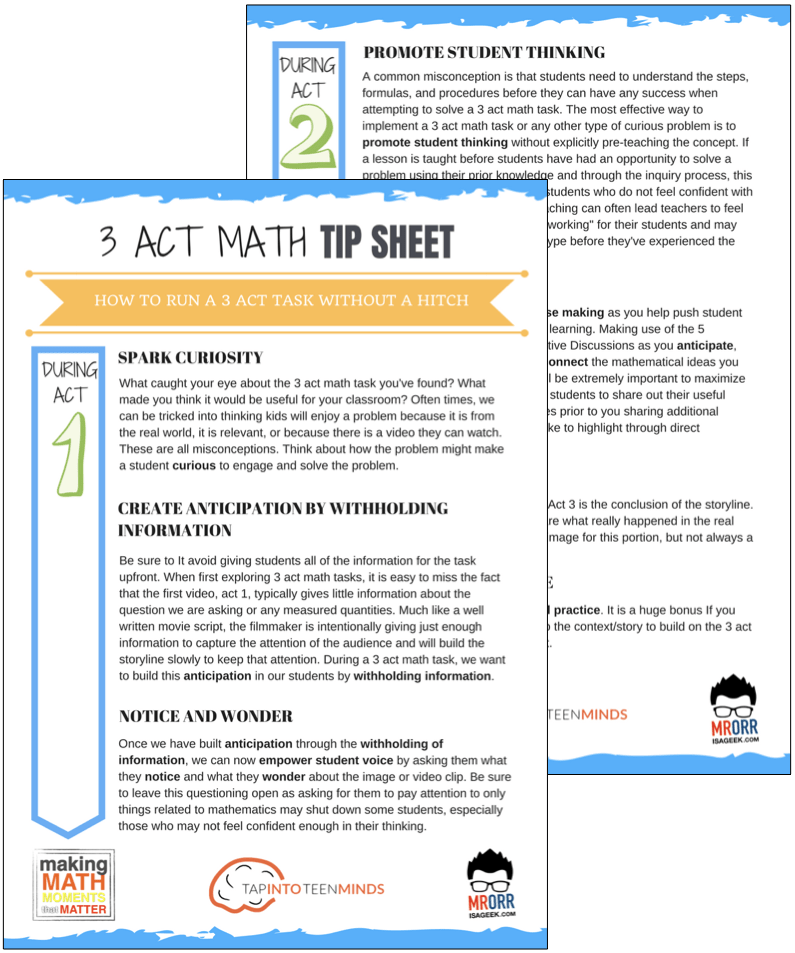
DOWNLOAD THE 3 ACT MATH TASK TIP SHEET SO THEY RUN WITHOUT A HITCH!
Download the 2-page printable 3 Act Math Tip Sheet to ensure that you have the best start to your journey using 3 Act math Tasks to spark curiosity and fuel sense making in your math classroom!
LESSONS TO MAKE MATH MOMENTS
Each lesson consists of:
Each Make Math Moments Problem Based Lesson consists of a Teacher Guide to lead you step-by-step through the planning process to ensure your lesson runs without a hitch!
Each Teacher Guide consists of:
- Intentionality of the lesson;
- A step-by-step walk through of each phase of the lesson;
- Visuals, animations, and videos unpacking big ideas, strategies, and models we intend to emerge during the lesson;
- Sample student approaches to assist in anticipating what your students might do;
- Resources and downloads including Keynote, Powerpoint, Media Files, and Teacher Guide printable PDF; and,
- Much more!
Each Make Math Moments Problem Based Lesson begins with a story, visual, video, or other method to Spark Curiosity through context.
Students will often Notice and Wonder before making an estimate to draw them in and invest in the problem.
After student voice has been heard and acknowledged, we will set students off on a Productive Struggle via a prompt related to the Spark context.
These prompts are given each lesson with the following conditions:
- No calculators are to be used; and,
- Students are to focus on how they can convince their math community that their solution is valid.
Students are left to engage in a productive struggle as the facilitator circulates to observe and engage in conversation as a means of assessing formatively.
The facilitator is instructed through the Teacher Guide on what specific strategies and models could be used to make connections and consolidate the learning from the lesson.
Often times, animations and walk through videos are provided in the Teacher Guide to assist with planning and delivering the consolidation.
A review image, video, or animation is provided as a conclusion to the task from the lesson.
While this might feel like a natural ending to the context students have been exploring, it is just the beginning as we look to leverage this context via extensions and additional lessons to dig deeper.
At the end of each lesson, consolidation prompts and/or extensions are crafted for students to purposefully practice and demonstrate their current understanding.
Facilitators are encouraged to collect these consolidation prompts as a means to engage in the assessment process and inform next moves for instruction.
In multi-day units of study, Math Talks are crafted to help build on the thinking from the previous day and build towards the next step in the developmental progression of the concept(s) we are exploring.
Each Math Talk is constructed as a string of related problems that build with intentionality to emerge specific big ideas, strategies, and mathematical models.
Make Math Moments Problem Based Lessons and Day 1 Teacher Guides are openly available for you to leverage and use with your students without becoming a Make Math Moments Academy Member.
Use our OPEN ACCESS multi-day problem based units!
Make Math Moments Problem Based Lessons and Day 1 Teacher Guides are openly available for you to leverage and use with your students without becoming a Make Math Moments Academy Member.
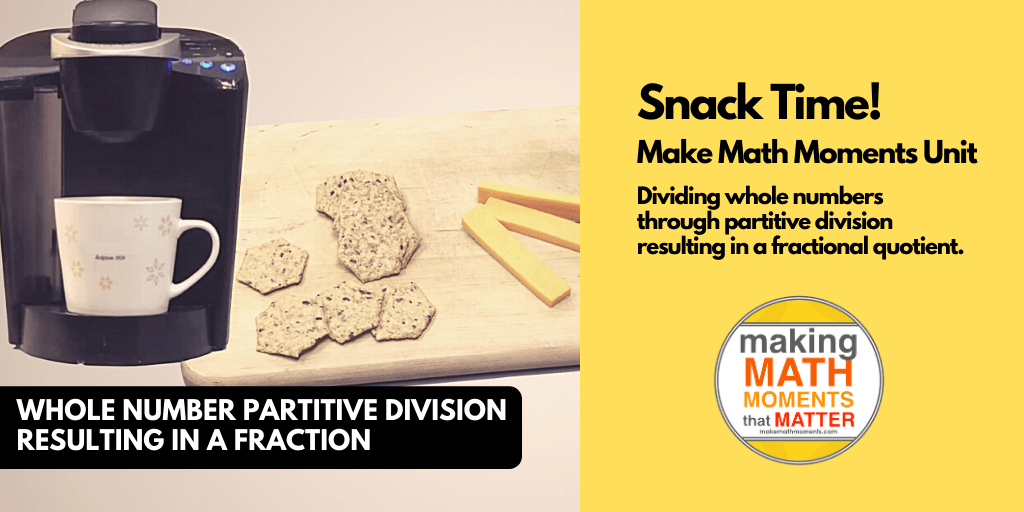
Partitive Division Resulting in a Fraction
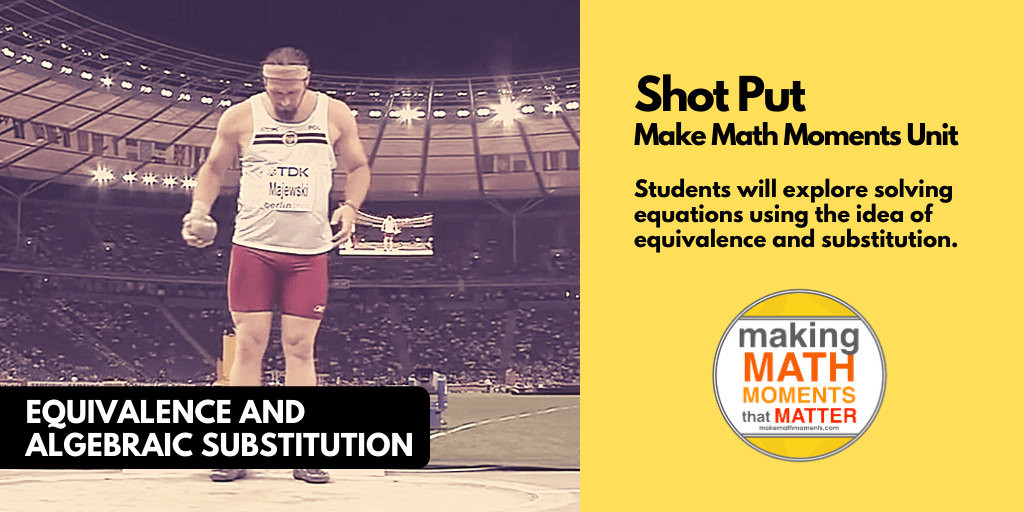
Equivalence and Algebraic Substitution
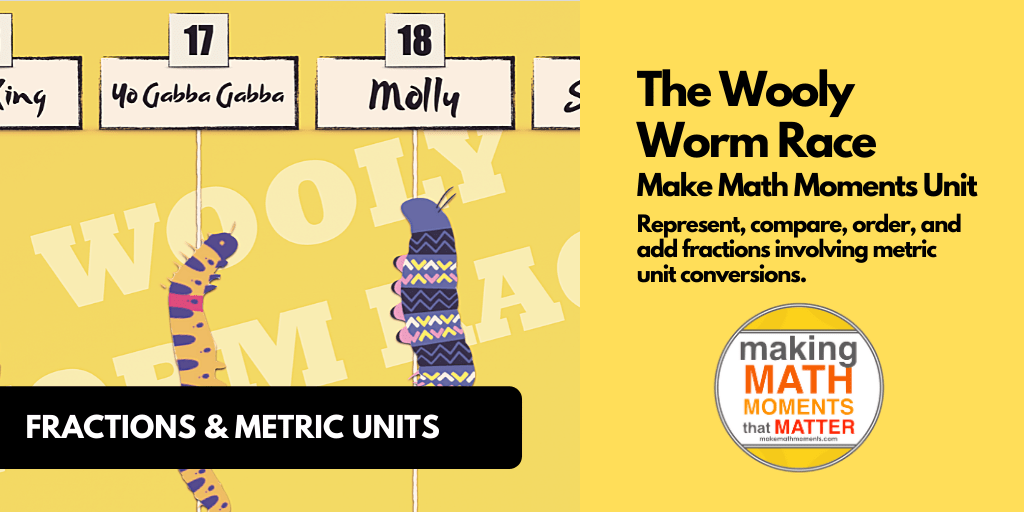
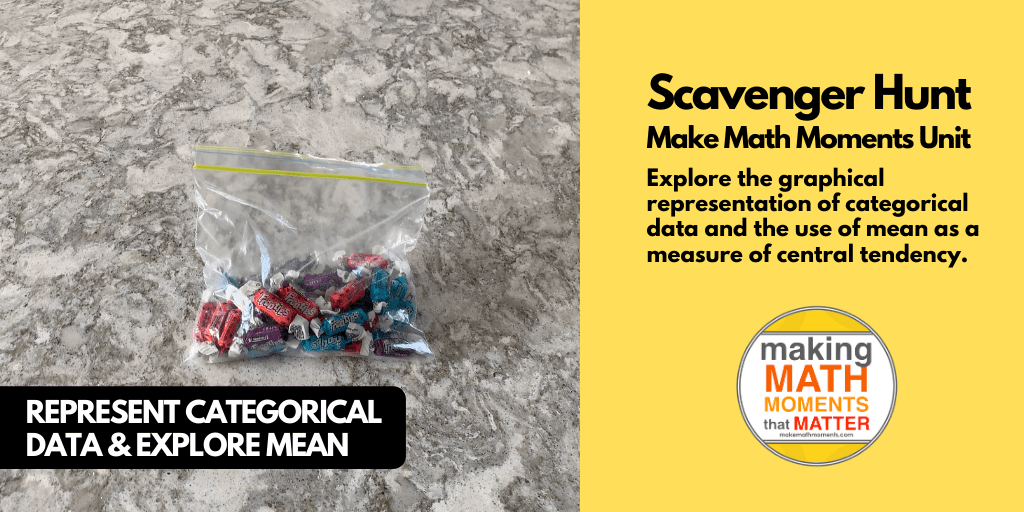
Represent Categorical Data & Explore Mean
Downloadable resources including blackline masters, handouts, printable Tips Sheets, slide shows, and media files do require a Make Math Moments Academy Membership.
ONLINE WORKSHOP REGISTRATION
Pedagogically aligned for teachers of K through Grade 12 with content specific examples from Grades 3 through Grade 10.
In our self-paced, 12-week Online Workshop, you'll learn how to craft new and transform your current lessons to Spark Curiosity, Fuel Sense Making, and Ignite Your Teacher Moves to promote resilient problem solvers.

0 Comments