Episode #491: Why Do Students Struggle With Math Word Problems and What To Do About It
LISTEN NOW HERE...



WATCH NOW...
We’ve all heard it: “My students can do the math—they just struggle with word problems.” They can perform the calculation when it’s presented directly, but put that same mathematics inside a context or multi-step problem and suddenly things become much more difficult. The instinct might be to give students more word problems to practice, but what if the real challenge lies somewhere deeper?
In this episode, Jon Orr and Yvette Lehman dig into adaptive reasoning, one of the five interconnected strands of mathematical proficiency described in Adding It Up. They explore the important difference between having strategies in your mathematical toolkit and knowing when, why, and how to choose among them. From think-alouds and metacognition to mathematical discourse and varied problem contexts, the conversation looks at how we can help students become more flexible problem solvers. It also challenges us to look beyond “students can’t reason” and consider whether they have the background knowledge, task clarity, and familiarity with the context needed to demonstrate their reasoning in the first place.
In this episode, you'll explore:
- What adaptive reasoning means within the five strands of mathematical proficiency
- Why knowing how to use a strategy is different from knowing when to choose it
- How think-alouds can make mathematical decision-making visible to students
- Why reflection and metacognition matter when students solve unfamiliar problems
- How mathematical discourse supports adaptive reasoning
- Three conditions to consider before concluding that students are struggling with reasoning
- Why background knowledge and meaningful, familiar contexts matter in problem solving
- How strengthening our own mathematical proficiency can better position us to support students
If your students can complete straightforward calculations but struggle when mathematics appears in unfamiliar or multi-step problems, this episode offers a different place to look. Rather than simply adding more practice, consider what opportunities students have to choose strategies, explain those choices, reflect on their thinking, and strengthen the adaptive reasoning that helps weave mathematical proficiency together.
Attention District Math Leaders:
K-12 Math Leaders: Download our free Math Coherence Compass to help your teammates, system leaders, and educators create aligned instructional practices—without adding another initiative.
K-12 Math Leaders: Not sure what matters most when designing math improvement plans? Take this assessment and get a free customized report: https://makemathmoments.com/grow/
K-12 Math Leaders: Ready to design your math improvement plan with guidance, support and using structure? Learn how to partner with us and follow our 4 stage process. https://growyourmathprogram.com
Looking to supplement your curriculum with problem based lessons and units? Make Math Moments Problem Based Lessons & Units
Be Our Next Podcast Guest!
Join as an Interview Guest or on a Mentoring Moment Call
Apply to be a Featured Interview Guest
It will take less than two (2) minutes to book your Math Mentoring Moment call.
Book a Mentoring Moment Coaching Call
Take two (2) minutes to book your Math Mentoring Moment call and let's work together to shake that math pebble out of your shoe!
Are You an Official Math Moment Maker?
Ensure that you follow, rate and review on Apple Podcasts, Spotify and other platforms to show your support and ensure other math educators can find the show.


FULL TRANSCRIPT
Jon Orr: I remember when I first started teaching the ninth grade. And the ninth grade here in Ontario is when we run our standardized tests. Well, one of them, you know, we have three, six, and nine. And I remember looking at some results. This is early in my career, like when I first started teaching. And I remember seeing some questions. And the thing about the EQAO standardized tests for the ninth grade that I remember kind of reflecting on was like, they ask questions in a not a straightforward way. There's not a lot of straightforward questions on that assessment.
And I remember thinking like, if you just wanted to know how to add integers, why didn't you just ask them how to add integers? Like, my kids can do that, but now they're gonna get that question wrong because there was thinking involved. It was like they had to figure out that you had to add integers to solve that problem, but it wasn't straightforward. And I'm like, why don't they just ask that? Like, if they wanted to know that, then we could answer that. And I remember thinking, like, my kids can do stuff, but they struggle with the word problems, the context, the figuring it out.
And when we moved into supporting the teachers around us, that was also the common worry, is like my kids just like word problems seem to be the struggle. Solving multi-step problems are always a struggle for us here in our building or our school system. And like we gotta focus on that. And when teachers say kids struggle with solving problems or multi-step problems or word problems, they're not wrong. Like those are tough things to teach.
And I think we kind of say, well, back then my answer was like, we'll do more of them. We'll just make sure we do more of them. But in today's episode, we want to unpack really the awareness here around like what's really happening when we are saying as a teacher that my students are struggling in that area, or I'm supporting teachers and you're hearing that they can do the straightforward stuff, but it's just the word problems that they're struggling with. We want to unpack why that's the case and give you a little bit of a checklist to look at so that you can be like, if that's the case, here's what you need to look at. Here's the things that you need to consider. And maybe these are the things that you can start to shift around so students are stronger in that area. Let's get into it.
Yvette Lehman: I'm working right now with one of our school level partners. And they kind of brought this same idea to the table. They said, as a state, across a state, we're collectively working on strengthening thinking and reasoning. So what I think that means is we're working on positioning students to be able to solve more complex problems. So probably on their standardized tests, it's the word problems, it's the multi-step problems.
Jon Orr: Right. They said the same thing, yeah.
Yvette Lehman: They're like, this is where things are falling apart for us. And I was like, okay, thinking and reasoning. What does it mean? Like how are we defining thinking and reasoning?
Jon Orr: Right, you did the deep dive.
Yvette Lehman: I did. I of course, you know, I'm like, okay, and thinking I kind of put to the side, but I was like, what does reasoning mean? What are the observable behaviors of a student who is reasoning? How do I know? And so I went back to probably my go-to research when it comes to deeply understanding mathematical proficiency. And I went back to the 2001 document from the National Research Council, Adding It Up.
I feel like I often say, and I've said it actually, I think on my own Make Math Moments episode, that learning about the five strands of mathematical proficiency was the start of my mathematical epiphany. You know, this journey that I went down.
Jon Orr: Yeah. And I was just gonna say, like you went down that a good number of years ago and it's led you here, but I think you're listening right now, you might be like, I don't know about that and this might be the start of your epiphany.
Yvette Lehman: Yeah. So, you know, and I would say that many leaders in the math education world often reference this research. It was a really significant meta-analysis of years of research that was co-edited by Kilpatrick and again released in 2001 by the National Research Council, Adding It Up. There's portions of this lengthy document available, free sources that can be found, I think, online.
Jon Orr: We'll put a link in the show notes.
Yvette Lehman: Yeah. And so, and but you've probably seen maybe the rope before. And essentially it's these five strands that really describe what it means to be mathematically proficient. So you have your conceptual understanding, buzzword that we often hear in math education, procedural fluency, another buzzword, strategic competence, productive disposition, and last but not least, this idea of adaptive reasoning, which is the one that I think I was the least confident in defining, which motivated me to get back into that original document and to make sure confirm my understanding of what we mean when we say adaptive reasoning.
Jon Orr: So the team that we're working with, their objective is to strengthen thinking and reasoning. And so I mean you're like, wait a minute, let's take the deep dive. And so reasoning led you to Adding It Up, which we know is one of the five elements of mathematical proficiency is adaptive reasoning, which is the capacity for logical thought, reflection, choice. Tell me more, like tell me what you learned when you kind of took a deep dive into adaptive reasoning and why, because I think we started this with like we want to be able to solve complex problems. And this is where the heart lives, I believe, is like the choice, the choosing of strategies in the adaptive reasoning. So if we're struggling with word problems, we're struggling with multi-step problems, it's likely we need to strengthen this rope or this strand of the mathematical proficiencies.
Yvette Lehman: Yeah. I was interested to read that they defined it as the glue that holds everything together. It's the lodestar that guides learning. And I guess I didn't really fully understand the implications of adaptive reasoning. And the best example that I can share with you is so strategic competence, which is one of the other strands, is our toolkit of strategies.
So I can develop my toolkit, and that can include both the use of strategies and models as tools for thinking. So strategies, for example, is like knowing that I can double and halve to multiply. It's knowing that I can use partial products. It's knowing that, for example, when I divide, as long as I'm dividing both the dividend and the divisor by the same scale factor, the quotient is the same. Like these are strategies that I can build up in my toolkit. And we often build them through problem strings or through number talks or through repeated practice, whatever it is. You're building up your toolkit.
But what adaptive reasoning allows us to do is select the appropriate one or to pivot or change our strategy when one is no longer working for us. So I often used to find when I was on my problem-solving journey, I would be like, well my students know how to double and halve, but I never see them using it to problem solve. And that was kind of that disconnect, right? They were building up their toolkit, they were increasing their strategic competence, but they weren't yet looking at the relationships between numbers or the context within the word problem and choosing the strategy that was most logical or made the most sense given the relationships or patterns.
Jon Orr: Right. Is that these are all intertwined. That's why it's the strands of one rope. But that's like my mind is like part of saying, like, okay, so if they're not choosing, it's like, how do I strengthen that then? Like if you said, look, we are strong in the actual strategy itself when I tell them use this strategy, but it's like, okay, so now it's like now I'm reading a problem and I can't select that strategy from my arsenal of strategies. Is it just repetition? Like I think as a high school teacher and middle school teacher, you're like, well, we'll just do more of it so that they can see the telltale signs that that's the strategy to use on that type of problem.
Yvette Lehman: That's such an interesting question. So I will say that one thing I really appreciated from Jennifer Bay Williams that I use all the time is they can't learn to choose it if they haven't learned to use it. So it's like they have to learn to use it first. It's not likely that these strategies are just gonna emerge organically through discovery.
Jon Orr: Right. If they are, I think even if they could be, what you're saying is they still have to practice using it. Right. Like it's like we could develop an activity that explores a relationship and then we talk about it and then I can formulate a strategy. But now we have to use it.
Yvette Lehman: For sure. So like games and opportunities.
Jon Orr: We can't choose to use it until we feel comfortable using it for sure. I agree.
Yvette Lehman: Right, right. So it's like we need to build in games and we need to build in opportunities for them to strengthen their toolkit. But then you mentioned, okay, so how do we bridge this, how do we weave these strands together when they're actually choosing them to solve a problem? And I think that's a great question. One that I don't necessarily have a perfect answer for right now, but where my mind is going is like think alouds. Like explicitly modeling a metacognitive process for students.
And that's actually a strategy that's reinforced in the Clearinghouse document on strategies for struggling math students. They talk about what are some high-leverage interventions for students struggling in math? And one of them is like think alouds, like talking through modeling your own problem solving and how you're thinking about how you're choosing a strategy based on the numbers or the relationship within the problem. So that might be one way to help bridge that gap between now I have the strategy in my toolkit, but I need to apply it to my problem solving. Do I do some modeling and some thinking aloud about my strategy selection? Like do we make the thinking more either visible or auditory in the classroom so that students are hearing other people thinking about strategy selection when there's problem solving?
Jon Orr: Right. Like my mind goes to like I said, like the idea of doing more to me is partly related into the doing more but in varying contexts. Like we learn obviously a lot through pattern recognition and being able to apply the whole choosing is like if I can't choose, if I have to use it before I choose it, now it's like okay, let's say I'm strong at using it. But now I need to be in different contexts to see the pattern components that go, I can use it here. And then like you said, we actually have to talk that out for sure to be like, yes, can we use it? Let's try that out. Like let's go down that road and think about that and then come back and go like, what did we see here to make us think that that pathway was a great pathway to go down? So that next time you see a similar pattern or a similar problem or a similar context, you can be like, look, try that. Like that worked last time. Like that's part of the adaptive reasoning practice.
Yvette Lehman: Yeah.
Jon Orr: Let's try strategies. Let's de-risk the strategy selection process. Cause we used to say this, I said this when I was teaching, is like we don't tend to do that a lot in when you're teaching kids. It's like, I'm gonna show you how to solve a word problem and then we'll just do more word problems. But instead of actually saying like, wait a minute, let's allow you to choose strategies to word problems and then reflect on the strategy choice process, which is an important metacognition component that we often overlook. We just go like, let me show you how to solve this problem without actually layering in any supports along the way. If you want to become a better problem solver, you gotta start with unfamiliar problems and then guide kids down this pathway to go like, how'd we get there? Let's reverse engineer to see where we are. Like otherwise we're just trying to do the band-aid, here's a problem, let me show you how to do the problem. And then now it's like you're relying on memorization to solve another problem instead of reverse engineering the metacognition part.
Yvette Lehman: When you think about that metacognitive component, I was just thinking as you were talking about the two factors basically that lead me to a strategy. And okay, there's three factors. One of them is like, what is the operation? Like what operation is emerging here? The relationship between the numbers, and then lastly, the context. Right? So what I mean by that is like, for example, with subtraction, there are different types of subtraction and there are different subtraction strategies. Sometimes the context of the problem is going to push you toward a particular strategy. And that goes to problem types.
And actually, interestingly, in that same document on supports for struggling students in mathematics, one of their other high-leverage strategies is noticing and naming problem types. So if you were like, well, this is a comparison problem, okay, what strategies do we have that lend themselves to the comparison of two quantities? Okay, now let's look at the numbers. Are the numbers close together or far apart? Because if you're subtracting 1000 minus 998, you're gonna use a different strategy than 1000 minus 4. And so, really being really transparent about that thinking in the process is so important for students to lift the hood on all that's going on in your brain when you're making choices about models and strategies to solve a problem. And letting them hear each other's.
And that's why I thought it was really interesting when I was digging into this chapter. Adaptive reasoning is absolutely closely linked to discourse. So, if you are a board or a school that's strengthening mathematical discourse in your system, you are strengthening adaptive reasoning. Or if your barrier is like, we don't have mathematical discourse, we don't hear students talking about their thinking or justifying their reasoning or asking good questions of each other, making connections, it's probably because this strand of your rope is weak. Because in order to justify my choice, in order to talk through what I did or why I did it or to compare what I did to what another person did, it relies on this strand of proficiency.
Jon Orr: Let's talk about the from the Adding It Up document, they have some recommendations. Specifically, I think when we say like my students are struggling with adaptive reasoning or they're saying they're struggling with multi-step word problems and we're not very good at it, I think Adding It Up is kind of saying before you make a judgment there, before you're like kids can't reason, there are three things you should really consider before making that assumption. Let's unpack.
Yvette Lehman: Yeah. So the recommendations for conditions to check before assuming is, and interestingly, we just recorded an episode, it was released two weeks ago, episode 487, where we talked about prerequisite skills. And basically one of the recommendations is do students have the necessary background knowledge to access this learning today? And if the answer is no, then that might be a barrier to reasoning.
The second is, is the problem that they're working through understandable? Like can they make sense of it? Can they visualize what's happening? And is it a task worth doing? Like is it motivating? Is it curious? Is it like we care to find an answer here?
Jon Orr: I guess what they're saying is like before you can assess whether you can assess adaptive reasoning or reasoning here, then you need to make sure that like are you asking them the first thing is like are you asking them to do something they don't have a skill set for? Right? Because now it's not that I can't reason through this. I just don't have the skills. The second one you're saying is like, is the task or the problem understandable and is it motivating? So basically what we're saying is like before you can assess whether the students are weak at problem solving or multi-step problem solving, maybe this task isn't worth doing. Maybe the kids aren't like, I don't want to solve this problem, or I don't care about this context or this problem, or I maybe I can't understand what it's even asking. It's not clear. And therefore reasoning isn't the issue here. There's an underlying understandableness around that problem before we can address that. And then what's the third one?
Yvette Lehman: Third one is asking ourselves whether or not the context is familiar and comfortable, which to me really speaks to a culturally responsive approach to instruction, where basically we're not asking students to visualize a problem that they have no prior knowledge in experiencing in the real world in their lives.
I actually remember, I love Kathy Fosnot's frog jumping unit for introducing one and two-step algebraic equations. It is my favorite unit. But I was like, they are not going to know what I mean when I'm like frog jumping. It's all based on a real frog jumping competition. And so before we started the unit, we watched all kinds of real frogs. I wish I could remember off the top of my head now where this is an annual competition.
Jon Orr: It's on our website. So if you go to makemathmoments.com and slash tasks, we have some frog jumping videos on there. I remember that.
Yvette Lehman: Yeah. And so it's like in order for them to be comfortable with the context, I needed to give them some familiarity. Because if I was just to present this problem about Rosie the Ribitter is going to be jumping so many jumps and then this, and they couldn't visualize what I meant and they got hung up in the context because it was unfamiliar, would that be a good assessment of their ability to reason? So that's kind of the last recommendation that came from the Adding It Up document of whether or not before we can assess whether a student can reason, do they have the background knowledge? Is the task understandable, motivating, and is it a context that they are familiar and comfortable with?
Jon Orr: Got it. Okay. So as we kind of wrap this episode, cause we unpacked, hey, we might see that our students are struggling to solve multi-step problems, complex problems, word problems. And we're saying we need to look strongly at adaptive reasoning because that's really the skill that could be the underlying cause here. We've got some checklists to see if that's really what we're strengthening. We also gave some strategies to say how we could strengthen that up by specifically thinking about how to do some more pattern recognition, but more metacognition type activities, think alouds, strategizing, allowing students to choose strategies and talking our way through it. What is there anything else we want to leave to the listener here, leader or classroom teacher, on thinking about why understanding and learning and strengthening adaptive reasoning is important?
Yvette Lehman: I think it really goes back to where we started the conversation, which is this idea exactly as you stated, like if our problem is in problem solving and we're just like students can't, we need to scaffold for them. We need to do gradual release constantly because they just can't work their way through these novel situations. We need to probably reflect on what about our own practice is creating those conditions.
There's more to this in the chapter than what we've highlighted there. So I guess my call to action would certainly be for anybody who is not familiar with this document to go in and, of course, look at the rope from the bigger picture as well as these interwoven strands and then focus in on adaptive reasoning because there's other recommendations, right? It's really, really closely linked to conceptual understanding as well. If I conceptual understanding is what allows me to model the problem. So if it's the frog jumping competition and I'm actually talking about frogs taking jumps along a number line, my conceptual understanding is what allows me to make the context visual and to build a physical or pictorial model or representation of that problem.
So this is where these are of course interwoven and there's always more work to be done in strengthening not only our students' mathematical proficiency, but our mathematical proficiency. Like a student problem is a teacher problem and a leader problem. So what are we committed to do to strengthen our own adaptive reasoning so that we're better positioned to support this behavior in students in the classroom?
Jon Orr: Yeah, we'll put the link to the Adding It Up document in the description below. So scroll down there and give it a click. We've also put together a classroom and also a district leader assessment. In that assessment, there are six components that we look at to strengthen our math classroom or our district program or our school programming around mathematics. In that assessment, in one of those six areas, we ask a series of questions about the Adding It Up document in the five proficiencies that we outlined here. So if you want to see where your current system or classroom stands around those five proficiencies and other areas that go into a complete mathematics classroom or complete mathematics program, you can scroll in the links below as well to access that assessment. If you fill out that assessment, we'll send you that report. And in that report, we have next steps, recommendations, there's going to be some learning to do or possibly some resources to grab. So in the link below, click that one that says assessment and we'll give you that report. Take care.
Your Customized Improvement Plan For Your Math Classroom.
Take the 12 minute assessment and you'll get a free, customized plan to shape and grow the 6 parts of any strong mathematics classroom program.
District leader/math coach? Take the District Assessment
Thanks For Listening
- Book a Math Mentoring Moment
- Apply to be a Featured Interview Guest
- Leave a note in the comment section below.
- Share this show on Twitter, or Facebook.
To help out the show:
- Leave an honest review on iTunes. Your ratings and reviews really help and we read each one.
- Subscribe on iTunes, Google Play, and Spotify.
The Making Math Moments That Matter Podcast with Kyle Pearce & Jon Orr
Weekly interviews, strategy, and advice for building a math classroom that you wish you were in.
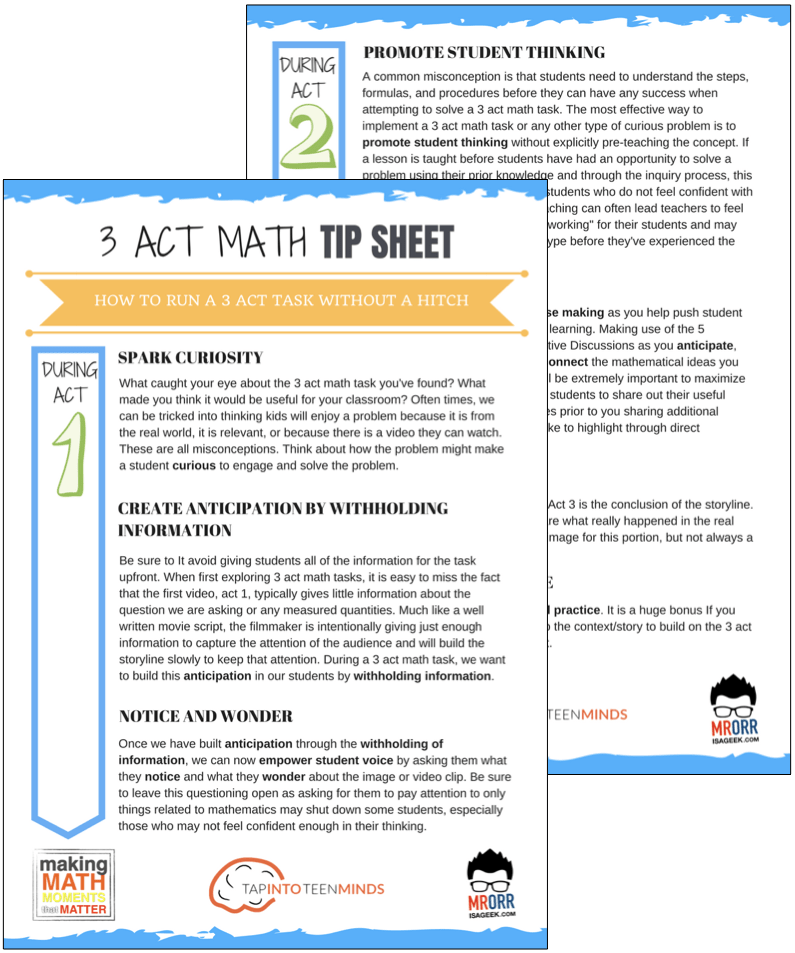
DOWNLOAD THE 3 ACT MATH TASK TIP SHEET SO THEY RUN WITHOUT A HITCH!
Download the 2-page printable 3 Act Math Tip Sheet to ensure that you have the best start to your journey using 3 Act math Tasks to spark curiosity and fuel sense making in your math classroom!
LESSONS TO MAKE MATH MOMENTS
Each lesson consists of:
Each Make Math Moments Problem Based Lesson consists of a Teacher Guide to lead you step-by-step through the planning process to ensure your lesson runs without a hitch!
Each Teacher Guide consists of:
- Intentionality of the lesson;
- A step-by-step walk through of each phase of the lesson;
- Visuals, animations, and videos unpacking big ideas, strategies, and models we intend to emerge during the lesson;
- Sample student approaches to assist in anticipating what your students might do;
- Resources and downloads including Keynote, Powerpoint, Media Files, and Teacher Guide printable PDF; and,
- Much more!
Each Make Math Moments Problem Based Lesson begins with a story, visual, video, or other method to Spark Curiosity through context.
Students will often Notice and Wonder before making an estimate to draw them in and invest in the problem.
After student voice has been heard and acknowledged, we will set students off on a Productive Struggle via a prompt related to the Spark context.
These prompts are given each lesson with the following conditions:
- No calculators are to be used; and,
- Students are to focus on how they can convince their math community that their solution is valid.
Students are left to engage in a productive struggle as the facilitator circulates to observe and engage in conversation as a means of assessing formatively.
The facilitator is instructed through the Teacher Guide on what specific strategies and models could be used to make connections and consolidate the learning from the lesson.
Often times, animations and walk through videos are provided in the Teacher Guide to assist with planning and delivering the consolidation.
A review image, video, or animation is provided as a conclusion to the task from the lesson.
While this might feel like a natural ending to the context students have been exploring, it is just the beginning as we look to leverage this context via extensions and additional lessons to dig deeper.
At the end of each lesson, consolidation prompts and/or extensions are crafted for students to purposefully practice and demonstrate their current understanding.
Facilitators are encouraged to collect these consolidation prompts as a means to engage in the assessment process and inform next moves for instruction.
In multi-day units of study, Math Talks are crafted to help build on the thinking from the previous day and build towards the next step in the developmental progression of the concept(s) we are exploring.
Each Math Talk is constructed as a string of related problems that build with intentionality to emerge specific big ideas, strategies, and mathematical models.
Make Math Moments Problem Based Lessons and Day 1 Teacher Guides are openly available for you to leverage and use with your students without becoming a Make Math Moments Academy Member.
Use our OPEN ACCESS multi-day problem based units!
Make Math Moments Problem Based Lessons and Day 1 Teacher Guides are openly available for you to leverage and use with your students without becoming a Make Math Moments Academy Member.
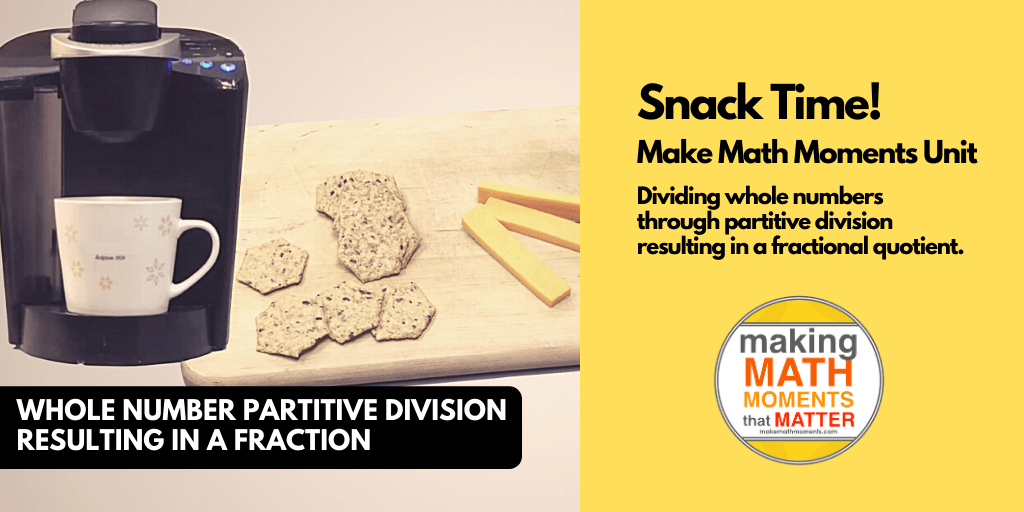
Partitive Division Resulting in a Fraction
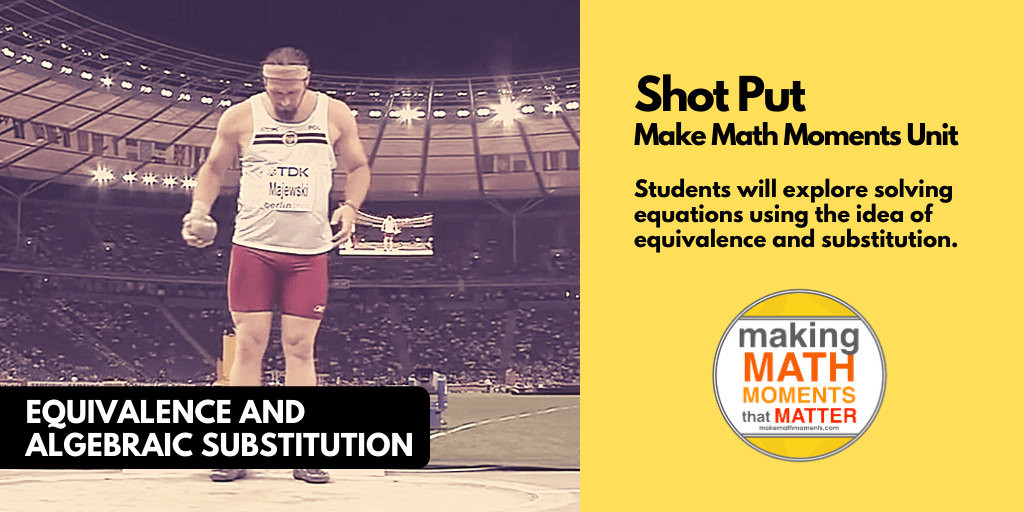
Equivalence and Algebraic Substitution
Represent Categorical Data & Explore Mean
Downloadable resources including blackline masters, handouts, printable Tips Sheets, slide shows, and media files do require a Make Math Moments Academy Membership.
ONLINE WORKSHOP REGISTRATION
Pedagogically aligned for teachers of K through Grade 12 with content specific examples from Grades 3 through Grade 10.
In our self-paced, 12-week Online Workshop, you'll learn how to craft new and transform your current lessons to Spark Curiosity, Fuel Sense Making, and Ignite Your Teacher Moves to promote resilient problem solvers.
0 Comments