Episode #490: Do This To Start Sustainable Math Improvement in Your School or District
LISTEN NOW HERE...




WATCH NOW...
If you could wave a magic wand and walk into any math classroom five or ten years from now, what would you hope to see? What would students be doing, saying, and thinking? How would the room feel? Those questions can reveal far more than a list of instructional strategies—they can help a team uncover what they truly want mathematics teaching and learning to become.
In this episode, Yvette Lehman and Beth Curran unpack one of their go-to routines for beginning a math improvement journey: the Magic Wand Wish List. They share how the routine has evolved to keep the conversation aspirational, asset-based, and centered on the student experience. From flexible thinking and multiple representations to meaningful mathematical discourse, confidence, curiosity, and resilient problem solving, the conversation paints a picture of mathematically proficient learners—and explores why creating that picture together is such an important first step toward coherence across a school or system.
In this episode, you'll explore:
- How to use the Magic Wand Wish List with educators and leadership teams
- Why the routine should focus on the student experience rather than conditions outside a team's control
- What flexible mathematical thinking can look and sound like in classrooms
- Why connecting multiple representations supports conceptual understanding
- How meaningful discourse can build student confidence and mathematical authority
- What it means to develop flexible, resilient problem solvers
- Why a shared vision creates greater coherence across classrooms and grade levels
- How to move from an aspirational vision toward an actionable next step
As you begin a new school year, consider bringing your team together around one question: What would you like to see happening consistently across your math classrooms? Keep the conversation asset-based, imagine the experience you ultimately want for students, and use that shared vision to identify the first small move your team can make together.
Attention District Math Leaders:
K-12 Math Leaders: Download our free Math Coherence Compass to help your teammates, system leaders, and educators create aligned instructional practices—without adding another initiative.
K-12 Math Leaders: Not sure what matters most when designing math improvement plans? Take this assessment and get a free customized report: https://makemathmoments.com/grow/
K-12 Math Leaders: Ready to design your math improvement plan with guidance, support and using structure? Learn how to partner with us and follow our 4 stage process. https://growyourmathprogram.com
Looking to supplement your curriculum with problem based lessons and units? Make Math Moments Problem Based Lessons & Units
Be Our Next Podcast Guest!
Join as an Interview Guest or on a Mentoring Moment Call
Apply to be a Featured Interview Guest
It will take less than two (2) minutes to book your Math Mentoring Moment call.
Book a Mentoring Moment Coaching Call
Take two (2) minutes to book your Math Mentoring Moment call and let's work together to shake that math pebble out of your shoe!
Are You an Official Math Moment Maker?
Ensure that you follow, rate and review on Apple Podcasts, Spotify and other platforms to show your support and ensure other math educators can find the show.



FULL TRANSCRIPT
Yvette Lehman: I'm here with Beth today, and we are going to talk about probably one of our go-to favorite routines that we do with systems of all different sizes. When we come together in a room with educators or leaders, we often kick off that partnership or that relationship or our conversation with our magic wand wish list. So today we're going to unpack a little bit why, what's the point of this routine that we engage in. But we're also going to share what would be on our list today.
Beth Curran: Sounds good, Yvette. I'm a big fan of this magic wand wishlist. I think that it achieves so much and helps so many systems just really get things moving. So let's jump in.
Yvette Lehman: I agree. I actually was first introduced to the Magic Wand wishlist when Kyle and I worked together at the same school board as consultants in the district office. And we use this during our professional development sessions with educators in our system. And now, as you know, we leverage it with our partners, our district or state, our school level partners as well. And it's been refined over the years. I'm gonna tell you, Beth, I'll tell you about the iterations. So essentially the Magic Wand wish list is a routine. We often do it early in a PD session and early in our math improvement journey with systems, where it's like, let's just get up, move around the room, start collaboratively brainstorming what we would like to see consistently happening across all classrooms. Now, the first time I did this in a PD session, I wasn't careful with my language. And it became a magic wand wish list of all the things people in the room wanted to change about conditions. Like I would want to see smaller class sizes. I would want to see better textbooks. I would want to see more photocopies available. I would want to see. And I remember being in the room thinking, like, my gosh, this is not it. You know, the idea is for it to be aspirational and for us to kind of start to co-construct this shared vision of ambitious, equitable teaching across our rooms and really define what is it we ultimately want for our students? What do we want their mathematical experience to be in our classrooms every single day? So I feel like our language around this task has shifted over the years because we don't want it to go down the road of basically making a list of things that are outside of our control that we can't change potentially. Like that's an important conversation, but not at this time in the process.
Beth Curran: Absolutely. But you can see where the mindset of a lot of teachers are, right? There are these systemic things within their schools and their systems and their districts that are holding them back from being able to achieve this ideal classroom, right? And so those definitely do need to be handled. But yeah, but I'm with you. We need to be thinking more when we are digging into the magic wand wishlist, we need to be thinking more about students and what we want for our students. And I think there's a question that I've seen pop up kind of when you're thinking about your magic wand wishlist questions to think about. One is, and this one always kind of sits really nicely with me, is if you were to run into a student in five or 10 years from now who was in your math class, what would you want them to remember or to share about what they learned in your math class? And I feel like that's a big one. And it really gets you to dig into what really is my focus and what do I want those takeaways for students to be. So, yeah, bringing it back to the students, I think that's definitely a good shift there to start thinking.
Yvette Lehman: I totally agree. And that absolutely, you know, as system leaders, part of our job is to clear the path. So all of the barriers that sometimes emerge are important. And absolutely there needs to be a space for them to be heard. And absolutely we need to clear the path the best we can. But for this routine, if we don't want to go there at this time, and really the purpose is to we talk about our compass, right? And to set a direction and to define where we're all collectively striving to be long term, then we want to make sure, like you said, that we keep our language focused around when we say what would be happening consistently, what would students be doing? What would they be saying? How would they be positioned? What would it look like, sound like, feel like when I walked into this ideal classroom?
Beth Curran: Yeah, so I'll get us started with one. Something that would be on my Magic Wand wish list would definitely be, I would want to see students, and I'd want this to be visual in some way, visible, is that their thought processes are flexible, that they're thinking flexibly, regardless of if they're solving basic calculations or complex calculations or if they're word problems, engaging in problem solving. I would want to see flexible thinking.
Yvette Lehman: That's so interesting because I that one makes a lot of sense because I was actually thinking, sometimes the challenge with this type of look for is when am I walking in? Am I walking in during a task-based portion of the lesson? Am I walking in during a mini lesson? Am I walking like a problem string? Am I walking in during purposeful practice, center, small group? But I think what you just described is universal across all of those structures.
Beth Curran: That's why it was tough on my list, I think.
Yvette Lehman: For sure. So it's like whether I walked in during a problem string or a math talk or during a task or purposeful practice, seeing students demonstrate that flexibility that they can solve problems in a variety of ways, that there isn't a single strategy that's the only strategy that they have access to. What if though? And this is where things get complicated. I'm just gonna quickly push back. What if they're being explicitly taught that strategy at that time? Like the idea, like Jennifer Bay Williams talks about, like we need to learn to use before we learn to choose. So just to like for our listeners to know that there is nuance here. Like that there might be times where I'm like, I know that you have a toolkit of beautiful strategies, but today in this game, we're going to practice breaking apart to multiply using additive thinking, you know.
Beth Curran: Yeah, so, but I wonder if even while that explicit instruction is going on, if you're still hearing students say, well, we're learning this new one, but I kind of like this strategy better. You're still hearing them talk through their flexible ways of approaching thinking through math, right? So I think you might still see a little bit or hear a little bit of that, even if they are explicitly being taught a new strategy. I think that might still emerge if we're looking and listening for the right things, right?
Yvette Lehman: That makes sense. Yeah. So they're comparing and contrasting that strategy to the one that they're most comfortable with.
Beth Curran: Exactly. And maybe they're even identifying, you know, we're learning this new strategy because these numbers lend themselves nicely to that. And so they're really tying it to a set of numbers or a set of a situation. Whereas you might hear students saying, oh, but if the numbers were this, right, I might do something different. But today the numbers are lending itself really nicely to this one particular strategy. So we're going to learn this new strategy. So I think you might still hear or see a little bit of flexible thinking. Yeah. So that would be on my, that would be at the top of my magic wand wish list. What about you Yvette?
Yvette Lehman: Okay, mine's not going to surprise you, and I know it's yours as well. I would always want to see multiple representations and broadly defined like it is in principles to actions, where multiple representations is concrete or physical, pictorial or visual, contextual, abstract, and what's my last one that I always forget? verbal. So that would be your oral explanation of what's happening. And I would just, it's not that I'm always looking for, let's say, manipulatives. And maybe there is space where there is, maybe someone could make an argument that it could always be represented concretely and that there may always be a learner in the room at that time at the concrete phase. But at the very least, I would want to see connections being made. And what I don't want to see, I guess I should contrast, is students being forced where it's like, show it three ways. You know, show it as a picture, show it as a symbolic and then explain it. Like I feel like that's really contrived and it can be really tedious for students who are like, why do I need to show it three ways when I've already consolidated my abstract understanding, or vice versa. But I would want there to be always evidence of connections. So maybe one student using this representation and another student using this one, and then they're comparing them, or the student uses one, but the teacher comes by and is like, I actually saw it this way. Or can I take your thinking and can I represent it visually to help me unpack it? Like just these opportunities continuously for us to be bridging those representations to kind of really consolidate our understanding.
Beth Curran: Yeah, and that's what's really going to focus on developing that conceptual understanding, right? We talk a lot about conceptual understanding. So what does that mean, right? It means that they deeply understand the math they're doing. So if we only provide opportunities for students to work through the concrete pictorial one time quickly, and now we're just abstract, abstract, abstract, and we're not engaging them in, you know, could we represent this? Or can I explain your thinking on the board with a picture? We're maybe depriving some of those students of the opportunity to develop that deep connection and conceptual understanding of the math. And so I think a really good example would be the difference between like a strategy and a representation or a model. If you can imagine double digit, double digit addition, where there's some regrouping necessary. And so a student might be able to walk you through the steps with that traditional algorithm. We're gonna add the ones and carry or regroup, you know, into the tens if we need to and that sort of thing. Maybe they can verbally say that. But then if another student or maybe even the teacher says, well, you know, could we represent this on a place value chart? Could we use disks or could we use base 10 blocks to represent that thinking? Because some of the students maybe just memorize steps and procedures, but don't quite understand why it's working. So even if it appears that they've got it, they can follow these steps, they can do this, they still might not deeply understand why they have to regroup 10 ones as a 10. And so that visual representation is really going to help them to be able to see that and see the connection, side by side, the algorithm and the picture of a place value chart with some place value manipulatives moving around on there, they're going to be able to see the connection between the algorithm and the steps that we do and why it really works with our base 10 system.
Yvette Lehman: I think with both of the two examples we described so far, and again, when we do this magic wand wish list, we try to be very specific. Like, what would you see? What would you hear? So it's like I would see students blank, I would hear students say, you know, to really paint this picture. I think though, it's so obvious when this is just part of the culture and the norm or expectation in that room. When students are used to defending their thinking through a variety of representations or they're used to having the flexibility to choose from their toolkit of strategies. It's very evident in their level of comfort with the math and their willingness to try and make mistakes and seek to understand. There's like this curiosity in the room that's hard to define.
Beth Curran: Yvette, I'm so glad you said that because that was actually exactly where I was going. What you're describing, I think, is when you say it's so obvious, I think that one of the things that I said, another thing that I said would be on my Magic Wand wish list would be I would want to see students who look confident and who are joyful. And then with regards to communication, so what does that look like? They're curious, they're questioning things, they're respectfully, maybe disagreeing with another student strategy or dissecting their thinking through that. And so I think that, you know, another thing that I had on my list of my magic wand wishlist would be confidence and joyful. And I think you can see that when you walk into a classroom.
Yvette Lehman: For sure. It also makes me think of, you know, who the authority is in the room. It's very obvious, right? When the discourse is teacher, student, teacher, student, as opposed to student, student, student, teacher comes in to clarify or to seek to understand or to advance the thinking. When they know that there's value in learning from each other. And that they have value that they can contribute to the conversation. That kind of leads me into my third one, which was around this idea of really meaningful mathematical discourse. And Lucy West is a Canadian researcher and she's not specific to math, but she does research around accountable talk. And there was a big move in Ontario about 15 years ago around accountable talk in the classroom. And I'll never forget, she said, you know you've reached what we're just finding here, when you walk into a room and you see students sitting around talking like little mathematicians, and they're proving and they're defending and they're questioning and debating, and then they're trying it over here and trying it over there, and they're testing conjectures and they're using mathematical language. And to me, that's part of my magic wand wish list. I just I want students to feel that they have the authority and the confidence to test and try. And that it's not about getting the right answer. It's about advancing the thinking of the collective, not only your own thinking.
Beth Curran: Right. Yep, absolutely. And I have one more on mine, which I think kind of ties it all up. It's everything we've been talking about altogether is resilient problem solvers. I think that's something that I would want to see, which of course gets back to, you know, do the students feel comfortable and confident enough to be able to turn to their partner and look at a problem and say, well, could we do this and let's try this and how about this? And what do you think we should try? And how could we get started? The multiple representations, could we draw a picture? Could we grab some manipulative to start this? And so I think it all kind of wraps up in this whole idea that we want them to be resilient and flexible problem solvers, right? So when posed with a challenging, unfamiliar problem, they don't just shut down, that they know that they have the understanding to be able to enter into this problem, maybe in a different way, but they have that confidence there to be able to say, I don't know how to solve this yet, but I know that I've worked through other problems and I know that I can get there if we put our heads together and we work together and we pull from all the flexible strategies that we have in our toolbox.
Yvette Lehman: That idea of well what can we do to get started? Like there has to be something that can unlock this problem even partially and can we find it?
Beth Curran: Yep. Which ties into your connections. Am I looking at this new problem and seeing a connection with something that I've learned in the past? And again, your multiple representations, your flexible thinking in order to approach a problem in lots of different ways. And so all of that, I think, kind of ties up into that idea of flexible and resilient problem solvers.
Yvette Lehman: I think what we just described here, Beth, is mathematically proficient learners. Like when I think about the strands of the proficiency rope and I think about what they actually all mean, you know, conceptual understanding, adaptive reasoning, strategic competence, procedural fluency and productive disposition. It's like we're talking about walking into a space consistently where we see students building their proficiency defined by more than answer getting. It's really the standards for mathematical practice. It's the process expectations. It's these big overall observable behaviors about how we interact as a thinker of mathematics. I am guessing our listeners are wondering. So we've painted this picture. And I mean, you can probably tell by listening. Beth and I are pretty aligned in our vision for what we would love to see happening consistently across classrooms. But why is it important for teams to do this work? Why would we suggest because we're talking about aspirational. We're not talking about today, tomorrow, what's happening necessarily in reality. Like we're talking about a vision for where we would like to be five years, ten years from now. So why would we recommend that people engage in this process?
Beth Curran: Yeah, so what comes to mind, Yvette, is, and I know you and John have used this image before, but this idea that we're building a jigsaw puzzle. And if everybody has their own separate idea on their little piece, their little piece of the puzzle that they would like to see in the classroom, but they can't quite see the whole picture, then everybody's just kind of holding on to their own piece and that puzzle is never going to be completely built. And so having that picture or that north star, that direction that everybody is kind of pulling in together so that they can see where their piece of the puzzle fits into that big picture.
Yvette Lehman: Yeah, so it's about creating coherence. It's about, we've used the analogy before, about we're all in a canoe and we're paddling really hard, but are we paddling in the same direction? I also think that similar to what you were describing about the students who needed to unlock the problem, they were like, I just need to figure out how to get started. I think that that's also really important for this work as well, because once we've defined where we want to go, the vision that we have for this long-term aspirational experience we want to create for students, the next question we will ultimately ask is, so where do we start? What's the first small move we can take that's within our control? What learning do we need to do? What are we willing to commit to as a team to get us closer to that vision?
Beth Curran: And maybe also identifying what are we already doing that's helping us to get to this? What are some of the things that we already see regularly in our classrooms? And maybe how can we strengthen that even? But not just focusing on things that we need to do, but maybe also recognizing, we're doing a lot of these really good things already. So let's make sure that we continue to do those.
Yvette Lehman: For listeners, so this episode is going to be released at the end of August. So it's beginning of the school year for everybody listening, whether you started August or September. If you're considering using this type of protocol to kind of kick start your professional development journey for this year, I think my recommendation for you would be make sure that it stays in a space of being asset-based. You know, it should feel uplifting and it should feel inspiring and motivating and it should help your community rally around a shared purpose. So being really intentional in how you present the prompt and how you facilitate this exercise is going to help you go down one path of either really motivating, inspiring, bringing your community together around a shared purpose as opposed to kicking the year off with something that might turn into a deficit type conversation about what students can and cannot do.
Beth Curran: Yeah, I think it might also be really interesting to bring all levels of your mathematics instruction. So middle school, high school, elementary school, bring them all together and do this together. Because I think it would be very valuable to hear what a middle school or high school teacher would put on their magic wand wish list versus what an elementary teacher might put on theirs and how you can create that coherence within the whole school system, right? So that we're all kind of, so that we make sure we don't miss things along the way. So almost that vertical alignment. I think that would be really interesting as well.
Yvette Lehman: If you are wondering what to do with this protocol, or maybe you're planning to use the protocol and you're wondering what to do next, reach out to us. We would be happy to jump on a call with you and to help you navigate this compass building, which is what we essentially call it. You're defining your vision, you're going to eventually emerge an objective, which is that more actionable next step or action you can take in pursuit of this shared vision of ambitious and equitable math teaching and learning. If you want support on that journey, reach out to us, book a call, makemathmoments.com forward slash discovery. Any final thoughts for our listener today, Beth?
Beth Curran: Gosh, I would just ask everyone to think about what would you put on your magic wand wishlist?
Yvette Lehman: Absolutely. So that's your call to action. Take a few minutes now after the episode and write down what you would like to see happening consistently across classrooms and define it through the lens of what would you hear see students doing and how would the room feel around you. All right, we'll see you soon on the next episode. Bye everyone.
Your Customized Improvement Plan For Your Math Classroom.
Take the 12 minute assessment and you'll get a free, customized plan to shape and grow the 6 parts of any strong mathematics classroom program.
District leader/math coach? Take the District Assessment
Thanks For Listening
- Book a Math Mentoring Moment
- Apply to be a Featured Interview Guest
- Leave a note in the comment section below.
- Share this show on Twitter, or Facebook.
To help out the show:
- Leave an honest review on iTunes. Your ratings and reviews really help and we read each one.
- Subscribe on iTunes, Google Play, and Spotify.
The Making Math Moments That Matter Podcast with Kyle Pearce & Jon Orr
Weekly interviews, strategy, and advice for building a math classroom that you wish you were in.
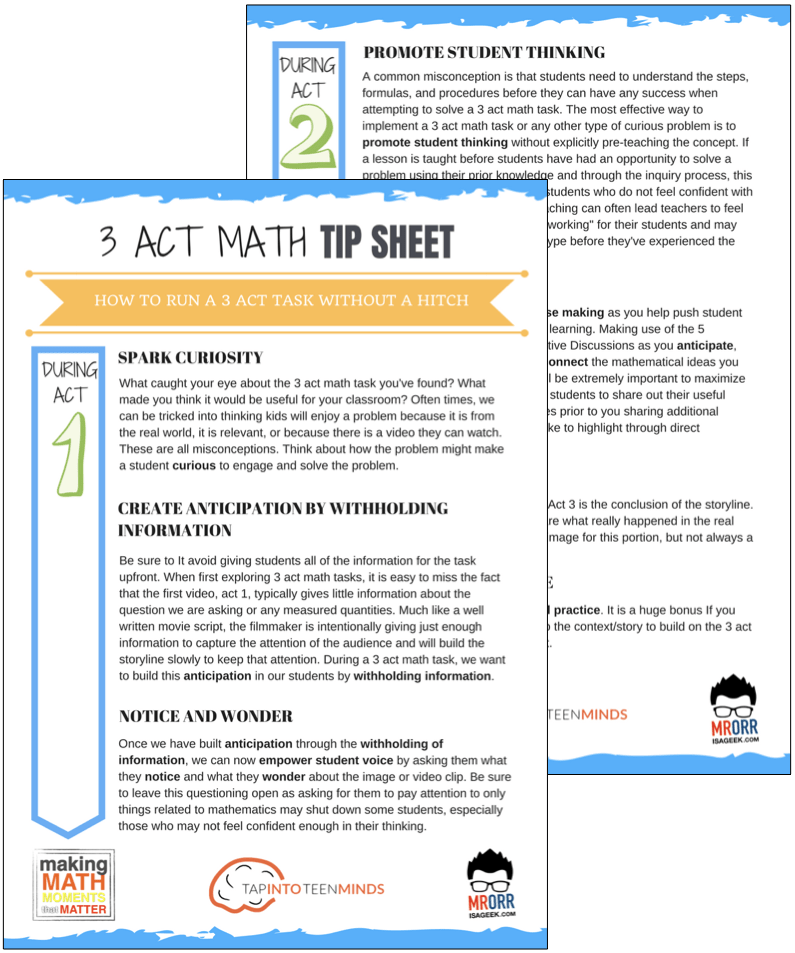
DOWNLOAD THE 3 ACT MATH TASK TIP SHEET SO THEY RUN WITHOUT A HITCH!
Download the 2-page printable 3 Act Math Tip Sheet to ensure that you have the best start to your journey using 3 Act math Tasks to spark curiosity and fuel sense making in your math classroom!
LESSONS TO MAKE MATH MOMENTS
Each lesson consists of:
Each Make Math Moments Problem Based Lesson consists of a Teacher Guide to lead you step-by-step through the planning process to ensure your lesson runs without a hitch!
Each Teacher Guide consists of:
- Intentionality of the lesson;
- A step-by-step walk through of each phase of the lesson;
- Visuals, animations, and videos unpacking big ideas, strategies, and models we intend to emerge during the lesson;
- Sample student approaches to assist in anticipating what your students might do;
- Resources and downloads including Keynote, Powerpoint, Media Files, and Teacher Guide printable PDF; and,
- Much more!
Each Make Math Moments Problem Based Lesson begins with a story, visual, video, or other method to Spark Curiosity through context.
Students will often Notice and Wonder before making an estimate to draw them in and invest in the problem.
After student voice has been heard and acknowledged, we will set students off on a Productive Struggle via a prompt related to the Spark context.
These prompts are given each lesson with the following conditions:
- No calculators are to be used; and,
- Students are to focus on how they can convince their math community that their solution is valid.
Students are left to engage in a productive struggle as the facilitator circulates to observe and engage in conversation as a means of assessing formatively.
The facilitator is instructed through the Teacher Guide on what specific strategies and models could be used to make connections and consolidate the learning from the lesson.
Often times, animations and walk through videos are provided in the Teacher Guide to assist with planning and delivering the consolidation.
A review image, video, or animation is provided as a conclusion to the task from the lesson.
While this might feel like a natural ending to the context students have been exploring, it is just the beginning as we look to leverage this context via extensions and additional lessons to dig deeper.
At the end of each lesson, consolidation prompts and/or extensions are crafted for students to purposefully practice and demonstrate their current understanding.
Facilitators are encouraged to collect these consolidation prompts as a means to engage in the assessment process and inform next moves for instruction.
In multi-day units of study, Math Talks are crafted to help build on the thinking from the previous day and build towards the next step in the developmental progression of the concept(s) we are exploring.
Each Math Talk is constructed as a string of related problems that build with intentionality to emerge specific big ideas, strategies, and mathematical models.
Make Math Moments Problem Based Lessons and Day 1 Teacher Guides are openly available for you to leverage and use with your students without becoming a Make Math Moments Academy Member.
Use our OPEN ACCESS multi-day problem based units!
Make Math Moments Problem Based Lessons and Day 1 Teacher Guides are openly available for you to leverage and use with your students without becoming a Make Math Moments Academy Member.
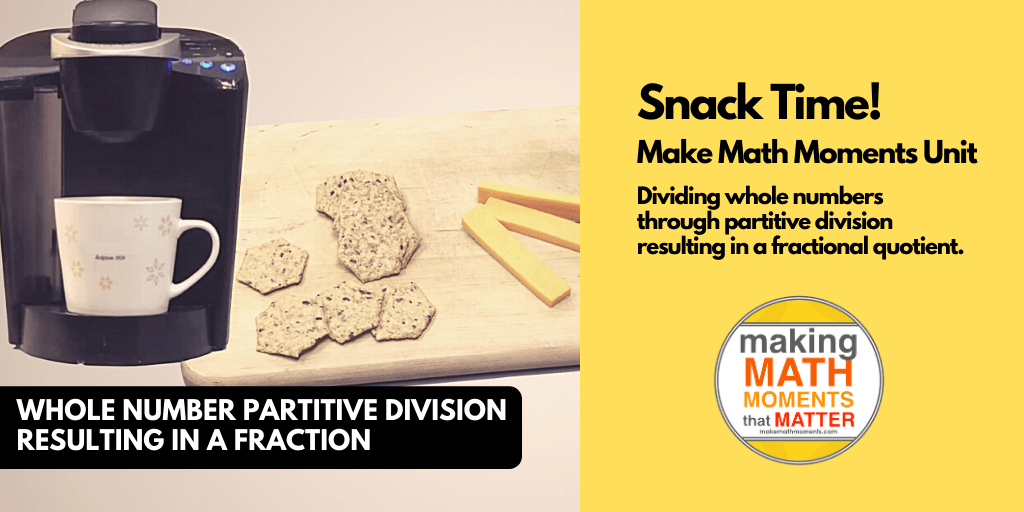
Partitive Division Resulting in a Fraction
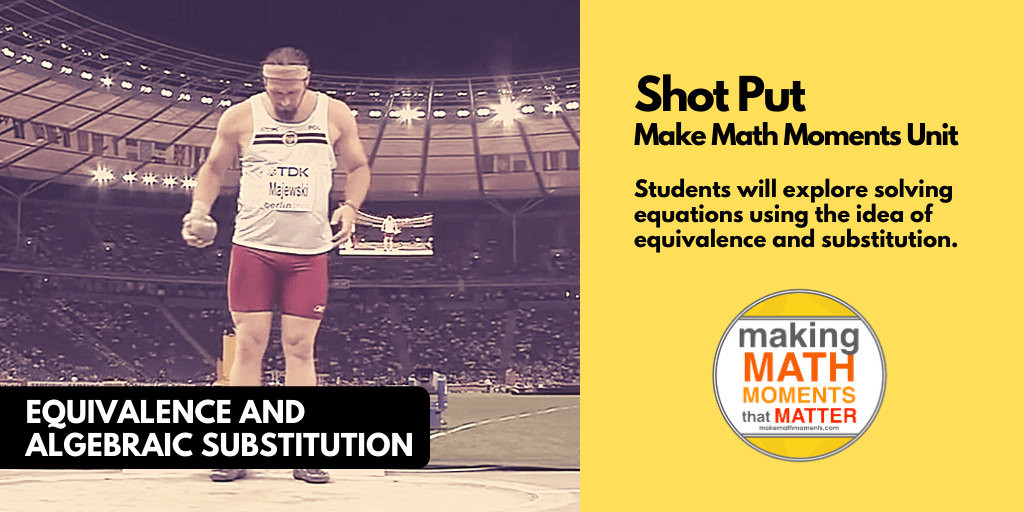
Equivalence and Algebraic Substitution
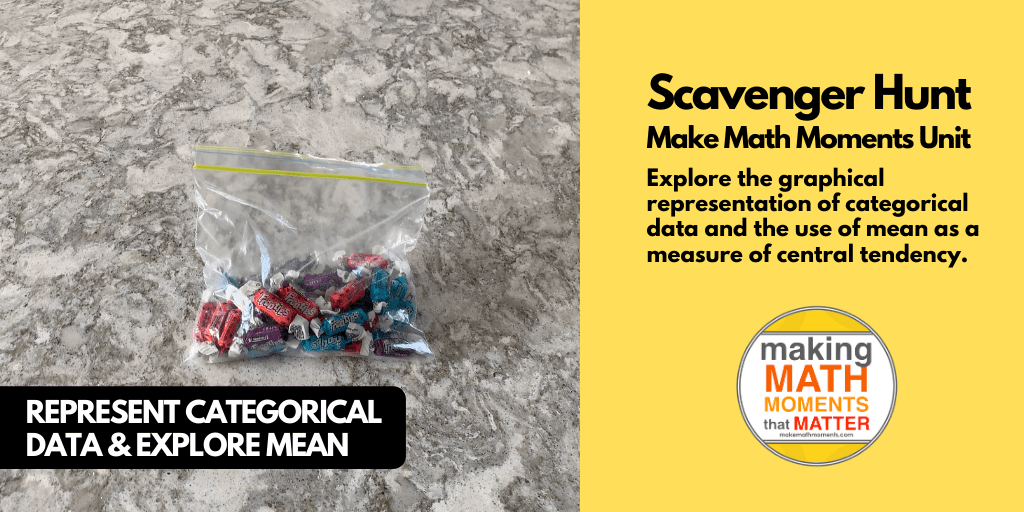
Represent Categorical Data & Explore Mean
Downloadable resources including blackline masters, handouts, printable Tips Sheets, slide shows, and media files do require a Make Math Moments Academy Membership.
ONLINE WORKSHOP REGISTRATION
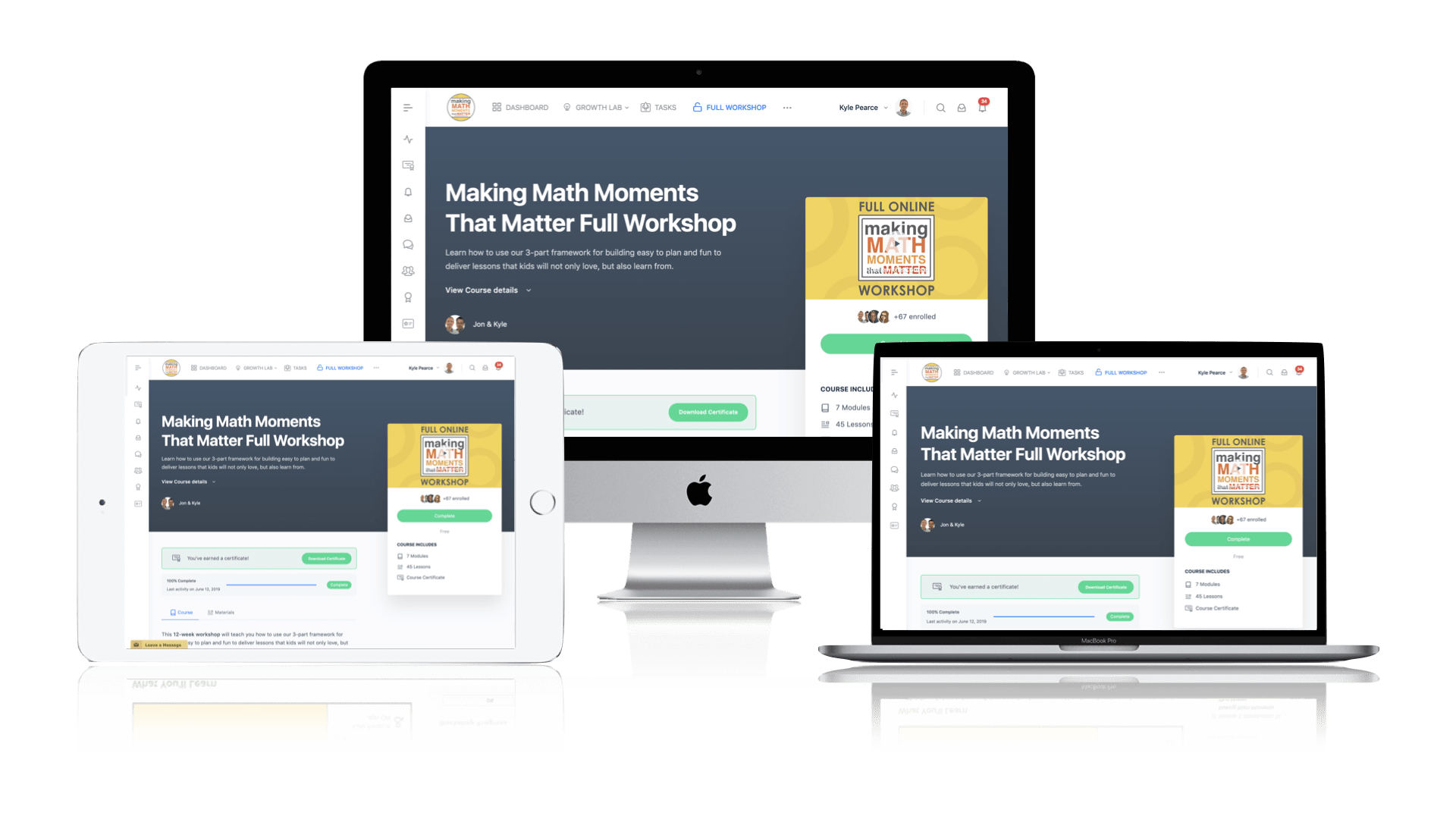
Pedagogically aligned for teachers of K through Grade 12 with content specific examples from Grades 3 through Grade 10.
In our self-paced, 12-week Online Workshop, you'll learn how to craft new and transform your current lessons to Spark Curiosity, Fuel Sense Making, and Ignite Your Teacher Moves to promote resilient problem solvers.
0 Comments