Episode #499: Are We Making Math More Disjointed Than It Needs to Be? An Interview with Graham Fletcher
LISTEN NOW HERE...
WATCH NOW...
Monday is make a ten. Tuesday is doubles. Wednesday is doubles plus one. Add a completely different context each day, and we may be making it harder for students to see how the mathematics connects.
In this episode, Jon Orr and Graham Fletcher explore the idea of finding a through line in mathematics. They unpack how greater coherence in both context and content can help students make connections, build conceptual understanding, and access the mathematics more deeply.
In this episode, you'll explore:
- What a “through line” looks like in mathematics
- Why constantly changing contexts can create unnecessary barriers for students
- How a familiar context can give students more space to focus on the mathematics
- Why variety in problem types doesn't require a new context every time
- How mathematical properties can connect strategies that often appear unrelated
- Why unitizing provides a through line from whole numbers to fractions and rates
- How understanding mathematical progressions helps teachers respond to the range of thinking in their classrooms
- What it means to become a wiser consumer of curriculum resources
Look back at the last couple of weeks of your math instruction. How often did the strategy, context, and mathematical idea change? Consider where a stronger through line could help students see connections that may currently be hidden.
Attention District Math Leaders:
K-12 Math Leaders: Download our free Math Coherence Compass to help your teammates, system leaders, and educators create aligned instructional practices—without adding another initiative.
K-12 Math Leaders: Not sure what matters most when designing math improvement plans? Take this assessment and get a free customized report: https://makemathmoments.com/grow/
K-12 Math Leaders: Ready to design your math improvement plan with guidance, support and using structure? Learn how to partner with us and follow our 4 stage process. https://growyourmathprogram.com
Looking to supplement your curriculum with problem based lessons and units? Make Math Moments Problem Based Lessons & Units
Be Our Next Podcast Guest!
Join as an Interview Guest or on a Mentoring Moment Call
Apply to be a Featured Interview Guest
It will take less than two (2) minutes to book your Math Mentoring Moment call.
Book a Mentoring Moment Coaching Call
Take two (2) minutes to book your Math Mentoring Moment call and let's work together to shake that math pebble out of your shoe!
Are You an Official Math Moment Maker?
Ensure that you follow, rate and review on Apple Podcasts, Spotify and other platforms to show your support and ensure other math educators can find the show.





FULL TRANSCRIPT
Jon Orr: Graham, welcome back. It's been a minute since you've been here on the Making Math Moments That Matter podcast. It was probably in the early days, like probably the first fifty episodes somewhere. I didn't look it up. So I did not do my homework here to getting into this, but this is gonna be like episode five hundred and two or something. So it's been some time since we've chatted here on the podcast specifically. So welcome. How you been?
Graham: Doing doing great. Yeah. Thinking about how long both you and Kyle have been able to keep this train running for it's pretty impressive. So whenever I get the opportunity to just chat with some math pals, I'm always game for it. So just a testament to you and the work that you've done, just supporting the community. Long, long time ago.
Jon Orr: Absolutely. It's been two thousand eighteen is when we kicked this thing off. And weekly episodes since then into two years ago, I think we went to two a week. And then this summer we went back to one just for the summer, you know. So we're coming back up to two a week. This is the second episode, it will go out the same week. So thanks again.
The one so let's kick before we get into your session, you're presenting at the twenty twenty six Make Math Moments Virtual Summit this year. So thanks again for that. We're going to talk about your summit session here today. But before we do, the question we've been asking every guest is not their math moment from the past, but I want you to think about a future moment. And that's sometimes weird to think about. But so imagine that you met a student, maybe you haven't taught yet, or you will teach, or will you will impact in some way. And it's been ten years since they left the school system. And you're talking with them at the store and you ask them, Hey, what was the biggest takeaway? You know, what was the thing that you remembered the most about the experience you had with me in mathematics? And the prompt you I want you to think about is what do you want them to say?
Graham: That's such a great question, right? I think for me, one of one of the big things is is how do we just invite kids into the conversation? So I think if a student were to say like there was this particular task that they use on any given day, or it could be an activity or anything along those lines, and they were like, you know what, I always remember this task. And if you ask them about like what made it like it made me feel smart. And so just allowing students just that that entry point to give them just the opportunity. Cause not all lessons are created equally. But if you create a lesson that a student still remembers after 10 years and they remember it and they're like, Yeah, that was that was really fun. That made me feel smart. Like they were able to connect to the math that we want them to connect with through a specific task. Then for me that's that's like the goal the gold star. I think that's what I'm kind of looking for. And then just thinking about what you all have there, making math moments. It's those math moments of like it was a good task that just invited them into the math that we really want them to tackle.
Jon Orr: Yeah. Shifting like their their access to the math, but also linking it to how they remember that experience and make make it memorable is is important, but then their connection to it so that then when they look back years later they're like, I felt smart is what you you said, but also probably I felt like that like that exp that experience with that teacher, that that in that system or that school or that classroom I felt differently than I did before and I felt like I belonged.
Graham: Absolutely. Yeah. One hundred percent. And I think we can agree that we as much as we both love math, if kids don't feel if students don't feel safe enough in a classroom to be in welcome and invited into the math conversation, then who cares about the math that we're trying to teach? So trying to create a space to where all students just feel invited.
Jon Orr: Absolutely. The con like I I've said this in the podcast many times over the years, but basically I probably taught the opposite of that for ten years or so, yeah, thinking about like math is math when you walk in this door and that's what be all end all is, instead of the actual student and and their and their experience or their relationship with it. I treated every kid the same. You know, they walked in, it like it didn't matter whether you were like reason you were late or not late or on time. It was this like here's what we're doing today, whether you like it or not, and whoever you are and and I'm not gonna actually consider any of your thinking into this. I'm gonna get my lesson out and then I'm gonna walk around and help whoever needs help. That like that was just how I taught for fifteen years until until I started to say, Hey, something's gotta shift here because everyone hates math. And I have something to say with it. And I have to own that I created some of those like those experiences. And it's like we can say math is math, but it's not. You know, it's it's the experiences we create with the individuals that are sitting in front of us.
Graham: Absolutely. Especially when students are trying to build their just their own personal identity around mathematics. Where if we're just trying to cut like hammer the math home, then we immediately shut the door on half the students we're trying to serve. So how do we open up that door? And yeah, I think we all start somewhere, but you look at where where people continue us as teachers, we continue to grow and I think that's it. It's just the journey, right?
Jon Orr: Absolutely. Absolutely. Now I'm sure this connects directly into the session you're going to hold for all of us at the the the summit in November. The title of your session is Finding the Through Line, Intentionally Building Meaningful Connections. So it feels like very much in line with this idea of what you want your students to remember about the experience. So what do you mean through line? Let's let's get into it. Like that feels cryptic to me right now. Like through line. Tell me about this line that you're throwing at me.
Graham: Yeah. And I I I was I was thinking about it and I think about like in ELA or reading, and I'll speak specifically from a a primary or an elementary point of view, is on Monday in in ELA in a reading world, on Monday we read the book If You Give a Mouse a Cookie. And then every single day for the rest of that stinking week, all you do is you talk about a mouse and a cookie. And so the mouse and the cookie is the through line of what's happening in ELA. But when we go to mathematics and say we take like a K-2 world, like kindergarten through grade two, like Monday is like make a ten and we talk about unicorns. Tuesday we talk about doubles and we talk about hamburgers. And then Wednesday we talk about doubles plus one and we talk about camping. Every single day is a different strategy, and every single day is a different context. So as we continue to like, it's not like in ELA we have this mentor text. But in mathematics, every single day is a different context. And so if we're continually changing the context for students, students are grappling so much with the context, thinking about just the limited experiences that so many students have. But if we can keep the constant of a context for like an entire week, then students get more access to the mathematics that we're talking about. But I'm thinking about many of our multilingual students, where if we're changing the context, they're struggling with just what am I trying to understand before they can even get to what are the mathematics that I'm trying to understand. So there's a through line of both context and then there's a through line of what is the math that we're teaching.
Jon Orr: Yeah. Yeah, 'cause I can imagine that because I got this image as you describe this as like every almost like a matrix. It's like every every day, if you're imagining like Monday through Friday on the on the days of the week, and then you have one level of your matrix or your your your your array, let's say, is like the content, but then you have all of a sudden another layer of like for each one of those, maybe there's a different context context. And it's like now when I think about my memory or I think about how I think about what we've learned this week is such a all of a sudden that matrix gets very, very large and very, very tall and often three-dimensional. And now my brain has to navigate through this matrix to go, that context relates to that idea or that idea? In this context, does that relate to that? Like how do I piece all of that together? And it can be sounds very and can be very confusing to kids, I imagine.
Graham: Yeah, absolutely. An image that lives rent-free in my head is I think I first saw it in John Van de Walle's Teaching Student-Centered Mathematics, where he talks about the five representations of mathematical ideas, where it's I got it pulled up here, like pictures, symbols, oral language, real world situations, and manipulatives and models. And so often students, if whether we're talking about a context or we're talking about the math, students don't get to play around with those five representations and models with a big math idea. They might play with like one and then they're on to the next context and then they're on to the next mathematical idea. But just giving students just the opportunity to sit in a singular context around a singular mathematical content idea that we're trying to explore and allowing them to see the pictures, the symbols, the oral language, the real world situations, and then also those manipulatives as well. So trying to find one singular context or one singular content and playing around in that. And and that becomes the through line.
Jon Orr: Right. Right. A c a con it's almost like an anchor, right? Like you get to the you get to the next day and you anchor back. So that's like it it it it immediately convey brings up imagery and memory of what we had in yesterday because you've linked the context to the content or the idea or the the topic of the day and then tomorrow it's just an immediate flood back into our in our memories because we remember those things much more deeply than s some of, you know, symbols or just disjointed ideas.
Graham: Yeah, there's a there c that's right. There's a can there's a connection from from the day from the day to day and and so oftentimes everything is different. Like in many of the resources that we use, whether you're in Canada or the United States, is even in one singular lesson in that core resource that you're using, there could be like four or five, you think about just three or four different story problems, and every story problem is about something different. And I think we've built this false dichotomy of we've got to keep ideas fresh so that students are engaged. But when we're always changing that to keep it fresh, we don't allow students to give them that comfort and that familiarity to take risks to more advanced and more efficient strategies of thinking. They kind of stick with the one that they feel safest with out of fear of being one.
Jon Orr: So don't think tech like resource providers, curriculum providers, curriculum writers, publishers, they're not doing this well.
Graham: No, I d I I I I I don't think that they're doing that. And that's one of the things that we'll unpack. So how do we how do we empower teachers to become wise consumers? It's a little bit of a heavier lift. AI makes this lift a little heavier for us now, in terms of how do we take some story problems and make them all about the same thing? Or what is the one thing we're talking about in this lesson and how do we keep that theme the lesson? I think about where we used to do like project-based learning, where you talk about something for like two straight weeks and you do the math part, the reading part, the ELA, like and and you're making all these connections where now everything is so granular on the day to day that it becomes really difficult for kids to make connections. But as teachers, we see these connections and we're hoping that kids make them, but we're not setting them up with a good opportunity to do that.
Jon Orr: Right, right. You could imagine like play the playing the devil's advocate, you know there are probably people and if you're listening to this podcast, you're probably like nodding your head, but you're supporting people who are shaking their head. And so the shake of the head is is in may maybe th maybe this isn't a shake of the head, but maybe this is where I thought maybe a teacher who might say this to me 'cause I'm imagining a teacher who I'm I'm picturing this person in my mind right now, bringing this up to me, is is saying, Well, what about prob like what what about pro like a a variety of problem solving. If if every problem is like everything's related to that mouse, then then what what about the variety so that the students see this in varying conte contexts? Like how when do I bring that in?
Because the textbook or the curriculum is probably trying to layer that in. And that's probably their their belief at that point while they're writing it that way. It's like, let's bring the idea, but then let's throw different contexts at it so that you can see it in different ways. You can see it in this area, in this area, in this area. And then also probably they're trying to go like, well, what what are we gonna rel like how do we relate to kids? Like eventually one of these things will be the thing that they relate to and and grasp onto. So the the teacher who's sitting back going, Well, where's the actual variety of problems? problem solving coming into play if we're always going back to the same context. What do we what do we how do we think about that?
Graham: So we I I I think about the variety of problem types that we're using. So thinking leaning into the work of cognitively guided instruction, where I'll I'll speak to like a K-3 world where they've got all of those different problem types where you've got start, change, result, unknown, you've got comparison problems part part whole. You have a variety of problems there, but they can all still be around the same context instead of giving them a bunch of different problems. And to be honest, when we're sense making, I think that is when we're building conceptual understanding and sense making, there's no need to keep changing around the context. Once students have an understanding of the math, that's when we can start changing it around. But so often we're jumping around from lily pad to lily pad. and that's what makes it difficult for students to make those connections. So just in the problem types that we're using, those can be different, but the context doesn't necessarily need to be different.
Jon Orr: Right. Right. And I saw I guess the way that I've I've come to look at it is is to think about that the content or the context is a way for us to unpack the behaviors of the mathematics, and we have to sometimes as educators come to terms with that. We I really haven't put that as a focus of the behaviors of division or the behaviors of subtraction or the behaviors of multiplication, of like what is really happening under the hood there, and how does this context actually allow me to experience the behavior differently. And I think I think selecting the context is extremely important for that idea. Like I'm often reminded of Yvette Lehman, you've met Yvette. She always brings up, and I think she learned this from Kathy Fosnot because her context for learning is very much this, right? It's very much through line from day-to-day units. So we've got five-day units that cover one theme. And and and Yvette always said is that is that sometimes you when when you're thinking about like let's say you're you're you're talking about a problem that you wanted some sort of patterning in and it and it was a linear pattern. Are you selecting a context that is linear in nature? And what I by le why what I mean by linear in nature is actually like you could measure this thing on a like linearly, like a line or a measuring tape instead of like something that's two-dimensional. So like the context has to really match the behavior you're trying to bring about. And I think that's a that's an important con important idea because many resources are like, well, this idea is about say multiplication, but then it's like you you're you're there's no way for you to organize these things in an array because like the c the the behavior is is not matching what the actual context is.
Graham: Yeah, absolutely. Just a quick little sneak peek. One of the examples that I use that I'll use in the session that we use is we'll talk just briefly about volume. And so many resources talk about cubed fruit, where they just cube a bunch of fruit and then they build this rectangular prism of small pieces of of fruit. And like when kids are looking at cubed fruit, like nowhere in the real world are they seeing cubed fruit. And I actually reached out to edible arrangements to see if they make a cubed fruit and they don't make a cubed fruit. So why on earth are we putting cubed fruit inside a fifth grade, at least in the United States, in a fifth grade resource when kids are like, cubed fruit? Where am I gonna see that from? So it's like it's not a context that kids are familiar with, but like if one resource uses cubed fruit, another one uses cubed fruit, like hey, apparently this is a good thing. So making us be wise consumers to where the context actually does serve the math or the mathematics really does serve the context. So I think what you just shared there is is a huge important connection that's needed.
Jon Orr: If there's one one major component you don't want people to miss, what is that component and why? Like about your session, about this idea of through line, building meaningful connections. What are you gonna share with us?
Graham: I think we we've talked so much about the context here at just beginning. And I think there's a through line of the context, but there's also a through line of of the mathematics. And I think about I'll stay in the K-3 world here, but we kind of play more in the intermediate grades in the in the in the session, is thinking about where in a K-2, K-3 world when kids start adding, we've built this false dichotomy that we need to go ahead and teach a thousand different strategies to students. And that's not what the standards typically say. It says students will understand addition and subtraction using their understanding of property and place value.
So, like thinking about where, like in if you're adding nine plus seven, well, kids could make a 10 with that. And then if you're adding 59 plus seven, you'd call it like a friendly number or a benchmark number. And then if you had to add five and nine tenths plus seven and two tenths, you could still take one from the two tenths to make a whole. And you'd call that make a whole. And what it is is the through line is the associative property. So why do we need to name seventeen different strategies when they're all actually using the through line of the same property?
And so that that's another big idea as we talk about content, context, but then also what are the through lines? I'm thinking about I know you and John have t I mean you and Kyle have talked a lot about like unitizing over the over the years, where unitizing with tens and ones, what does that look like with fractions when three fourths is really three one fourths and how that leads into unit rate when you're in the the inner in the in the middle school grades of like seven, eight, and nine. So there's that through line of an understanding of a unit. So where are those through lines within the map that we teach? Because when we can see those through lines of not context, but content, it makes it we become much more efficient in finding out where students' areas of weakness might be in an understanding and we can go back and find out where that thinking is. So when we understand these three lines as from a content point of view, it becomes we become much more empowered as teachers to meet kids where they are.
Jon Orr: How do we get better at that? Like what w what are your recommendations there? Because like like we didn't learn that. You didn't learn that. Like you learned that along the way. I I I have a degree in mathematics and in, you know, I didn't learn unitizing and and how to think about, you know, that the as how the associative property and how that like I I memorized how to factor, you know, and and that so well how do how do we educators knowing I think knowing that on building our own proficiency in math actually is gonna make us more flexible in the classroom. How do how do we grapple with with trying to make ourselves better that way?
Graham: That might that might be the million dollar question because it's not quite in pre-service. And that and that's that's a hill for for another day.
Jon Orr: No. Some I've seen some free services, you know, that, but but it's like how do how do we like what are the small moves that we do daily? Is it is it just you you know, you're hearing y you're either likely not hearing this for the first time or you if you are if if if you are say nodding your head, you're probably saying, like, I made that commitment a long time ago that I'm just going to strengthen that up for myself because I had the epiphany that I can't I can't be, you know, I can't use all these flexible, robust teaching strategies in my math class unless unless I know the behaviors underlying the mathematics. Otherwise I I just won't be able to do it. And I and I almost can't rely on anyone else doing it for me.
Graham: That that that's tough, right? You and I are both in a place of privilege where we get to work in multiple grade levels. And then you talk about elementary school teachers and they're teaching seventy-five subjects fifty-four days a week. And it's hard to understand the the math content the way that that right? Like here we are geeking out with math. Well, they're probably still wrapping up their kids and putting them again thinking about who gets on the right bus and not.
I I think one of the big shifts for me for me was as a third grade teacher when I realized like I don't teach third grade students. What I teach are eight year olds who function at a kindergarten through like seventh grade level. And so it would be nice if you only had third grade thinking in your third grade class. You'd never need to do it again. So I think it comes back to the work that I've I've done quite a bit of is looking at progressions and it's just hard. And you need time to to to look at to look at that.
And I think that's it. The more the more that we peel that onion back on progressions, the more we see that it becomes a much deeper dive. But here's two math heads talking and we don't teach like a bunch of other subjects. It's a it's a it's a difficult lift, but I think coming to the virtual summit, I think that's one way that you can continue to do that, continue to put yourselves in situations to just learn and grow and improve your craft along the way.
Jon Orr: Yeah. Yeah. I I I echo that. F putting yourself in situations where you're not avoiding the mathematics, like not avoiding the doing of the bit in and learning it. I think that's that's an important idea and you're and you're absolutely right that we you know, I would love to have a case where we had specialist subjects teaching math. It's just not the reality. We we have we have teachers, like you said, teaching a million subjects a day and and we don't have the time to dedicate towards that and it might not be the top priority of the room because you're teaching, like you said, eight-year-old eight-year-olds, not mathematicians. There's other pressing things.
Graham, if there's one thing you want to leave with the listeners today about your session, what's that gonna be?
Graham: Before they come to this to the session, as they as they build up to the session, they're looking at the session as you're going into it. Think about your like your last two weeks of teaching. Now, granted, if if you're up in the north, depending on when the the the it's released, you might only have a couple a couple weeks before the virtual summit. But when you're I'd like for you to just think about like your last two weeks of of of teaching and think about when you're approaching math, think about how disjointed it is. We're like every day is it might be a different strategy, every day is a different context. And just come to that lens of what would it look like if we began to focus more on a through line of content and a through line of context as as as well. So just coming coming with coming with an open mind, nothing really actionable, just thinking about like, is everything really disjointed? And are we painting a much muddier picture for kids than what we think we are?
Jon Orr: Amazing. Amazing. Thanks again, Graham, for taking time today to chat math and talk about your session. If you're listening to this, the registration is open right now. There's a link below this, somewhere around this. You can go click, register completely for free. We'd love to see you in this session and there's many other sessions. So thanks again, Graham, and we'll meet up soon and and talk in person.
Graham: Absolutely, pal. Can't wait.
Your Customized Improvement Plan For Your Math Classroom.
Take the 12 minute assessment and you'll get a free, customized plan to shape and grow the 6 parts of any strong mathematics classroom program.
District leader/math coach? Take the District Assessment
Thanks For Listening
- Book a Math Mentoring Moment
- Apply to be a Featured Interview Guest
- Leave a note in the comment section below.
- Share this show on Twitter, or Facebook.
To help out the show:
- Leave an honest review on iTunes. Your ratings and reviews really help and we read each one.
- Subscribe on iTunes, Google Play, and Spotify.
The Making Math Moments That Matter Podcast with Kyle Pearce & Jon Orr
Weekly interviews, strategy, and advice for building a math classroom that you wish you were in.
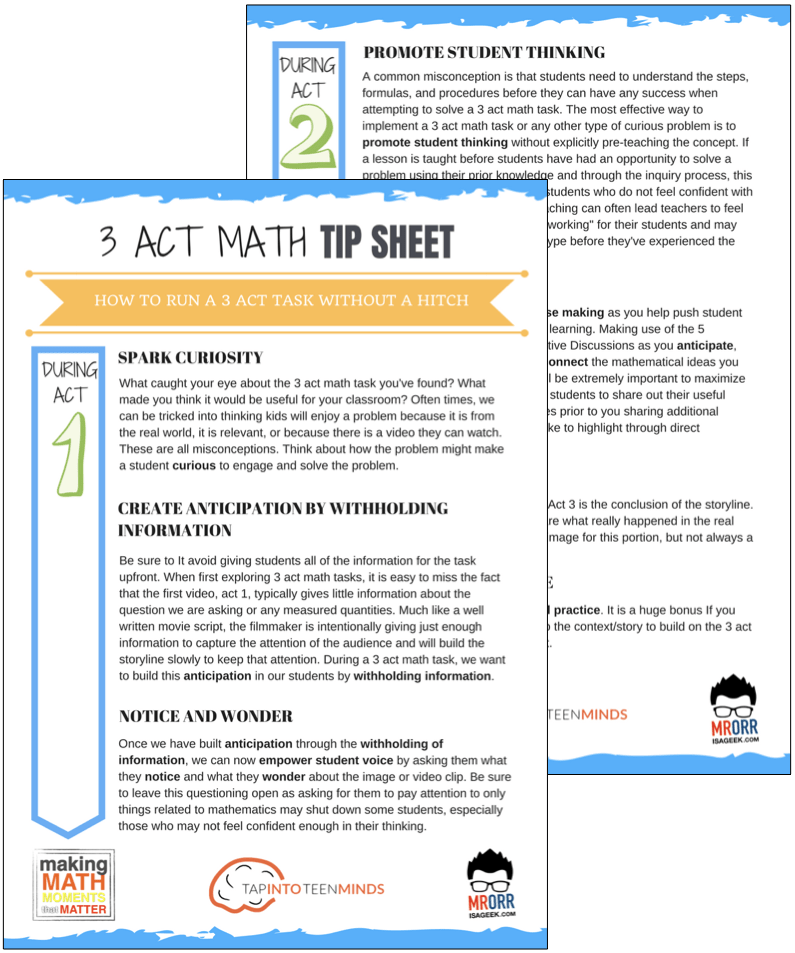
DOWNLOAD THE 3 ACT MATH TASK TIP SHEET SO THEY RUN WITHOUT A HITCH!
Download the 2-page printable 3 Act Math Tip Sheet to ensure that you have the best start to your journey using 3 Act math Tasks to spark curiosity and fuel sense making in your math classroom!
LESSONS TO MAKE MATH MOMENTS
Each lesson consists of:
Each Make Math Moments Problem Based Lesson consists of a Teacher Guide to lead you step-by-step through the planning process to ensure your lesson runs without a hitch!
Each Teacher Guide consists of:
- Intentionality of the lesson;
- A step-by-step walk through of each phase of the lesson;
- Visuals, animations, and videos unpacking big ideas, strategies, and models we intend to emerge during the lesson;
- Sample student approaches to assist in anticipating what your students might do;
- Resources and downloads including Keynote, Powerpoint, Media Files, and Teacher Guide printable PDF; and,
- Much more!
Each Make Math Moments Problem Based Lesson begins with a story, visual, video, or other method to Spark Curiosity through context.
Students will often Notice and Wonder before making an estimate to draw them in and invest in the problem.
After student voice has been heard and acknowledged, we will set students off on a Productive Struggle via a prompt related to the Spark context.
These prompts are given each lesson with the following conditions:
- No calculators are to be used; and,
- Students are to focus on how they can convince their math community that their solution is valid.
Students are left to engage in a productive struggle as the facilitator circulates to observe and engage in conversation as a means of assessing formatively.
The facilitator is instructed through the Teacher Guide on what specific strategies and models could be used to make connections and consolidate the learning from the lesson.
Often times, animations and walk through videos are provided in the Teacher Guide to assist with planning and delivering the consolidation.
A review image, video, or animation is provided as a conclusion to the task from the lesson.
While this might feel like a natural ending to the context students have been exploring, it is just the beginning as we look to leverage this context via extensions and additional lessons to dig deeper.
At the end of each lesson, consolidation prompts and/or extensions are crafted for students to purposefully practice and demonstrate their current understanding.
Facilitators are encouraged to collect these consolidation prompts as a means to engage in the assessment process and inform next moves for instruction.
In multi-day units of study, Math Talks are crafted to help build on the thinking from the previous day and build towards the next step in the developmental progression of the concept(s) we are exploring.
Each Math Talk is constructed as a string of related problems that build with intentionality to emerge specific big ideas, strategies, and mathematical models.
Make Math Moments Problem Based Lessons and Day 1 Teacher Guides are openly available for you to leverage and use with your students without becoming a Make Math Moments Academy Member.
Use our OPEN ACCESS multi-day problem based units!
Make Math Moments Problem Based Lessons and Day 1 Teacher Guides are openly available for you to leverage and use with your students without becoming a Make Math Moments Academy Member.
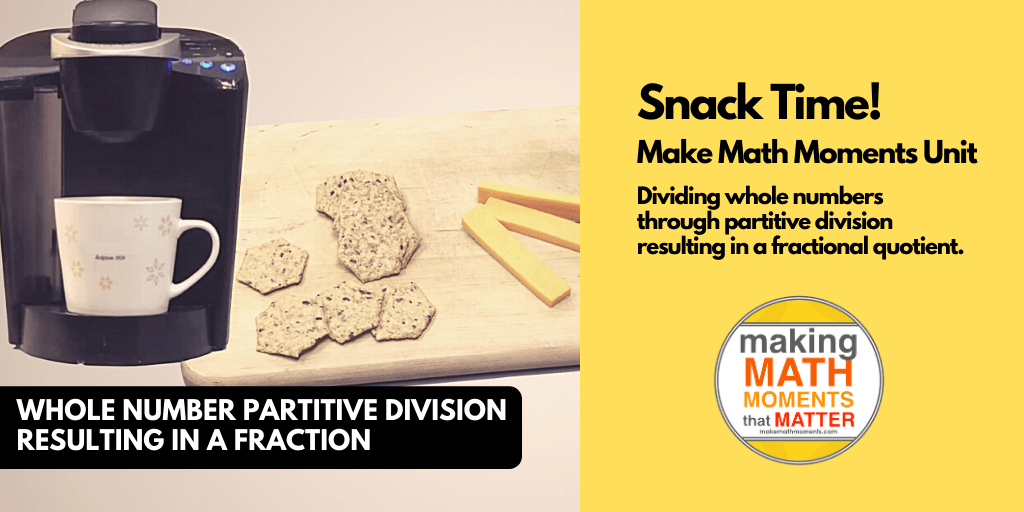
Partitive Division Resulting in a Fraction
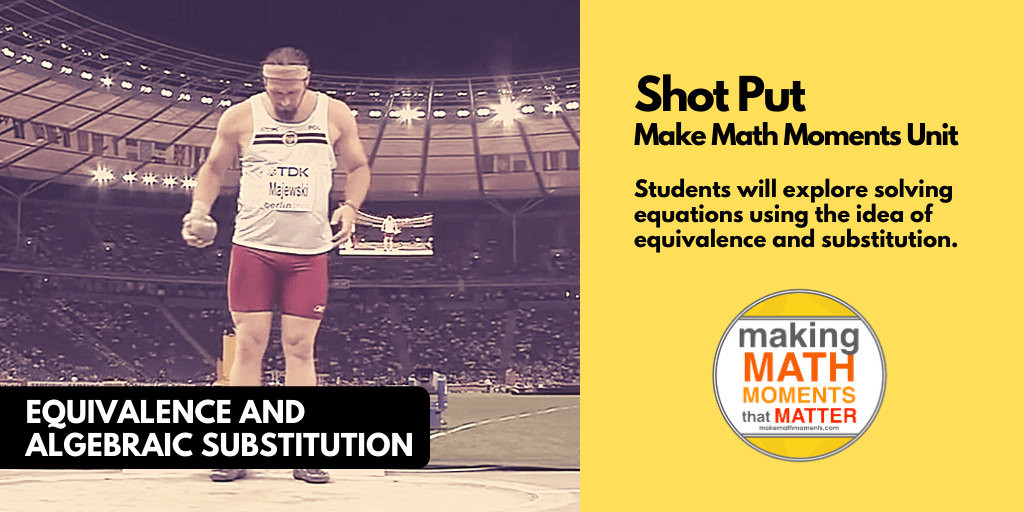
Equivalence and Algebraic Substitution
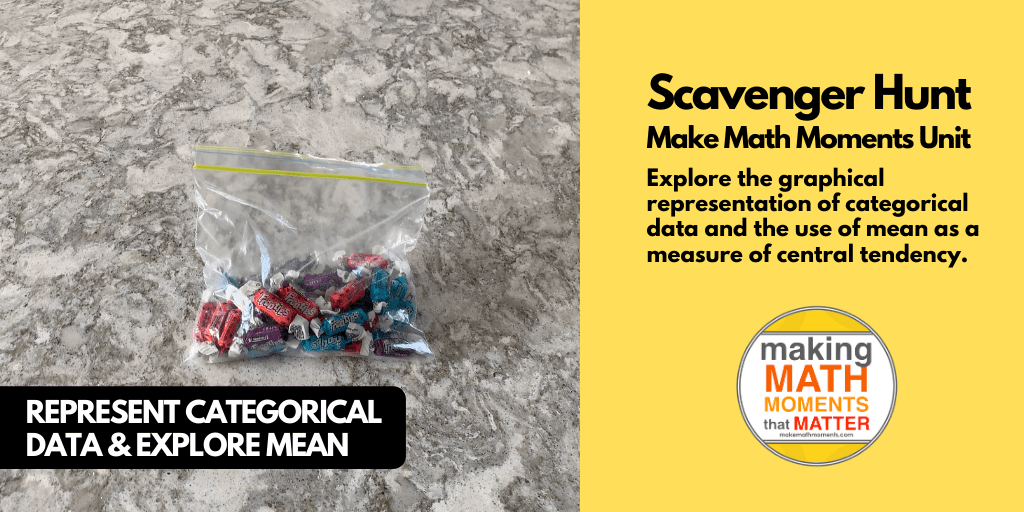
Represent Categorical Data & Explore Mean
Downloadable resources including blackline masters, handouts, printable Tips Sheets, slide shows, and media files do require a Make Math Moments Academy Membership.
ONLINE WORKSHOP REGISTRATION
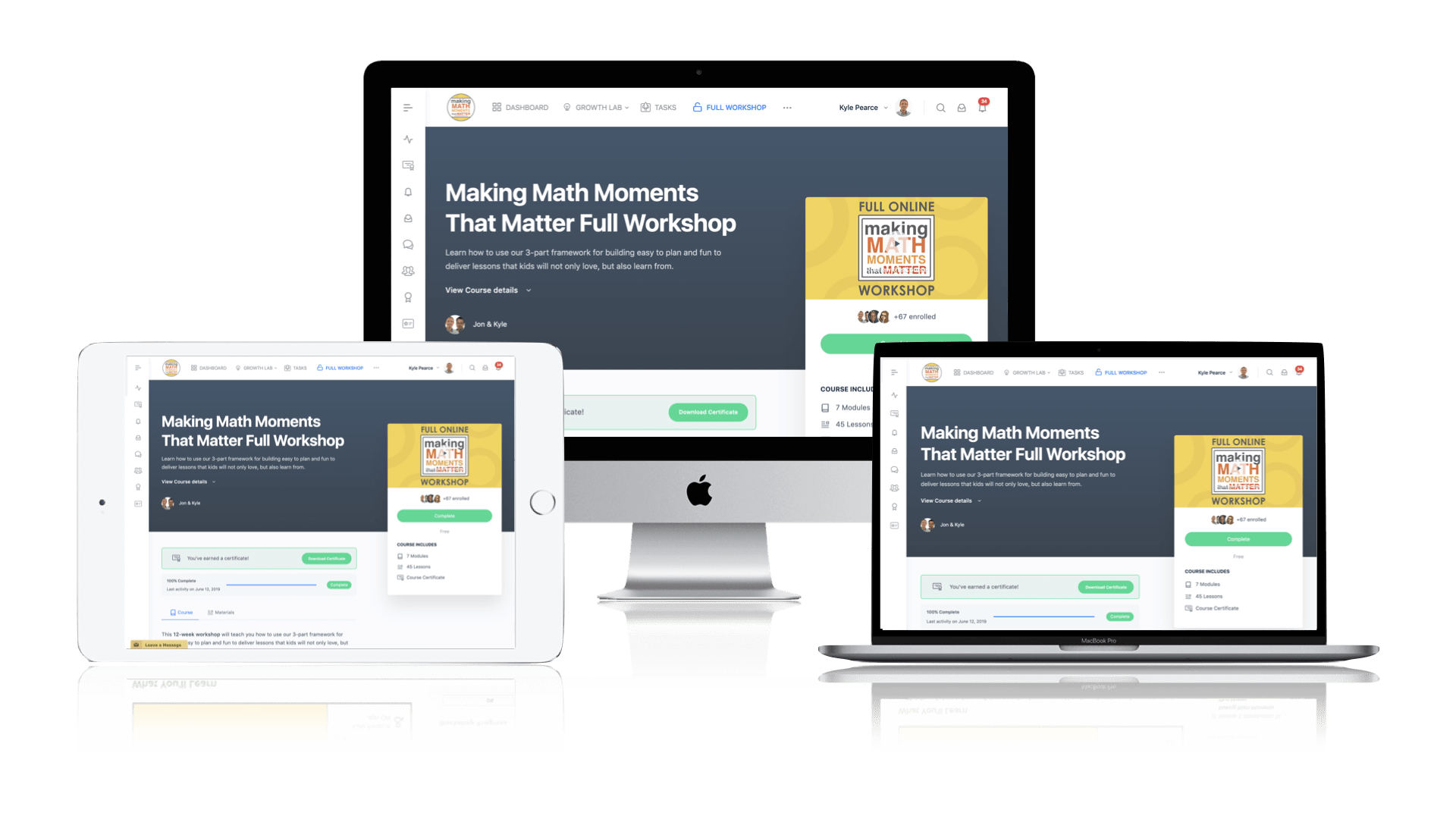
Pedagogically aligned for teachers of K through Grade 12 with content specific examples from Grades 3 through Grade 10.
In our self-paced, 12-week Online Workshop, you'll learn how to craft new and transform your current lessons to Spark Curiosity, Fuel Sense Making, and Ignite Your Teacher Moves to promote resilient problem solvers.
0 Comments