Episode #498: From Classroom Observations to a Focused Math Improvement Plan
LISTEN NOW HERE...



WATCH NOW...
In this episode, Jon Orr and Yvette Lehman unpack a recent three-day visit with a K–12 school working to strengthen its math improvement plan. They share how the team moved from a broad vision to classroom evidence, one focused instructional move, and short-term key results designed to build momentum.
In this episode, you'll explore:
- Why a shared vision needs to describe what students and teachers will actually be doing
- How a Math Coherence Compass can create alignment across multiple campuses
- The difference between student participation and independent mathematical thinking
- How classroom observations can reveal strengths and opportunities without becoming evaluative
- Why the team focused on student confidence, risk taking, perseverance, and curiosity
- How one existing part of the curriculum became a high-leverage instructional move
- Why short-term key results can help turn a long-term goal into immediate action
- How accountability and follow-up help new practices become part of the system
Look at your current math improvement goal and ask: What is one observable change we could realistically make this quarter? Get specific about the action, how you'll support it, what evidence you'll collect, and when you'll come back together to see what you're learning.
Attention District Math Leaders:
Register for the 2026 Make Math Moments Virtual Summit
K-12 Math Leaders: Download our free Math Coherence Compass to help your teammates, system leaders, and educators create aligned instructional practices—without adding another initiative.
K-12 Math Leaders: Not sure what matters most when designing math improvement plans? Take this assessment and get a free customized report: https://makemathmoments.com/grow/
K-12 Math Leaders: Ready to design your math improvement plan with guidance, support and using structure? Learn how to partner with us and follow our 4 stage process. https://growyourmathprogram.com
Looking to supplement your curriculum with problem based lessons and units? Make Math Moments Problem Based Lessons & Units
Be Our Next Podcast Guest!
Join as an Interview Guest or on a Mentoring Moment Call
Apply to be a Featured Interview Guest
It will take less than two (2) minutes to book your Math Mentoring Moment call.
Book a Mentoring Moment Coaching Call
Take two (2) minutes to book your Math Mentoring Moment call and let's work together to shake that math pebble out of your shoe!
Are You an Official Math Moment Maker?
Ensure that you follow, rate and review on Apple Podcasts, Spotify and other platforms to show your support and ensure other math educators can find the show.


FULL TRANSCRIPT
Jon Orr: So, Yvette, you just got back from an in-person visit to a school site where they're one of our clients, one of our district teams that we support in their ongoing efforts for sustainable math improvement. We're trying to create a math plan with them, but also support them in that process all year long. You were visiting them for three days. You did great work, I heard, but I need more details. Like let's get into the details. What did we do with this team? How did we help them? What was their initial like this is the problem we need solved in terms of the math work we're doing and what do we do to support them? Let's, I'll let you kind of lead, where do we want to go here? Let's share this update with the Make Math Moments That Matter community.
Yvette: So, just for some context, this is a single K-12 school, but it's a very large school spread across five campuses. So, and but they're all within, you know, a block or two of each other. So it's just a very, very large K-12 school with individual sites for K-1, 2, 3, 4 to 5, 6 to 8, and then a high school campus. And when they first approach us, and I will tell you, having been there, I mean, amazing things happening in this school. It really blew me away, truthfully, and we'll unpack that a little bit more when I talk about our observation day.
But they came to us because they were really feeling what they would describe as stuck when it came to math improvement. And they said, and they reiterated this during our time together in person, they just didn't know where to go next. They feel like they've tried a lot of different things, they've adopted new curriculums, but they're just not seeing the transformation that they were hoping to see. And they were looking for, you know, some guidance or some support in making some meaningful change. So, as you said, we were there for three days.
Jon Orr: Got it.
Yvette: Our first day, we came to the table with their math task force. And their math task force had representation from all five sites. And it was a combination of coaches, administrators, and teachers. And there were at least two people from every site.
Jon Orr: Did this exist before or before they had reached out to us or is this a
Yvette: That's right.
Jon Orr: Yeah, okay.
Yvette: Yeah, so this task force did some work together last year to start laying some of the foundation. And of course, you know, some people left, some people came, but for the most part, it was the same people sitting around the table who had already started to do some visioning work last year. So we weren't starting from scratch. But really the purpose of our first day was to get clear. And we worked through building their coherence compass, but again, not from scratch. They had a vision statement that had previously been drafted. But it was, as we came to discover through the exercises that we engaged in that day, it was very vague. You know, it was using words
Jon Orr: Hm. What do you mean?
Yvette: like engaged and equity and like trying to think of some of the other kind of big buzzwords that were within their vision, but none of they were really open to interpretation drift. And you definitely would walk away thinking, but what do they really mean?
Jon Orr: What do you mean interpretation, Yvette?
Yvette: Well, basically, you know, somebody else and I wish I had the vision right in front of me right now, but it was very generic. You know, students will engage in rigorous math in an equitable environment supported by, you know, staff and families. Okay, you know, it was
Jon Orr: Okay. What's wrong with this?
Yvette: I guess the challenge that we worked through that day is so what do you actually mean?
Jon Orr: Yeah.
Yvette: You know, what should we see happening? What should we hear happening? Can we, can we describe
Jon Orr: Yeah.
Yvette: so we started to pull out words like engagement? And we were like, well, how do you know a student's engaged? Because again, the vision is essentially where we're all working toward. We always use our canoe analogy, you know, where we talk about this idea that it's never an effort problem. Everybody's working really hard, and you might even all be in the canoe and you're paddling, but you're not paddling in the same direction because we don't have clarity or coherence around where we're actually trying to go.
So after we, as always, you know, we engage in a lot of math tasks on this day, this launch day with the team. And we really spent some time refining their vision, you know, massaging it, getting more clear about what we meant when we said engaged and rigorous and equity. And we landed on something that paints a more vivid picture of where they, what, you know, it's like say what you mean and mean what you say in a clear way that people could walk out of the room and paraphrase.
Jon Orr: So I'm imagining like, 'cause you imagine like okay, we try to condense this vision statement to help paint a picture of where we really want our student or what our students to experience here in our school system so that we can share it across school, you know, the campuses. But then it's like, okay, if we're gonna break down each of these like statements or these words or these terms that could cause us to, you know, when you say engagement here, we all have different meanings of engagement. Now I'm imagining that your vision statement is three pages long.
Yvette: It's just, you know, I'm gonna read it to you. I'm gonna see if you, if you think it's because of course, you know, I'm cautious of that. I think that we need to not have something that is three pages long because again, people need to be able to own it. And then that's what I'd really try to position the math task force that they are champions of this messaging. So when they leave this room, when they go beyond these walls, you know, you are the first group that is launching this effort and championing this vision that you have for equitable, ambitious math teaching across your site. So we need to understand it.
So this is where we landed. So again, originally it was kind of one pretty generic statement with a lot of buzzwords. Where we landed was students own their mathematical thinking and act as mathematicians by talking, reasoning, and problem solving with peers, taking risks and persisting through challenge with curiosity. Teachers facilitate this ownership through questioning, responsive instruction, and space for students to lead. Equity and access grow from shared ownership among educators, families, and students. So when you hear that, what shift do you think this team is trying to make?
Jon Orr: I think they're trying to make more ownership in terms of math, what instruction looks like in the classroom with students, but also a shift towards more appropriate mathematical discourse in the classroom, thinking happening in the classroom, more student action than teacher led action. Like yes, teacher led action is absolutely part of it, but I think what the image that I get is that there are more students are doing the math and actually engaging with the activities rather than say the sage on the stage or the lecture format that you know I taught for ten years.
Yvette: Nailed it. So when we did the magic wand wishlist with this group, the actual, the highest, you know, when we did our crowdsourcing and people walked, so we did the magic wand wish list, right? Where they in their grade level teams made the list of what they wanted to see happening consistently across all classrooms. And then we had them go around the room and star the ones that they thought were most important. The top one was teacher as facilitator. Which was interesting. So then we really got into a big conversation about what that looks like, what that sounds like. And so it was very evident from that first day that the team felt a need to transition how students are positioned in the classroom as independent thinkers as opposed to mimickers, you know, where everything is being modeled for them.
Jon Orr: We see this a lot, I think, right? Like I think when we, 'cause we've done this type, you know, that's why we have a name for it. You know, we have names for the structures and the activities that we do with our teams when we go visit them or whether it's in person or whether it's virtual and we hold these sessions. The magic wand wish list is that activity that we help start to formulate what is the vision going to say? What are they really working towards? The compass is a tool that we help them build so that that vision can translate into actual practice and what does that look like? Like on a daily basis, a weekly basis, a monthly basis.
But I think I think what I'm getting at here about like the commonality when we do this across North America with school districts. So what we see a lot is that I think there are a lot like this math task force is made up of teachers who are doing the heavy lifting, the teaching multiple subjects. You know, like there's a lot of work that all these amazing teachers are doing on a daily basis and you've got this activity that says we want to shift our instruction from here to here. Like we see this all the time. People want that. And I think the hard part is like we just don't know how. Like we want to. We see glimpses of like what that classroom could look like. I want a classroom where it's bustling and kids are debating back and forth and thinking and solving problems and being resilient. But how do I do that with the kids I have in front of me, with the curriculum I'm supposed to teach that maybe doesn't structure things like that? Or how, like that's where I think a big barrier is come up and is to say, like, we all want that, but now help me with the how.
Yvette: Right. So, you know, of course after we've landed on this vision, we did some more math and I need to share with you, John, we did the band reward task from the University of Waterloo as our second task with teachers that day. Almost everybody worked through lunch on it.
Jon Orr: Band reward task.
Yvette: Yeah, remember the one where it's basically the fractions? So it's like Kayla, Sophia, and Octavia get a portion of the reward. So that's from the University of Waterloo.
Jon Orr: Yes. Okay. It's a proportion, right? We'll put a link to that in the show notes if you want to have a peek.
Yvette: But it was great because we started the task before lunch to start to set the stage for defining our student learning objective. And almost everybody had a working lunch to continue thinking through that task. People were relentless in their willingness to unlock it.
Jon Orr: So they hadn't solved it and they're like, I just need to figure this out. Okay, good. It is a high cognitively demanding task that may on the surface does look like hey, it's just percentages and proportions that I need to use to piece this together. But there's a lot of deep thinking that needs to go in and the solution can be so elegant. And sometimes we seek very complex solutions to that problem. Well, the first time I tried to solve it, I try to create multiple equations and multiple variables. And I'm going, hey, I need a matrix to solve this problem. And the way you solved it was so elegant and easy that I'm like, ugh. And it's like this is why we choose this problem to solve with people when we do in person is to think about it a little differently to help them see what their instructional practices could look like to bring about different models, different strategies to solve problems.
Yvette: And that was a great primer, right? For our next task, which was essentially to figure out okay, if that's the object, if that's the vision for five years, ten years from now, we're all rowing in the same direction. What needs to change now for students? And so where they landed, because of course, with our objective, we want it to be focused, but also lofty enough that we will be able to maintain it for three to five years. That's part of the flywheel idea, right? That we're continuing to build momentum. So they chose to increase student disposition by taking risks, trusting their own thinking, and persevering through hard problems.
Jon Orr: Okay.
Yvette: And the reason they chose that is there was kind of a general belief that students can't if we don't. So I can't put this hard problem in front of students because if I don't pre-teach it, model it, have them practice what I'm doing, or walk them through the problem step by step, line by line. They can't. And so that was the shift that the math task force wanted to see for students. This trust and belief that students are capable of engaging with difficult mathematics. And the big thing that the band has helped us understand is that it's not always about getting the answer, it's about the thinking.
You know, the making of connections and the conjectures and trying different things. And even if let's say by the end of those thirty minutes, forty five minutes, the teachers in the room didn't have the exact answer, there had been a lot of thinking, a lot of discourse, a lot of math happening in that room. And so can we give students that opportunity, even if let's say today they're not ready to get to the answer, can they enter? And you know, so of course we talked about low floor, high ceiling tasks and how do we create more opportunities for students to independently think without being primed with all kinds of modelling and scaffolding and direct hand holding.
Jon Orr: And so I get I and the in the and the task force made up of teachers is nodding their heads along this like we're all on the same page here still. Yeah.
Yvette: This was all them. Like we really didn't influence, I wouldn't say at all on the first day. This really emerged from their thinking. And so what we had them do is we had each of the sites working, you know, they would work together, then we would do a discussion protocol where they'd get to talk to people from other groups, then they'd work together, and then we'd do a big share out. And all throughout each site was capturing their ideas in a working document so that the leadership team could have access to that after and we could have access to it. And a lot of these big ideas were really being echoed across divisions. It was actually pretty amazing to see how much they were, you know, on the same page. It had already started really in the Magic Wand wishlist. We'd already started to see this, you know, the commonality across these different grade band sites. And then with the starring of sentences that really stood out to them, we could definitely tell that people were already heading in this direction of we want students to be more independent. We want them to be confident, to take risks and to try even if they're not right. And that we believe that they're capable of persevering through hard problems, even if they don't believe that yet.
Jon Orr: Right. And and did you get a sense like that the group is is saying what we all wanna, you know, they they're saying what you wanna hear. You know, like I think we've, if you're listening, you've probably had PD sessions or at the beginning of school years where you're talking about these important ideas in terms of instruction in terms of mathematics and thinking about disposition and thinking and discourse and group work and collaboration amongst students and more student problem solving with students. But then you get that sense it's like, okay, we did it and everyone's nodding their heads, but like that's just what happens on a PD day in August or September. Did you get a sense like that's what was happening here? 'Cause it's, you're, it's all roses right now.
Yvette: Well, I think that I didn't get a sense that people were saying what we wanted to hear. I could definitely tell there was enough psychological safety in the room where people felt okay to voice opinions. You know, and there was some challenges and some pushback and some honest conversations. What I worry about is the launch is the easy part.
Jon Orr: Sure. Exactly.
Yvette: Right? Of course, within this space, there's no distractions. We're protected and sheltered for these three days. We can say that this is the work we want to do, and then we go back to doing what we were doing. But I will tell you why I don't believe that's true in this case. Okay.
Jon Orr: Yeah. Exactly. Exactly. Okay, keep going.
Yvette: So by the end of the first day, one of our tasks was to essentially, and we're gonna run out of time on this episode. We may have to do a part two, John. But one of our tasks by the end of the first day was, we were going in the next day to do observations in many classrooms, including some of the people on the task force, but also people not on the task force. And we were very clear that we did not want to come in with our own lens or perspective of what we were hoping to see. We wanted the task force to co-construct it.
Jon Orr: Okay.
Yvette: So we said, you know, if a student was demonstrating that they're taking risks, owning their thinking, and persevering through hard problems. What should we see? What should we hear? So all of the teams got into a table and they populated their success criteria, getting really specific about what students are doing, what students are saying. That evening, Beth and I basically took all of those indicators and we put them into buckets and we consolidated them into a smaller list because we couldn't look for everything. It needed to be manageable.
But we were basically looked through all the indicators and said, well, what are they really saying? And we emerged four buckets, which was student confidence, risk taking, perseverance, and curiosity. And we had some indicators for each one that were basically, you know, a succinct way of capturing everything that the team had drafted. Okay, this is where the magic happened, John. On day two, we now we have these look fors.
Jon Orr: Uh-huh.
Yvette: When we go to do the observations at every site, we're accompanied by leadership. So it wasn't just the, yes. Coach. Yes. Right. Yes.
Jon Orr: Leadership like administrator, principal, vice principal or or assistant principal, coach, coordinator. Okay.
Yvette: So it wasn't just Beth and I doing the observations. It wasn't even just the math coordinators and I, you know, doing the observation. So when I went to, for example, the grade five, four, five site campus, the the principal, the assistant principal and the coach from that building were with me.
Jon Orr: And this is a recommendation you put into play with, say, well, organizing the structure of these three days?
Yvette: And it was actually something that they said as well, because we try to be flexible, right? It's like, we'll work with what you're able to offer. Because sometimes it's hard to release people or or different demands don't allow for that type of time. But the team really felt it was critical because any decisions that were going to be made moving forward, the principals had to be on board, right? They are an absolute, you know, key stakeholder. So we had the look fors, and basically what we said is when you see that behavior, tally. And if you see or hear a really good example of it, record it verbatim, you know, word for word, so that we can improve our look fors. And what we were looking for is where were the tallies falling? You know, were we seeing more evidence of risk taking, less evidence of persevering, more evidence of confidence, less evidence of curiosity? Kind of seeing, you know, where what's our strength and where's the opportunity for growth?
And it was really powerful because of course we saw what we saw. We watched student behavior and and I think not surprising to the math task force, not surprising to our team, we saw very, very few opportunities for students to persevere through problems because they were never given independent problems. It was a lot of we do. Like a lot of we do. Yeah.
Jon Orr: Yes. I agree. Like that's typically what you see. Yep.
Yvette: Like it wasn't even like an I do, we do, you do. It was a lot of we're gonna walk through every step together.
Jon Orr: Yeah.
Yvette: So that obviously naturally emerged an opportunity to figure out, well, where does the you do live within this curriculum?
Jon Orr: Yeah.
Yvette: I will say though, what we did see a ton of was what I would define as engagement, not necessarily independent student thinking. But you know how I always say the dynamic we often see is like teacher, student, teacher, student, sleepy time for everybody else, like Lucy West. We did not see that. Because they had spent a significant amount of time building up talk routines and protocols in their rooms. That there was a lot of choral response, tons of hands in the air. Students were actively playing their role.
Jon Orr: You saw this K-12?
Yvette: K-12. It was the most, let's call it participation.
Jon Orr: And this is the magic.
Yvette: Yes. It was the highest level of participation I have ever seen.
Jon Orr: Wow. So we're talking about a school who is saying, hey, we're doing some really great things in our class, but we're not sure exactly what we're striving for generally across, but we we have some really great engagement happening already. So we're starting from up this
Yvette: Awesome, yes.
Jon Orr: floor and we need to go to this component, which makes me wonder like, you know, is is that you know what what does it mean for everyone else who's like I'm listening right now, going like, my like I don't see that. Like you just said, we've never typically see that when we visit schools.
Yvette: I have not, it was unbelievable. And and I mean all learners. So this is a population where in JK/SK, 80 plus percent of their students are multilanguage learners. And by the time they move through middle and high, it's about 20%, but that's because students have lost their designation at that point, right? But you know, you're talking about a high multilanguage learner population. And I've never seen that level of and it was the routines were consistent from room to room.
Jon Orr: Mm-hmm.
Yvette: Right? So I didn't see a huge variability. So if I was in a grade five classroom, first of all, they were all in the same lesson because they co-plan. So there's
Jon Orr: Yep. So so it sounds like they're they're mimicking a lot of the recommendations we make to teams to have some of these things in place in in narrow focus and and make sure that we have we have collaboration time. Like they in a way when we think about supporting and and making recommendations to schools and school districts, it's this team is doing well here, well here, well here structurally already, which is is is a great move and and to move forward with and on
Yvette: Yeah. But of course, so you know, there was great things to praise and to highlight. And I mean, I even said to my friends over the weekend who are educators, I've never seen learning spaces like the ones I saw, truthfully. It was incredible. But I don't think they're comfortable seeing students struggle.
Jon Orr: Mm, they rescue.
Yvette: It it it is so supportive. You know, even they were doing a a protocol in the one fifth grade classroom where they were filling out, you know, they're reading the word problem and then they're filling out a chart, what I know, what they want me to show, you know, what they want to know, and the answer. And even that portion was line by line, bullet by bullet, completed together. Like it was very
Jon Orr: Right. So like it's kinda like this
Yvette: We do.
Jon Orr: comes to the engagement piece of the definition as like, well what do we like what are we really calling engagement? Like is that cognitively engaged or we're behaviorally engaged? It's like I'm I'm actively putting my hands up but I know that I have like my the the level of thinking that I actually need to engage with here might be low 'cause I'm really just filling in things as we go through them.
Yvette: And the team talked about that a lot, you know, the difference between true engagement and participation. Right? Like there's a lot of participation. You know, people know students knew their role because the routines were so well established. But they also really weren't being asked questions that hadn't already just been answered. Right? You know, they're just repeating basically what has already been modeled. So, anyways, great things happening, but great opportunities as well. And so it was really ideal.
In the K-5 space in particular, was that the curriculum has a two-day lesson cycle, and the first thing on day one is a try-it. And it's intended for exactly what it sounds like for kids to try it before the modeling and the connection, which is the explicit instruction part. But the try-it was not being leveraged as an independent formative assessment gathering student-led. So that's the one move. Right? There's that's a low-hanging fruit, high-leverage move for the entire K-5 team to just say, we're not deviating from the curriculum, we're not layering on top, we're gonna revisit this one portion of the lesson structure and work to make it more student-centered.
So that's kind of what emerged on day three. So you can imagine now we've done these observations, the math task force comes back, the leaders join us, and now we're saying, okay, we use the accountability framework that I borrowed from Change the Culture, Change the Game, a book we recently read, which is basically see it, own it, solve it, do it. So it's like we've seen it. We were all on the same page about what we had seen. There were some honest conversations about what we had observed. Now we need to own that change, find a solution and and make it happen. And so for K-5, it was such a easy move to just say, and so what we did on the third day is we actually started the day by engaging the team in a try-it. And we took it right from their curriculum and we turned it into a more task-based opportunity.
And what's interesting is the try it, model it, connect it. To us, that's one part of the lesson cycle where, you know, you might be modeling it during the task for some groups, but it's like by the end of that time, let's say, because time's always a concern, right? Where's the time to do this? We're still doing the explicit instruction that the teachers want. We're just not doing it all up front, lockstep, modeling it for everybody without allowing students to enter it with bringing their background knowledge or using any of their own independent reasoning. So anyways, that was a big win for the K-5 team to have this really accessible I can make that change. And they they saw it, which was huge.
Jon Orr: For sure. And the the task force team came back together to kind of say, like, we saw this, we experienced it, we know that this is a move we can make. How does that, we 'cause you referenced the math coherence compass as a tool for helping decision making but also framing work ahead to make it this practical. Like, hey, yes, we talked big game about vision, but how does that really, what does that mean moving forward? So talk to us about where this move lives in terms of the compass and what they actually are gonna do repeatable because what we heard last, heard from you saying we we modeled it for them so they knew what the triad could look like, which is really important for them to go like, we thought it was this, but now we know that it could look like this. How do we build that so that we continually get stronger at this one thing? So it mimics the strength that they had on some of the other practices that they've built up over the last, you know, number of years because they got narrow in terms of the support and the ideas and the structures that they could be putting into place to strengthen certain aspects of their teaching. What about this try it move for the K to five group?
Yvette: So to me, the compass is what keeps this entire K-5 work connected and coherent and aligned. And as they come back to the table, they are always coming back to the vision, coming back to the student learning objective. But the action steps lived in their action tracking sheet, right? Which is, you know, and and we have a template that we share with our teams to basically say now you are identifying a specific key result that your team is committed to hitting by the end of the first quarter.
And it was just interesting because we had all of our teams working independently on this, but the K-1, 2, 3, and 4, 5 all had a very, very similar key result. Not word for word, you know, the depth that they're going to go to, for example, might have been slightly different. Some of them were prioritizing more increasing teacher awareness around how the triad could be reenvisioned to make it more student-centered. And they felt like the teachers needed to do that learning first as opposed to actually seeing it being implemented in classrooms differently next week. They had different depths of their key results based on what you know strategic supports they had in place and competing priorities they have at their site.
But they essentially all landed on a similar comparable key result for the first quarter around. We're going to come back to our teacher collaboration periods. We're going to leverage staff meetings to unpack and understand how we can make subtle shifts in the triad to get us closer to the student learning objective. And so then they, you know, they have their key result, they know how they're going to monitor it. We talked about monitoring and what's realistic to monitor. At first, the one very ambitious administrator team is like, we're gonna see a shift in the triad in 80% of lessons that we observe. And like, how
Jon Orr: Right.
Yvette: like how many lessons, you know, is that realistic between now and the end of October? Or is it that by the end of October, teachers are gonna have an increased awareness around how the the teacher's role within the triad and the students' role within the triad? We're gonna get more coherent.
Jon Orr: Right. Like you help them with I think you I think that's one of the the big pieces that you you help teams with specifically is is that when we build math improvement plans, setting appropriate goals for seeing improvement has to be realistic and how do we help teams see the realisticness of the goals they're setting? Because everyone, every school typically has to send in their school improvement plan and there has to be an element of our numeracy or mathematics on it. But it's like, like you said, it's like, let's see 80% of this happening or we need this much gain. But it's like and in until we reverse engineer what it actually takes to see that type of improvement, all the way back through the repeated support structures, the the time in class, the coaching, the the PLCs, the the full day pullouts. Like when we put all that down, and this is that part of the compass that we help teams unpack, when we think about the west side of that compass, the strategic supports that we could be putting into place, when we reverse engineer it, we then be it becomes clear what what impact we could actually make in our classrooms with our students on a short timeline like a quarter or even a year because we we've given the clarity to say this is how we actually can set goals or key results based off what you have available to you for supporting that shift in instruction or the shift in behavior or or the shift in in in mindset and belief. And I and I think that's one of the, you know, our superpowers to help teams, you know, see that see that realisticness of what they're trying to accomplish.
Yvette: So you asked earlier, you know, this all sounds great. We're all motivated, you know, everyone's excited about this work, but we all know the biggest challenge is going to be what happens this week and next week and the week after. And that's why I think that the action tracking sheet with a Q1, a quarter one key result that's really short term. It's right in front of our face as opposed to saying by May twenty twenty seven. You know, we're setting this really short-term milestone with really clear action steps with due dates within the next month and a half.
Now, our job as coaches is to support with that accountability, to check in, to follow up. So we're back there in a month. So that in itself puts a little bit of pressure on the teams, right, to follow through because they know that our visit is going to be coming up and we're going to touch base with each leadership team at least once virtually between now and then to you know, and then we reference there because that's the do-it part of the accountability framework. And the problem is if we don't do it, if we don't do what we say we're going to do, then of course nothing is going to change.
Jon Orr: Yeah. Exactly. And I think I think, you know, the do the do it or the the habit, like the accountability part is like it's kinda like I I hear I think I heard, you know, 'cause it when I often would think about accountability, habits, repeatable things that create patterns, create traits in ourselves or create things that that that just live in our system, like how do we how do we use our PLCs to strengthen this key result? Or how do we how do we put coach when we put coaches in the classroom, what are they consistently supporting with? Like those are micro habits. And so it makes me think about like atomic habits with James Clear. And and when we think about that, it's like the repeated compounding of those habits actually creates the outcomes that we're actually looking for.
And we have to in the accountability part is like how what can we commit to so that it eventually, yes, someone's tapping us on the shoulder or looking over. There's an accountability piece to be like, I'm doing the habit, kinda like I'm brushing my teeth when I was a kid because my mom was looking over my shoulder saying, like, did you brush your teeth before you go back to school? Or but then eventually like you don't you don't do that, you know, you don't you don't brush your teeth because your mom's looking over your shoulder as an adult. You learn the habit that became the part of what you do for the benefit of, you know, having healthy gums or healthy teeth. But it's like the same is true when we support schools and school districts in shifting their habits and the processes to create math improvement and use the structures. They yes, you need some of that accountability early on, like your mom looking over your shoulder, so that a year from now, two years from now, three years from now, your operating system, you know, the way you brush your teeth, you don't need to be reminded anymore. It's just part of what you do because you've built the actual habit and not that they say the, hey, we're just doing these things because we thought we needed to do
Yvette: Excited about some wins this past week. I feel like we, you know, accomplished a lot in three days as far as strengthening coherence. We made some really strategic moves around the observations and having administrators at the table, bringing administrators in on the third day, right? Not all administrators were part of the task force, but all administrators attended a portion of the third day when the planning forward was happening. Because of course, they needed to be prepared to commit to that work with input from the teachers that were part of the task force. So they weren't making those decisions on their own without input from educators. So we're excited to see where this team goes.
Jon Orr: Got it. Yeah, and we will keep you updated on the progress that this team is is making as the year unfolds. We are, like Yvette said, we are visiting back to support and be that accountability partner, be that thought partner, but also be that facilitator while while this team is moving forward with their key results and their math improvement plans. So we will have future episodes to kind of update you on their progress and where where they stand with hitting some of those key results and those on their say math coherence compass. So look for those in the future episodes.
If you are looking to get your math improvement plan drafted, if you're looking for your action plan, the the detailed you moves that you're going to make on a on a daily, weekly, monthly basis to help you hit some of those key results that you have maybe have or haven't set yet. There's a link down below. You can book a call with our team. We create math improvement plans for schools, for school districts so that you can hit the goals that we co-set with you. That's what we do on a regular basis. That's what we did with this team. We built their plan, their dashboard, their math coherence compass with them over the course of three days. And now they have that plan in place to support all year long to hit those key results. So book that call. We can, you know, we have some spots left for this school year and moving into the next school year. And we can we can talk about whether we can support you in developing that math improvement plan.
Your Customized Improvement Plan For Your Math Classroom.
Take the 12 minute assessment and you'll get a free, customized plan to shape and grow the 6 parts of any strong mathematics classroom program.
District leader/math coach? Take the District Assessment
Thanks For Listening
- Book a Math Mentoring Moment
- Apply to be a Featured Interview Guest
- Leave a note in the comment section below.
- Share this show on Twitter, or Facebook.
To help out the show:
- Leave an honest review on iTunes. Your ratings and reviews really help and we read each one.
- Subscribe on iTunes, Google Play, and Spotify.
The Making Math Moments That Matter Podcast with Kyle Pearce & Jon Orr
Weekly interviews, strategy, and advice for building a math classroom that you wish you were in.
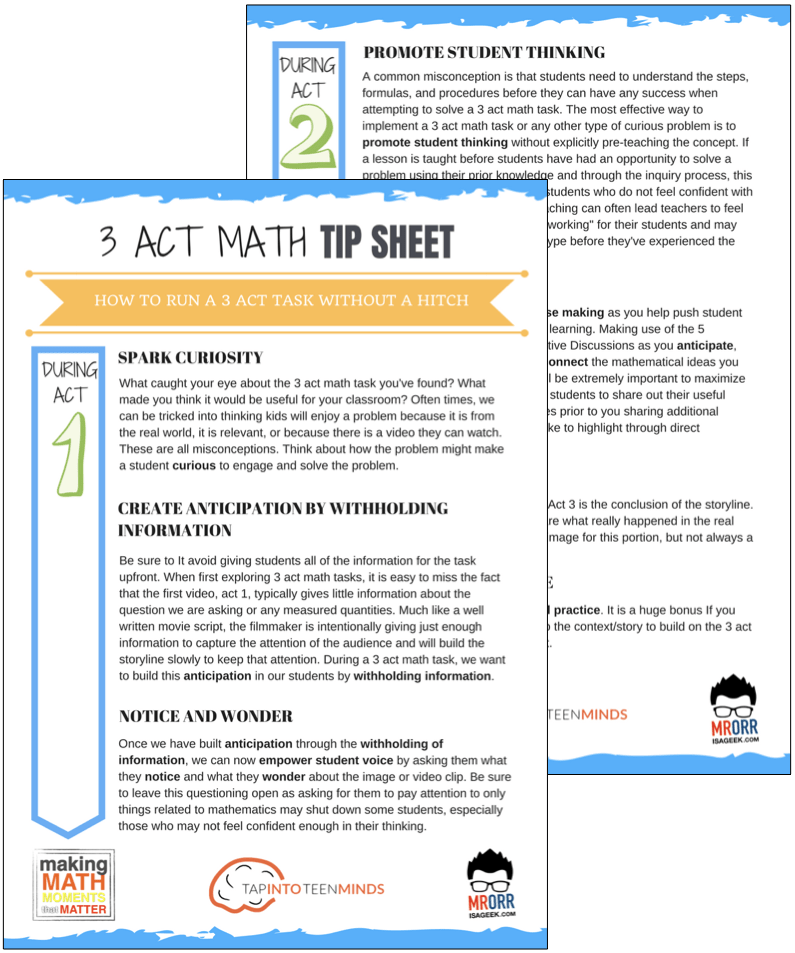
DOWNLOAD THE 3 ACT MATH TASK TIP SHEET SO THEY RUN WITHOUT A HITCH!
Download the 2-page printable 3 Act Math Tip Sheet to ensure that you have the best start to your journey using 3 Act math Tasks to spark curiosity and fuel sense making in your math classroom!
LESSONS TO MAKE MATH MOMENTS
Each lesson consists of:
Each Make Math Moments Problem Based Lesson consists of a Teacher Guide to lead you step-by-step through the planning process to ensure your lesson runs without a hitch!
Each Teacher Guide consists of:
- Intentionality of the lesson;
- A step-by-step walk through of each phase of the lesson;
- Visuals, animations, and videos unpacking big ideas, strategies, and models we intend to emerge during the lesson;
- Sample student approaches to assist in anticipating what your students might do;
- Resources and downloads including Keynote, Powerpoint, Media Files, and Teacher Guide printable PDF; and,
- Much more!
Each Make Math Moments Problem Based Lesson begins with a story, visual, video, or other method to Spark Curiosity through context.
Students will often Notice and Wonder before making an estimate to draw them in and invest in the problem.
After student voice has been heard and acknowledged, we will set students off on a Productive Struggle via a prompt related to the Spark context.
These prompts are given each lesson with the following conditions:
- No calculators are to be used; and,
- Students are to focus on how they can convince their math community that their solution is valid.
Students are left to engage in a productive struggle as the facilitator circulates to observe and engage in conversation as a means of assessing formatively.
The facilitator is instructed through the Teacher Guide on what specific strategies and models could be used to make connections and consolidate the learning from the lesson.
Often times, animations and walk through videos are provided in the Teacher Guide to assist with planning and delivering the consolidation.
A review image, video, or animation is provided as a conclusion to the task from the lesson.
While this might feel like a natural ending to the context students have been exploring, it is just the beginning as we look to leverage this context via extensions and additional lessons to dig deeper.
At the end of each lesson, consolidation prompts and/or extensions are crafted for students to purposefully practice and demonstrate their current understanding.
Facilitators are encouraged to collect these consolidation prompts as a means to engage in the assessment process and inform next moves for instruction.
In multi-day units of study, Math Talks are crafted to help build on the thinking from the previous day and build towards the next step in the developmental progression of the concept(s) we are exploring.
Each Math Talk is constructed as a string of related problems that build with intentionality to emerge specific big ideas, strategies, and mathematical models.
Make Math Moments Problem Based Lessons and Day 1 Teacher Guides are openly available for you to leverage and use with your students without becoming a Make Math Moments Academy Member.
Use our OPEN ACCESS multi-day problem based units!
Make Math Moments Problem Based Lessons and Day 1 Teacher Guides are openly available for you to leverage and use with your students without becoming a Make Math Moments Academy Member.

Partitive Division Resulting in a Fraction
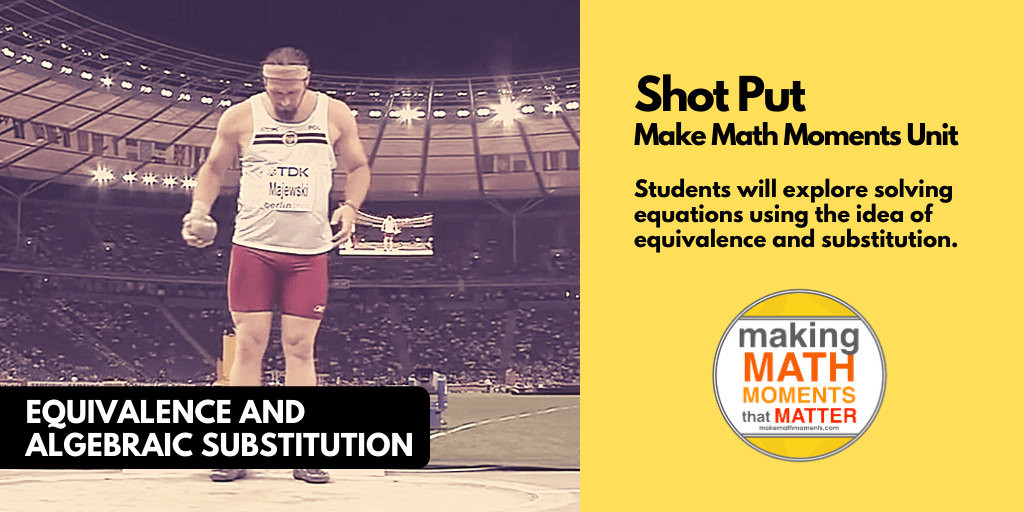
Equivalence and Algebraic Substitution
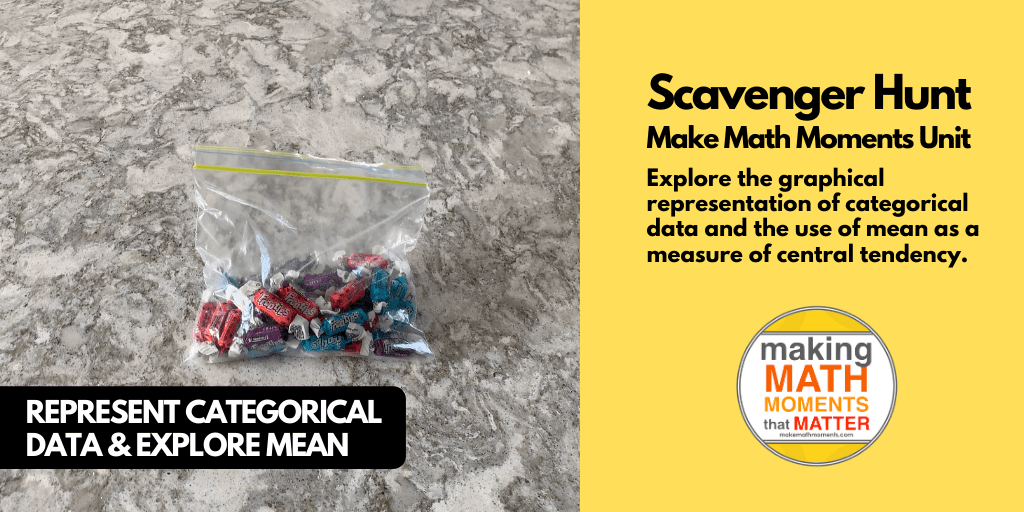
Represent Categorical Data & Explore Mean
Downloadable resources including blackline masters, handouts, printable Tips Sheets, slide shows, and media files do require a Make Math Moments Academy Membership.
ONLINE WORKSHOP REGISTRATION
Pedagogically aligned for teachers of K through Grade 12 with content specific examples from Grades 3 through Grade 10.
In our self-paced, 12-week Online Workshop, you'll learn how to craft new and transform your current lessons to Spark Curiosity, Fuel Sense Making, and Ignite Your Teacher Moves to promote resilient problem solvers.
0 Comments