
Episode #497: Zak Champagne: Creating Curious Kids in the Math Classroom
LISTEN NOW HERE...




WATCH NOW...
In this episode, Jon Orr and Zak Champagne, author of Curious Kids in the Math Classroom, explore how small shifts in classroom practice can foster authentic curiosity. They discuss creating safe spaces, modeling genuine curiosity, using cliffhangers, and adapting the curriculum you already have.
In this episode, you'll explore:
- Why curiosity is something we can foster rather than force
- How repeated moments of curiosity can shape students' relationship with mathematics
- Why authentic teacher curiosity matters more than manufactured “wonder”
- How classroom community creates the safety students need to share unfinished ideas
- How cliffhangers and uncertainty can invite students into mathematical thinking
- Simple ways to adapt existing math tasks without replacing your curriculum
- Why fostering curiosity is a long game, not a checklist of strategies
- How small, sustainable changes can transform classroom experiences over time
Don't try to overhaul every lesson. Choose one small move that creates a little more room for students to wonder, ask questions, or explore an unfinished idea—and keep building from there.
Attention District Math Leaders:
Register for the 2026 Make Math Moments Virtual Summit
K-12 Math Leaders: Download our free Math Coherence Compass to help your teammates, system leaders, and educators create aligned instructional practices—without adding another initiative.
K-12 Math Leaders: Not sure what matters most when designing math improvement plans? Take this assessment and get a free customized report: https://makemathmoments.com/grow/
K-12 Math Leaders: Ready to design your math improvement plan with guidance, support and using structure? Learn how to partner with us and follow our 4 stage process. https://growyourmathprogram.com
Looking to supplement your curriculum with problem based lessons and units? Make Math Moments Problem Based Lessons & Units
Be Our Next Podcast Guest!
Join as an Interview Guest or on a Mentoring Moment Call
Apply to be a Featured Interview Guest
It will take less than two (2) minutes to book your Math Mentoring Moment call.
Book a Mentoring Moment Coaching Call
Take two (2) minutes to book your Math Mentoring Moment call and let's work together to shake that math pebble out of your shoe!
Are You an Official Math Moment Maker?
Ensure that you follow, rate and review on Apple Podcasts, Spotify and other platforms to show your support and ensure other math educators can find the show.



FULL TRANSCRIPT
Jon Orr: So, Zach, welcome to the Make Math Moments That Matter podcast. It's been some time, you know, we've always had you on the list to bring on and it's time. So welcome.
Zak: Let's go. Yeah, thanks so much for having me. It's a real pleasure to be here.
Jon Orr: Awesome, awesome. So the question that we've asked every single guest since the beginning, and this is episode four hundred and ninety nine, maybe, is basically what is your math moment? And so let me just frame this for you. So math moment is like think about something from your past, something that's like this moment has stuck with you. And when you think about math class, like when someone says math or math class, sometimes or I guess often I still 'cause this still happens to me that I get a flash. It's like a flash of like this moment in time that has stuck with me and either defined me in a positive way or maybe in a negative way, or maybe it was negative and it helped me think about it, or positive and it helped me think about it differently. But when we say math class, something pops in your mind. Like you can't help it that in a way, right? Like you can't help thinking this moment. What's that moment for you?
Zak: Okay, we're gonna go back to tenth grade. I was in Orange Park, Florida, Orange Park High School. And I was the kid who I was sort of like I had really no feelings about math. I was fine. I was it was good at it. I didn't love it, I didn't hate it. It just I was just it was always just kinda there. And in tenth grade I finished algebra two. So I had I was a little early on the cycle and I went in to meet with my guidance counselor and I still remember her, she said Zach, you're at the moment now where you have completed your high school requirements for math. You don't have to take any more math in high school. You can go on and take I think she probably recommended pre-calculus or something. This was the mid nineties, so there wasn't the race to calculus that we see now. Anyway, the point is she said to me, you can be done or you can go on. And like any good tenth grader, I was like, I'm done. Like what I don't want to take any more math classes.
And I think that really so, you know, I did not go on and do anything else in math in high school. I took philosophy instead for two years, which was really fun. But then I got into college and, you know, I had to like I hadn't done any math for two years, right? And so that was a real that was a real defining moment for me that like someone gave me this out and I took it. And then, you know, later on math became my profession, which is kind of ironic I think.
Jon Orr: Right. Now thinking about that moment, like what like how does that how does that or did that or what does it look like now in terms of what you think about for teaching and teaching students and how did that influence you and how you teach today?
Zak: Yeah, it's a great question. I, you know, I went on and graduated in the late 90s from college and started teaching in a fifth grade classroom. And I, you know, mimicked exactly what I thought I remembered from school, right? About halfway through that year, Marita Ng, who became one of my lifelong mentors and friends, handed me the Investigations in Number, Data and Space curriculum. At the time, John, this was in the States, this was what we called a reform based math curriculum, right? This was like the very different from the way that I learned and I thought mathematics should be taught. And that curriculum and that in interactions with Marita changed my trajectory. I completely rethought the way that I approached the teaching and learning of mathematics and came to understand that kids show up with really important math ideas. And you know, my job was to sort of create experiences where they could explore those and deepen those and play with those and be a part of that. And so because I sort of had that break of didn't not learn math and had to relearn it again in college, I started out in a way that was very traditional and quickly was lucky to be handed that program and interact with so many amazing people that helped me understand and think differently about math.
Jon Orr: Awesome. Awesome. Now obviously that I'm sure that moment is part of it, you know, it inspired you to shift teaching or from the way that you first started, but then also it's got to be I got to assume that it's a huge part also of why you've written, you know, your book. You're that you're you're probably, you know, there's been a long time coming, Curious Kids in the Math Classroom, which we do want to unpack here today. And thinking about why why do we want curious kids in our classrooms? What do we do? All of those, you know, great, great things that we want. Like, I guess what like what said like I gotta write a book about this? Because it's like I was thinking it was like there you could have been a written about engagement. You could have written about mathematical discourse. You could've been thinking about just thinking in general. But why curiosity? Like what is it about that that we really need to like grapple with in terms of our classroom?
Zak: Yeah. Yeah. I think, man, this is there's a lot to unpack here. But, you know, for me, I think if you ask most teachers today, if you ask them if you want your kids to be curious, the answer to that question is usually a resounding yes, right? And and let's be clear, like kids show up curious, right? Formal schooling squashes it a lot of times, right? So I don't wanna I don't I don't think I can make you curious. I think I can help create an environment that can foster your curiosity, right? So I think most teachers want this, but I think we're backed up against a system that actively works against that. Right. And we don't need to unpack all the reasons why. We all know the tests, the curriculum, the scope and sequence, the pacing guide, all that stuff has an effect on teachers that really feels like we don't have time to do to foster curiosity, right?
And so what I wanted to do was provide lots of little things teachers can try. In the book, I call them Curiosity Practices. They're just one thing you can try right now to really go do something a little bit differently today that will provide some space for curiosity to thrive, curiosity to exist. And honestly, the other thing I wanted to do was I this is a little behind the scenes here. What I really wanted to write was a book like on like a year in the life. Like I wanted to tell you what it's really like to be a teacher from day one to day one eighty and just kind of like journal through all of that. And you know, I have all, you know, I was doing all this work at the time and was writing a lot. And so I wanted to do that. You know, I was counseled out of the fact that that probably, you know, someone doesn't want to read my diary, I don't think. But anyway, so what I ended up doing was each of the chapters of the book starts out with a story from my classroom because I wanted to tell some of those stories. I wanted to tell the times I failed, right? I wanted to tell the times that things were going well. And so I wanted to center it around those stories. And then from those stories pull out some of the practices that teachers can try to foster curiosity.
Jon Orr: Yeah. Awesome. Awesome. You know, and I it what you said earlier about like creating an environment for kids to be curious. And then you mentioned, you know, you I think either you hinted at something there about like that that triggered a memory in recent memory, I just had a conversation with Peter Liljedahl and we were talking about states versus traits. And a lot of times when we think about traits of us human beings and then sometimes we have traits, but then sometimes we're in a state. And sometimes we confuse the two because I'm here in this state doesn't necessarily mean I always have that trait. And so I guess my wonder is do you believe that curiosity is it a state that we can be in, or is that a trait that follows us wherever we go?
Zak: Mm. Yeah. I love this nuance. I love this question so much. I one have never thought about it. So I'm gonna go with my gut here, right? I think, and there is some cognitive science to suggest that I think we're born curious animals, right? Like when you're really young, you know, kids do all kinds of things because they want to know what's gonna happen, right? I always use the example of like the kid, my kid in particular, like at the high chair, would just like drop a P off the side. Every like over and over and over again. And I think they were doing that to just make sure it was going to fall to the ground every time, right? But once they were two years old, they didn't need to drop it anymore because they weren't curious what was going to happen with that P when they dropped it off the high chair, right? They knew it was going to go down.
So I think we are born into a we have a trait of curiosity. And again, sort of we know this that over time humans become less curious. Now and I say that cautiously and the fact that, like, we don't need to test gravity anymore, right? We might find other things we're curious about, but we have learned some things that we don't need to do anymore. So I think it's a trait. However, I really believe that when we can get kids in a state of curiosity, this is what happens. The more curious we become, the more farther down a rabbit hole I go with something I've been thinking about, the more questions I start to ask. And I think it then can become a trait again. When we allow ourselves to exist in states of curiosity, we do it so much that we start to seek it out. We start to look for moments where I can dig a little deeper or ask another question or push like push a little bit into a space of debate, maybe even like, wait, why do you think that? Right. It's got because now I'm curious. So I think it and maybe this is with all things, but like the more you do it, the more it's gonna become a trait. That's where I'm that's where I'm living right now.
Jon Orr: Totally. That's exactly the way I was viewing it as well, is that because and especially because it's subject or context specific. I can be I can be way more curious in say arts or, you know, or this one very particular topic that I've been studying on YouTube and I could just go down the rabbit hole there 'cause I just want to keep being more I have more curiosity and more curiosity, but doesn't mean I'm I'm a curious or I have a strength in curiosity in another area. But I also I also completely agree with you based on repeated behavior and repeated action, that we could develop habits that basically define us as a trait. Right. So it's like the more I do this, the more actions I've repeatedly shown to myself, therefore I've now adopted it as part of my personality, and then isn't that a trait? Right. So like the more which means as teachers, the more opportunity we can do to create environments where students act in a state of curiosity, then the repeated nature of that over and over again, we can help we can help bring back the I have a trait of curiosity in math class.
Zak: One hundred percent. One hundred percent. Yeah. You know what else is interesting about this is that, you know, I talked with Liesl McConchie a lot in the beginning of this book when I was writing the book, I read a lot of the cognitive science work around like what's happening in our brain. I don't pretend to show up as an expert in that, but one of the things that stuck with me was that when Liesl talks about being when you're in a state of curiosity, what's happening is your brain is feeding you dopamine. Like you're actually happy because you're you're curious. You want to figure something out and you're gonna you have more of a drive, you're more motivated to keep working on it when you're curious about something. Now, here's where it got where it got interesting for me. The minute you find out the answer or you solve this curiosity, dopamine stops. You're not in that, you're not getting fed dopamine anymore. And so what happens, I think, if we think about our brain, when I finish that, I think, well, I want to do that again. Let me what what else can I be curious about now? I want to get back in that state where my brain's feed dopamine and I'm feeling good again. So, like, I think there's probably some cognitive science to support this is what we're feeling and talking about, right?
Jon Orr: For sure. I'm I'm sure there is. We'll we'll make a little note here to kind of go and do a fact check on us.
Zak: Please do, please do.
Jon Orr: Now I'm I'm also curious about your opinion on on this this part of curiosity. 'Cause I think I think curiosity can be masked depending on who's looking and what that really means. And what I really mean by that is like sometimes we can dress curiosity up as a teacher. By all by kind of like playing the part, which means like I, you know, I I've performed this, I've created something mysterious, I've withheld information. This is something that, you know, I used to do all the time in my class. Like I, you know, Dan Meyer is like you can always add, but you can't subtract. So let's pull this stuff away. Let's create this state of anticipation. But then like where does where does the curiosity get transferred? You know what I mean? Because I can be curious and I can try to create as many states at that I can, but but where like in your opinion, where does the where does that transfer to the kid who's actually curious? Like is it fake curiosity because we created the the environment? Or like when when does the kid like what does it look like, I guess, when the kid and our students are actually curious in the moment?
Zak: Yeah, this is this is so fun. So I think one of the things I was very cautious of in this book, in the writing of this book, is that like I didn't want curiosity to become a checklist. So we do this in education a lot. Someone writes a book and the five practices, like we all of sudden it's like you gotta do these five things, and if you do these five things, this is what's gonna happen.
Jon Orr: Check, check, check, check.
Zak: Yeah. And curiosity doesn't work like that. And and what I what I how I think it works and how it worked for me was like it's a belief we have to put forward in the classroom and it takes sometimes the whole year for certain kids to actually believe that they can show up and really be curious. They're unpacking all kinds of math trauma and math baggage when they come to class. So having said that, I don't want it to become a checklist. In the same sense, it's repeat you have to do this repeatedly. You have to show up as a curious learner yourself. And John, you said it, which is this can't be fake. Kids sniff that out in a second. The like, Hmm, I wonder what would happen if I added 37 and 45. They're like, bro, you know the answer to that, right? Like you don't show up with fake curiosity. You really need to show up as a curious learner.
And so the ways that I always did that was like showing up, coming alongside a young person when they were trying to solve a problem and just asking questions. I don't know what they're doing. I mean, I've I've done a lot of work in math ed, and I think I might have some ideas where they're going, but just showing up maybe I've been being like, wait, what are you doing right here? Tell me more about what you're doing. That's a way I can show up and be authentically curious to my students, right? And showing them that when I model my own curiosity, this is a space where we all are going to show up curious, right? And the more I did that, the more they would do that to their classmates. They would, you know, compare their strategies and be like, wait, what how are you doing it that way? Right. So it's like this. I I call it in the last chapter of the book, I call it the long game. It's playing the long game. This isn't something that you can just try a few things and boom, we now have curious classrooms, right? It's it's it's a way that we build classrooms that center students and center their humanity. And then all of us showing up as authentically curious about all kinds of things.
Jon Orr: Right. Now, since I guess we're talking like look for like look for is like what does that look like in the classroom? The many people who are listening to this podcast are in positions of leadership. Math coaches, math coordinators, who are trying to shift instruction and support the hardworking educators to shift some instruction towards more of the you know, effective teaching practices or practices like you're in your book. Like what what does like if we're if we're actually strict trying to say that's going to like elements of this book, we're gonna pick one, we're gonna pick two to focus on. What does it look like in the classroom for us to know that we've made a dent in creating more curious kids in our classrooms? Like what does that look like?
Zak: Yeah. I think it's so from the leadership standpoint, I think it starts and I would say if you're gonna pick something and this this crosses all disciplines, but I think the first thing you can do is work with your teachers on creating classroom community and safe spaces, right? That's gonna benefit them in all areas or all content areas, but no one's gonna show up and feel like they can be curious and share vulnerable ideas and ask questions that might seem silly, but they're not going do that they don't feel safe. And so I say it starts with helping teachers create classroom community where they feel like they're where kids feel like they're a part of something, where they're connected to something, where kids feel like they're that they can show up as their true selves. And then that's gonna be a safe space for them to be vulnerable and to share unfinished ideas. So that's big work.
One of the one of the things I always suggest to math coaches or leaders, if you really want to like foster curiosity at the school-based level, just throw up a curiosity board in the teacher's lounge and let people post questions up there. You model your own curiosities of things you're curious about. These don't have to be about education at all. Just like, you know, I wonder how long whales can stay under water. I don't know what it is. Whatever you're curious about right then, post those things up there. Model that, like be, you know, being uncertain, not knowing things, is is in fact not a flaw. It's it's a it's a characteristic that we wanna we wanna thrive in. We wanna live in that uncertainty. So there's ways that we can model it at the leadership level.
I also always, always suggest to leaders, when you have the privilege to go into a teacher's classroom and watch them in all of their brilliance, before you do that, ask them, what do you what should I look for today? What's something I can watch out for in your teaching, right? That's modeling my own curiosity. Like I wanna I wanna I wanna know what you want me to do and I wanna learn more about your practice, right? So showing up as a curious observer as a as a leader is really important.
Jon Orr: Yeah, love it. Love it. I wanna go back to something when you were talking about the you know, the dopamine and and specifically when you said like when when a curiosity is solved, you like it's it's you know, the dopamine stops, right? It's like it's like there's no more of that and then therefore like talk to me about the importance then of cliffhangers, you know, like like part of your book, you've got a chapter in your book on cliffhangers and the importance of that in math class, which sounds you know, this is something that that that Kyle and I would put into with the lessons that we created. But I mean but I mean, tell me what that means to you in math class.
Zak: Yeah. Yeah. So we're gonna, you know, I got this well, the term cliffhanger is used all over, right? TV, books, movies, TV, they have cliffhangers because they wanna keep you keep you watching. It's a trait, you know, sort of like this thing that we do to keep people engaged in the work. This book that I read by Susan Engel called The Hungry Mind, it wasn't about a book about schools per se. It was a book about curiosity, about what happens in our brains. And she did have a section on schools and she talked about this idea about curricula built on cliffhangers. And I liked this so much. Now she was talking more about the like, okay, guys, when we get back from lunch, we're gonna find out whatever the thing is. Or when you get back, when we get back from recess, we're gonna solve this mystery. And so when kids come back from recess, they're excited to figure it out. And that's sort of like the example she gave in there.
But I thought a lot about you mentioned Dan already about Dan's work with Three Act Tasks. I thought a lot about slow reveal graphs, Jenna's work with slow reveal graphs. I thought a lot about the any kind of routine that we're doing that is hiding something from kids. And those are the cliffhangers I think that can get kids curious. Now, I talked I write about this in the book too, but I also I think there are times where that falls flat, right? I tried it a lot of times where I would just hide some information in a word problem and kids were like, I don't care that you hid that, right? And I thought it was gonna be like, ooh, I gotta find out like how many leaders are actually in the thing or whatever it is. So it doesn't always work.
But there are times I think that we can leverage cliffhangers to keep kids thinking, well, I have this question now. And as we know from like three act tasks, if I have a question, I'm gonna be more willing to try and figure that out. Right. So now I have some autonomy in what I'm doing. So if we us agree on our main question in a three-act task, that's a classroom question. That's not a question the teacher gave to us. That was our question. So we're gonna go try and figure that out. We're gonna spend a little more time trying to resolve our uncertainty, right? And that's the definition of curiosity is a human's innate desire to resolve uncertainty. We have this innate desire to resolve it. And so if we can provide uncertainty in a classroom with a cliffhanger, with something that's missing, with something that I want to figure out, kids are going to be driven to try to resolve that.
Now, there is a big caveat in this, and that is that uncertainty, one, you gotta have a classroom where uncertainty can feel safe. So we go back to classroom community. And two, you you got you this can't go on too long, right? You don't you humans don't want to stay in a state of uncertainty for too long because one, the dopamine stops. And two, that quickly turns to frustration if if I don't get some resolution or if I don't make some progress on that path. And so the cliffhanger itself is the beginning, but you as the teacher have to then go in and really, you know, use all that sort of like
Jon Orr: To close the gap.
Zak: Yeah, close the gap. Help help kids move along that progression. Watch for those moments where you see a kid becoming frustrated because, you know, ambiguity can be scary sometimes, right? Like we we want to resolve that ambiguity that we give them in these these kinds of tasks. And we got to help them on that way. So it's not just cliffhanger piece out. I'm gonna go sit at my desk for a while, right? You gotta get in there and really do that work.
Jon Orr: Yeah. Yeah. Yeah. And especially especially if you're just beginning, you know, to to introduce like how do I introduce a cliffhanger in my lessons, my from my experience of of doing that over the years was you got pushback early on from the kids themselves, right? It's especially especially the ones who have say shown significant success in past years following the ma well, I'm gonna use air quotes here. The math game, right? The math game. Hey, you lecture, I take great notes, I memorize, I do great on the tests. How you're changing the game on me now. And so wait a minute, I don't really want to be curious or I don't really want this cliffhanger. Just tell me the answer so I can copy it down and I can move on. And that's sometimes the when you first start you experience that and you're like, I'm on the wrong path. I gotta go back or I gotta shift.
Zak: Yeah, you know, I w yeah, and those same kids a lot of times when you get to the to the resolution of a three act task and sometimes the answer is not the one that the math model predicts it's gonna be, they're even more frustrated. They're like, I crunched the numbers, I followed the rules and now you're telling me that's not the answer. And so that that can be really frustrating for sure.
Jon Orr: For sure. Right, right. Yeah. Right. For sure. Yeah, for sure.
Jon Orr: Now talk to us a little bit about the what what we could do when we go to adapt tasks, adapt lessons. Because because when I think back to the way I adapted my resources that I had at my disposal, I had I wasn't doing it probably in my first year. You know, I wasn't doing it, you know, because I wasn't comfortable with my one my mathematics, one the kids, one you know or no, I guess two, three. Three, the, you know, it's just the dynamics, the progressions, the the grade level. And and I felt like I got better at that over years of adapting and knowing when to adapt tasks. So there's that aspect of like confidence, but also experience. There's there's another aspect that I feel like I hear a lot lately, which is many teachers, especially in elementary, have curriculums that they have to follow with fidelity. Right. So this is this buzzword that's been floating around for the last couple of years. And it's and like you said before, there's there should be some nuance in there. But I think what happens is there's a lot of checkboxes that are happening. But it's like, okay, I got this curriculum I gotta follow because I'm teaching the fifth grade or the fourth grade, but and so are three to four other people in my building. How do I modify how do I think about adapting tasks to be more curious? Is it with just mean make sure we have a curriculum that builds that in, or is it like what are we doing? Like how do I really grapple with that like with with that kind of struggle that that becomes real?
Zak: So glad you asked this question. 'Cause the the the easy answers that that no one wants to hear are like, yeah, get a better curriculum. And the fifth grade teacher down the hall is like, what are you talking that's I've I've no control over what curriculum's handed to me, right? So let's let's get into the nuance here. So you got let let's let's take sort of I I hate to say it's what I would call maybe worst case scenario. You've got a traditional curriculum you've been handed, you've got a pacing guide you gotta follow, you got actual administrators coming in to check and make sure you're on the right page on the right day. Because and again, I I I am not knocking administrators. They're doing this because they believe that's like what's gonna make you sort of access make it an equitable school, right? All my teachers need to be doing same thing. So kids in every class get the same experience.
What I would say, when we think about adapting those tasks, I would say just use the problem you have to use to kick off your lesson or whatever it is, and just peel some stuff back. Right. You're gonna use the exact same problem that everybody else is doing and just start without a question, a questionless word problem, right? We're gonna give them the word problem and it's gonna be, you know, Mr. Zach has twelve crayons and Miss Claire has nine crayons. And then just ask like, what do you wonder about this? What do you notice about this? So I haven't asked a question yet. We don't know what we're gonna have to do mathematically with that, but that gets kids a little curious. It gets them a little interested in, okay, whatever. This context is kind of dumb, but like at least there's something for me to think about.
So I say I would say like peel just a little bit back from it. Let them kind of lean in and think a little bit about it, but you're still using the resource you have to use. You're using it in a way though that can spark a little more curiosity, right? You know, Brian Bush years ago talked about numberless word problems. Take the numbers out, right? Just tell a story. And then kids are thinking they start to think about the context. So I think there are ways that you can slowly, you can dial stuff back, talking to go, we'll go back to Dan again, sort of like peel as much back as you can from the problem you have to do. And slowly give it to them, slowly reveal it as you go.
Now, there's also a huge caveat with like asking teachers to do one more thing is is an unfair ask. They're already asked to do too much. So I get it that like adapting every task every day is not a fair ask, but maybe it's just once a week, maybe it's twice a week. And the more you do it, the better you'll get at it, the better and then faster you can do it, and the more you'll know what what to dial back and how to how to reveal a little bit more at a time.
Jon Orr: Absolutely. Yeah. I think that that would be a recommendation I would make is that I think a lot of times we and I've said this you know a lot and it is that we we often you know, you might be listening to this or you might have seen someone who is exemplifying teaching with curiosity very well. And you're like, I want to be able to do that. Or all the things we're talking about here is like, I want to completely overhaul what I'm doing. But then we have to like take a little bit of grace and say, you're comparing your, you know, your bottom eighty percent of what you're doing to someone else's top twenty. Right. And you're thinking you're thinking it's a all shift. And then the other part that I always try to think about is that what you're reading, like like when you read Zach's book, you're reading Zac like you're saying, a diary in a year, but really this is a diary, probably I'm gonna make an assumption. This is a the diary in the the forty eight years in education somewhere, because you were, you know, a kid somewhere, teach you know, in mathematics where it's this long of experience that led you to today's moment around your today's thinking and your today's practice in the math. But we think we need to jump there right away, knowing not understanding that it took us a lot of different trials and errors to like go, this is where we landed now. But like we have to like take a step back and go, that's real. Like we have to make sure we understand that.
Zak: Yeah. It's it's a it's it's a both and in this situation, right? It's acknowledging that again, it's a for teachers, it's a long game, right? We're we you got you you gotta keep working at this, you gotta keep trying things, and you don't have to do it all right now, right? So acknowledging that you're not gonna be your your best self every day and all of that, that giving yourself grace, so important. Acknowledging that you have to take the time to do it, but at the same time, just trying one thing here and there, just try something. Give a little bit more time and space for the the maybe it's not curiosity that you want to focus on. Maybe you're focusing on asking better questions or fostering discourse in your classroom. Just try one little thing and it's gonna, it's gonna fail and it's gonna be awful at times. But the next time you try it, you're gonna do it a little bit differently. But you don't have to try and throw everything out and try the please don't ever think you have to throw everything away and try and like restart that as this perfect person you want to be, right? Yeah.
Jon Orr: Right. Yeah. Totally. Yeah. Yeah. So the you know, the recommendation of doing one thing like one of my goals for the last ten years I was teaching was one memorable moment each day. But I taught three different sections of three different classes and I saw, you know, a hundred kids. So I wasn't doing that across all three classes. It was like the ninth grade class today got the memorable moment. You know, and then then it was like 'cause that's the reality of how much we could actually put into lesson design and assessment and all the things that come with it. So one thing one day is is sometimes a good starting spot. And if it is if if if it is like this small adjustment to my existing curriculum, then that can be a great starting move. But you're when you say when I say starting move, what you're really saying is I'm making commitment to myself to going down that pathway. And therefore, if I commit daily or if I commit weekly, then three years from now I will look completely different and my classroom will look and my students will have a good different experience because I made that commitment today.
Zak: Yes. Yes. Totally. Gosh. I mean, I feel like I feel like you're my my counselor today. I love hearing that. Like that's exactly what we all need to hear in this moment, right? Like as a human being, just try and do something today that makes you a little bit better. And you're not gonna be perfect today and you're not gonna be perfect in three years, but you're gonna be in a different spot if you continue to do those things. So, so important. Yeah, I love it, man.
Jon Orr: Love it. Yeah. To close out today, what's I know, I know. What's
Zak: No, I don't want to do that. Let's keep going. Okay.
Jon Orr: what's one question about the work you're you know you're currently doing around curiosity that you just don't have an answer yet to. That you're still working on, you know, like I'm you're s it's still a work in progress.
Zak: Yeah. Yeah. I think it is we we kind of talked a little bit about this, but I think it is still like, how do we as teachers, how do we build that space where curiosity can thrive when the reality is all of these things are that that we talked about earlier. I'm not gonna name them again, but also kids are bringing math trauma, math baggage into the classroom. And every year, it's the beginning of the school year, while when we're recording this for a lot of folks, and you're trying to start that build that space. You're trying to build it all. And I don't know how to like do that at scale. I don't know how to really do that outside of like me closing my door and going and do it in my space. So I think a lot about like how do we help teachers build the space where they want kids to be learning when there are all these other constraints put upon them. And so for me it is curiosity. For like other people might be some other initiative they're trying to do, but like there's it's so hard in the constraints that we're given to do some of the things that we want to do. And it really it feels so big and hard to me to even think about it at scale.
Jon Orr: Yeah, for sure, for sure. Zach, what's one if if you could only leave one takeaway, one thought, one important idea to for the for the math educator listening right now as they they wrap up this episode, what would be that one thing?
Zak: This work starts and ends with centering the humanity of the young people in your room. You it is a gift to be alongside them as they learn. If you if you if you can start and build a space where kids' experiences, kids' lives, kids the the the baggage they bring in the door, if that is at the center of everything you do and you always come back to that, I believe any initiative or anything you're trying to do can grow can only grow from that. It has to begin with the young people in the room that are in front of you and their experiences and the and the ideas that they bring to the table.
Jon Orr: Curious Kids in the Math Classroom by Zach Champagne. There's a link somewhere around this, whether wherever you're watching or listening, you go ahead and click it. You can get a copy. Zach, thanks for joining us here today at the Making Math Moments That Matter podcast. We look forward to connecting and and meeting up with you soon and especially in person.
Zak: Can't wait.
Jon Orr: Where can listeners now go to learn a little more about the work you're doing?
Zak: Yeah, you know, you can check out the work that Mike and I do at Flynneducation.com. Always love working alongside my friend Mike Flynn. The book is available wherever you find your books, Curious Kids in the Math Classroom. I am also releasing a companion podcast that is called Curiosity Continued, 10 part limited series, only 10 episodes, one episode per chapter of the book, where I invite a guest on to talk about the content of that chapter. We got folks like Brittany Hege and Christopher Childs and Dan Meyer and Christopher Danielson, who wrote the forward. Claire Riddell, my wife and colleague. What a great crew of people that came on that podcast. So check that out wherever you get your podcast. You can watch it on YouTube. I'm on Instagram at ZachChampMath. I play around on LinkedIn sometimes. I miss Twitter. I wish I was there, but I I I don't find that space safe anymore. So no longer over there. But find me. I'd love to connect in person. Thanks again for having me, John. This is a real fun time.
Jon Orr: Thanks for sharing your insights with the Make Math Moments community.
Your Customized Improvement Plan For Your Math Classroom.
Take the 12 minute assessment and you'll get a free, customized plan to shape and grow the 6 parts of any strong mathematics classroom program.
District leader/math coach? Take the District Assessment
Thanks For Listening
- Book a Math Mentoring Moment
- Apply to be a Featured Interview Guest
- Leave a note in the comment section below.
- Share this show on Twitter, or Facebook.
To help out the show:
- Leave an honest review on iTunes. Your ratings and reviews really help and we read each one.
- Subscribe on iTunes, Google Play, and Spotify.
The Making Math Moments That Matter Podcast with Kyle Pearce & Jon Orr
Weekly interviews, strategy, and advice for building a math classroom that you wish you were in.
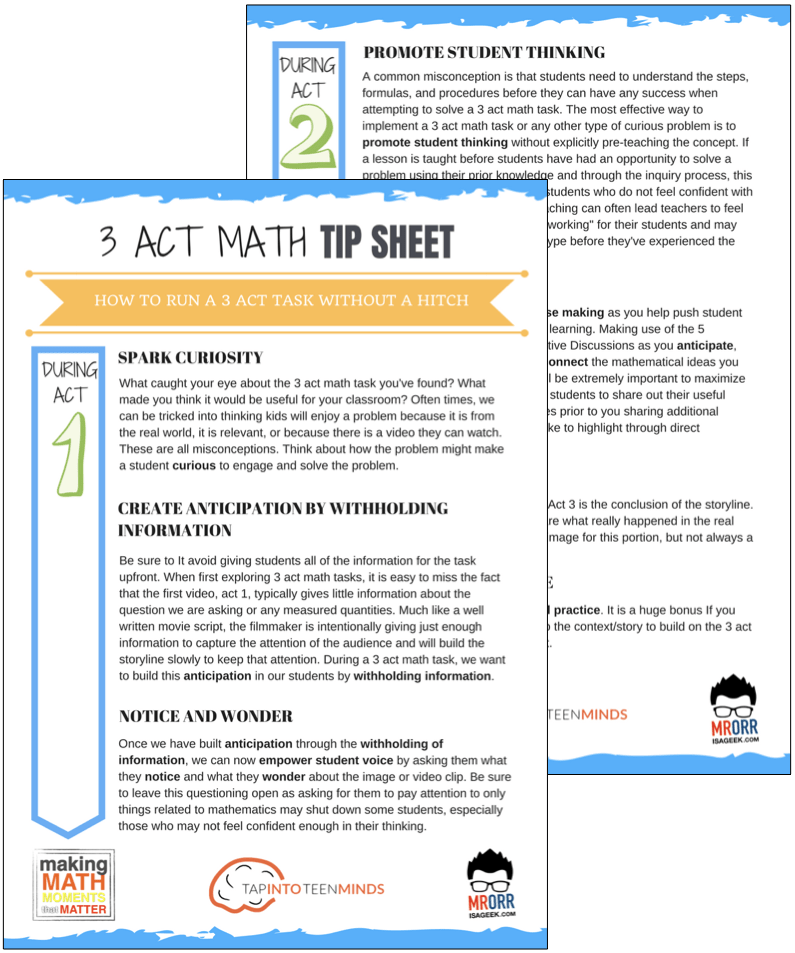
DOWNLOAD THE 3 ACT MATH TASK TIP SHEET SO THEY RUN WITHOUT A HITCH!
Download the 2-page printable 3 Act Math Tip Sheet to ensure that you have the best start to your journey using 3 Act math Tasks to spark curiosity and fuel sense making in your math classroom!
LESSONS TO MAKE MATH MOMENTS
Each lesson consists of:
Each Make Math Moments Problem Based Lesson consists of a Teacher Guide to lead you step-by-step through the planning process to ensure your lesson runs without a hitch!
Each Teacher Guide consists of:
- Intentionality of the lesson;
- A step-by-step walk through of each phase of the lesson;
- Visuals, animations, and videos unpacking big ideas, strategies, and models we intend to emerge during the lesson;
- Sample student approaches to assist in anticipating what your students might do;
- Resources and downloads including Keynote, Powerpoint, Media Files, and Teacher Guide printable PDF; and,
- Much more!
Each Make Math Moments Problem Based Lesson begins with a story, visual, video, or other method to Spark Curiosity through context.
Students will often Notice and Wonder before making an estimate to draw them in and invest in the problem.
After student voice has been heard and acknowledged, we will set students off on a Productive Struggle via a prompt related to the Spark context.
These prompts are given each lesson with the following conditions:
- No calculators are to be used; and,
- Students are to focus on how they can convince their math community that their solution is valid.
Students are left to engage in a productive struggle as the facilitator circulates to observe and engage in conversation as a means of assessing formatively.
The facilitator is instructed through the Teacher Guide on what specific strategies and models could be used to make connections and consolidate the learning from the lesson.
Often times, animations and walk through videos are provided in the Teacher Guide to assist with planning and delivering the consolidation.
A review image, video, or animation is provided as a conclusion to the task from the lesson.
While this might feel like a natural ending to the context students have been exploring, it is just the beginning as we look to leverage this context via extensions and additional lessons to dig deeper.
At the end of each lesson, consolidation prompts and/or extensions are crafted for students to purposefully practice and demonstrate their current understanding.
Facilitators are encouraged to collect these consolidation prompts as a means to engage in the assessment process and inform next moves for instruction.
In multi-day units of study, Math Talks are crafted to help build on the thinking from the previous day and build towards the next step in the developmental progression of the concept(s) we are exploring.
Each Math Talk is constructed as a string of related problems that build with intentionality to emerge specific big ideas, strategies, and mathematical models.
Make Math Moments Problem Based Lessons and Day 1 Teacher Guides are openly available for you to leverage and use with your students without becoming a Make Math Moments Academy Member.
Use our OPEN ACCESS multi-day problem based units!
Make Math Moments Problem Based Lessons and Day 1 Teacher Guides are openly available for you to leverage and use with your students without becoming a Make Math Moments Academy Member.
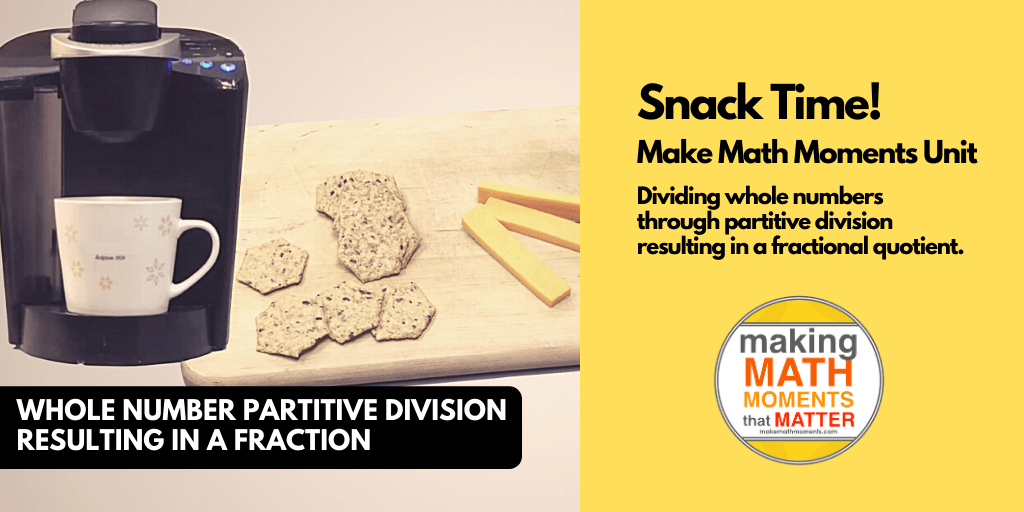
Partitive Division Resulting in a Fraction
Equivalence and Algebraic Substitution
Represent Categorical Data & Explore Mean
Downloadable resources including blackline masters, handouts, printable Tips Sheets, slide shows, and media files do require a Make Math Moments Academy Membership.
ONLINE WORKSHOP REGISTRATION

Pedagogically aligned for teachers of K through Grade 12 with content specific examples from Grades 3 through Grade 10.
In our self-paced, 12-week Online Workshop, you'll learn how to craft new and transform your current lessons to Spark Curiosity, Fuel Sense Making, and Ignite Your Teacher Moves to promote resilient problem solvers.
0 Comments