Episode #496: Math Wars: Why Conceptual vs. Procedural Is the Wrong Math Debate
LISTEN NOW HERE...



WATCH NOW...
In this episode, Jon Orr and Yvette Lehman explore what changes when we stop debating how math should be taught and start examining the knowledge students need to access today’s learning. Mathematics is cumulative, and those prerequisite ideas may be far more complex than the curriculum progression suggests.
In this episode, you'll explore:
- Why the conceptual-versus-procedural debate may be missing the bigger issue
- What it means for mathematics to be “ruthlessly cumulative”
- Why grade-level curriculum progressions don't always reveal true prerequisite knowledge
- How specialized content knowledge helps teachers respond to student misconceptions
- What multiplying fractions reveals about factoring, scaling, ratios, and proportional reasoning
- Why high-leverage visual models can help uncover the mathematics beneath an algorithm
- How teachers can build their mathematical knowledge one concept at a time
- Why strengthening teacher capacity needs to be a long-term system priority
Choose one concept you're teaching and look beneath the expectation: What does a student actually need to understand to access this idea? Try representing it with an area model, ratio table, or double number line and see what prerequisite ideas become visible.
Attention District Math Leaders:
K-12 Math Leaders: Download our free Math Coherence Compass to help your teammates, system leaders, and educators create aligned instructional practices—without adding another initiative.
K-12 Math Leaders: Not sure what matters most when designing math improvement plans? Take this assessment and get a free customized report: https://makemathmoments.com/grow/
K-12 Math Leaders: Ready to design your math improvement plan with guidance, support and using structure? Learn how to partner with us and follow our 4 stage process. https://growyourmathprogram.com
Looking to supplement your curriculum with problem based lessons and units? Make Math Moments Problem Based Lessons & Units
Be Our Next Podcast Guest!
Join as an Interview Guest or on a Mentoring Moment Call
Apply to be a Featured Interview Guest
It will take less than two (2) minutes to book your Math Mentoring Moment call.
Book a Mentoring Moment Coaching Call
Take two (2) minutes to book your Math Mentoring Moment call and let's work together to shake that math pebble out of your shoe!
Are You an Official Math Moment Maker?
Ensure that you follow, rate and review on Apple Podcasts, Spotify and other platforms to show your support and ensure other math educators can find the show.


FULL TRANSCRIPT
Yvette Lehman: On today's episode, John, we're gonna unpack an article that was actually shared with us by one of our district partners recently. Landed in our inbox and of course right away I was eager to dig in and I shared it amongst our team. The title of the article was The Two Sides in the Math War. The Two Sides in the Math Wars Are Fighting the Wrong Battle. And it was published on the 74 by Joel Rose. So of course the title right away caught my attention and I was eager to hear, you know, and when they talk about the two sides of the math wars, they're talking about people who are promoting a more conceptual approach versus a more traditional focus on the algorithm approach. And basically the article is saying like neither camp is going to, let's say, win this argument unless we get real about this other big underlying barrier to math achievement and positive outcomes.
Jon Orr: Yeah, because you can imagine that when you read the article, the two sides in the math wars are fighting the wrong battle. You're like, okay, so here's another article about saying there's no like two opposites like you got these two ends of this continuum or this spectrum, and there's the answer lies somewhere in the middle. And because I think that's what everyone when you hear about like traditional like rote memorization, traditional algorithm is what we should be teaching kids to streamline this thinking. And then we'll layer in problem solving later versus let's make sure that we understand the behaviors of the mathematics and layer in fluency and layer in problem. Like there's the two sides of this battle. And then most people say, well, okay, if I'm a reasonable teacher, then I'm going, I know there's somewhere in the middle that there's a blend here where we want to have automaticity. And we also want to build conceptually and we have to like how do we layer that in? But I think what and I know what this article is saying is it's not like going down that pathway. It's not like saying there's a middle ground here somewhere, let's figure this out. But it's saying like no matter what side you're on, or if you're in the middle, you're still focusing on the wrong thing.
Yvette Lehman: Right. And basically the barrier that they highlight is you have, let's say you're a fourth, fifth, sixth grade teacher, and you have twenty-five to thirty students sitting in front of you. You have one teacher, one lesson, and the lesson that day makes a lot of assumptions about the knowledge, skills, and understanding that the students need to bring to the table to be able to access that learning, whether through the algorithm or through a more conceptual approach.
Jon Orr: Say that again in easier words. My simple brain needs to hear it.
Yvette Lehman: A different way. Okay, so basically the idea is I'm showing up today to teach this grade five lesson, this grade six lesson. And I have my high quality instructional material, I'm following my pacing guide. And let's say I am going to approach it conceptually. That's the path that I'm taking. We're gonna start concrete, go to pictorial and abstract, we're gonna understand. But I still am building off of almost like a foundation of prior knowledge and the consolidation of big ideas that came before.
And I love, I had heard this reference before from Steven Pinker, but this idea that the math curriculum or math standards are ruthlessly cumulative. It's like as soon as you pull one piece of this Jenga tower that you're building, you have like a crack in your foundation that's going to be a barrier for accessing future learning.
Jon Orr: Okay. So so I think what you're saying is is that when I go to plan a lesson, and I think we all have to do this, right? Is like when I go to plan a lesson, there is a prerequisite knowledge we're starting with that my students have to have. Otherwise, because math is ruthlessly cumulative, that I'm relying on the fact that the sixth grade teacher did their job. I'm teaching seventh grade or I'm a ninth grade teacher teaching algebra. And I'm like, well, I know that they need these skills, or they taught this in this grade coming in, they should have that skill. And I just used air quotes there. But so I think when we plan lessons, we all have to do that at some point, because otherwise you're always just rewinding and going like, well, where do we start? And where do I where do I decide the line is drawn to say this is a prerequisite skill?
And I think I think that you when you think about these two sides, there's and I think this is the point I think maybe I want you to elaborate on is like when you if I'm teaching very conceptually and if I'm teaching procedurally, are is that is that baseline prerequisite the same thing on both sides?
Yvette Lehman: I love that question. So I okay, so I'm gonna tell you what I believe. And I can't confirm this for every single concept. But I often believe, and I believe this to be true, the standard algorithm originates from somewhere. It's based on relationships and behaviors of number and operations. And so to me, it's like it doesn't really matter. If I want to jump right to the algorithm and I want students to be successful with it, then I probably need to understand something about how it works, because otherwise how do I help students understand their misconceptions? So I guess in a short answer, I wanna say, I think if we were to lift the hood, there would probably be some of the same underlying prerequisite skills, whether I teach it conceptually or through the algorithm, because of course the algorithm is based on the behaviors of mathematics. It's like why it works.
Jon Orr: Right. Well, thinking about so thinking about two digit by two digit multiplication. It's like am I going to teach how to multiply two digit by two digit numbers that are two digits? Like and I'm gonna be like, okay, here we go. We're gonna teach it and I'm gonna teach it in a very traditional way. You're gonna stack some numbers and you're gonna carry some and you're gonna move this and you're gonna put a zero here and you're gonna say, carry this down. Like there is things going on in there that I think like, but when you think about that as a whole. Somebody's going to say, well, all you need to know to teach that lesson is how to multiply one digit numbers and add.
Yvette Lehman: Okay, so here's gonna be my pushback to that person. When I think about, and I reference this all the time, I think Deborah Ball's diagram of the mathematical knowledge required for teaching is so critical here because if I was looking for general content knowledge alone, I would say sure. But when it comes to specialized content knowledge for teaching, which is where I am responsible for helping somebody else understand how to do it and how to recognize when they've made a mistake or their answer is unreasonable. That line of thinking of all I need to do is multiply single digits by single digit falls apart. It might be enough for content knowledge for me to get the correct answer on that multiplication problem. But it won't be enough for me to help those who are struggling to understand or who are continuously making errors and not understanding why their answer is now unreasonable.
Jon Orr: Are you now in the conceptual land? Like you're sliding down the continuum, right?
Yvette Lehman: Right. And this is, I guess, why like there really isn't a debate between, you know, because when it comes to specialized content knowledge for teaching, where I'm trying to take every person in the room and help them be successful, I need to be prepared for a variety of misconceptions or gaps in learning that are preventing students from accessing that algorithm successfully. So I have specialized content knowledge requires conceptual understanding. Right. If I need to be able to help others understand, not just get the answer myself, which is that's general content knowledge. Okay.
Jon Orr: So so think about the two the we started this kind of thought exercise here with thinking about the assumptions we're making when we're planning our lessons. And we were saying, hey, if you're thinking about, you know 'cause I think the idea is like, well, which side has more thinking involved and more like understanding, right? 'Cause there's like it's like this is why I think people lean towards the traditional the algorithm because it's like I only need to know that I need to multiply one digit by one digit and add. But you're but we're saying is wait when you slide down the continuum, there's much more depth, which requires much more understanding on our part, but also on the kids' parts to get them to the floor to teach at the conceptual. So like this is where the article kind of like unpacks the battle, right? It's like saying like, look, you're thinking about it wrong because because if you're thinking about the assumptions you need to make on the traditional side, and then you're thinking about the assumptions you're making over here, both require important information that you're not planning for. Because if you're gonna do the conceptual, there's a whole bunch of stuff there that we have to really like assume kids already understand about maybe scaling numbers or factors of 10 or place value. Like there's a lot to unpack there, which you could argue is more to unpack on the conceptual side than just say, teaching a traditional approach for like a baseline. And so like the battle here isn't which side should you do? The battle here is really understanding the progression of ideas around multiplication. And that's where we miss our focus. It's like, let's not debate which side we should be on here. We should be really debating like, what are we doing to support these
Yvette Lehman: Do we understand the progression?
Jon Orr: I like a progression of ideas from addition into multiplication or like is that is that the actual progression. Hey, I'm multiplying or I'm adding, I'm multiplying? Well what comes before that? Well adding. Is that right? Like are we on
Yvette Lehman: And I think that's the point. Like to me, I think if we focused on how concepts progressed, we imagine we're all just unpacking. We're making sense of like how are students going to access this big idea today in today's lesson? What comes before it? What knowledge are we assuming? What skills are we assuming? It would probably silence some of the debate because it would reveal the necessity to address both sides. Right. And we would just getting to the heart of the problem, which is essentially we can't assume that everybody in the room sitting in front of us today is ready for this learning.
The one that I've been unpacking recently, it's just top of mind for me, is multiplying fractions. And this is where I'm gonna highlight the difference between what we're describing and where I was maybe five years ago. When I used to think about the progression of multiplying fractions, I used to look at in the Ontario curriculum, you can basically look across that expectation. And you can see, you know, where it comes from and where it's going. So it's like, let's say, for example, in fourth grade, we're adding fractions with like denominators. And then in fifth grade, we're adding fractions with unlike denominators. And in sixth grade, we're multiplying whole numbers by fractions. And in seventh grade, we're multiplying fractions by fractions.
And in my mind, before I started to do this work, I would have been like, well, that's the progression. So if they can't multiply fractions by fractions, I need to go back to multiplying whole numbers by fractions. I need to go back to adding. But I don't believe that is the progression. That's not actually when I get to multiplying fractions by fractions, the underlying skills and knowledge and understanding is actually unique to the behavior of multiplication, not addition. It's actually rooted in some division and some proportional reasoning and some ratio reasoning thinking. It's so fascinating.
The one that I did was five sixths multiplied by one and seven eighths.
Jon Orr: Okay, I'm writing this down right now. And if you're not driving, you're probably going like, well, I could write this down too, but a lot of times you're listening to this while you're doing something else. So you've you figured that out. Okay, go ahead. 'Cause I was like, tell me an example here.
Yvette Lehman: Okay, so it's five sixths multiplied by one and seven eighths. Okay. One and seven eighths.
Jon Orr: One and seven eighths. Okay. All right.
Yvette Lehman: Okay, so when I was working with my son on this, we approached it two ways. We approached it first through the standard algorithm, and then I was like, now I need to make sense of this behavior. Like what's actually happening here? And it was interesting. So, first of all, you know, right away we were like, well, we need to get rid of this mixed number. So that's an assumption that a student knows how to do that. That it's like, I can understand equivalence between one and seven eighths and fifteen eighths. So that was like a first assumption.
Then we use the standard algorithm and we just multiplied across. And we don't, we don't know why. We're just like, that's what we were told to do. We're gonna trust that it's gonna work. And we ended up with 75 48s. And we were like, what does that even mean? It's so unfriendly. I can't make sense of it. And so then we were like, well, we know we should probably simplify. So then we were like, well, we need to find a common factor. So that's another thing. Like common factors are, and I'm gonna say this again, I think common factors are actually the biggest prerequisite skill for multiplying fractions. And I'm gonna show you where they live in the conceptual approach as well. That's my number one prerequisite skill for multiplying fractions now is common factors. Because I needed it here to be able to make sense of this quantity. So we ended up with 25 sixteenths. And from there we were able to kind of reason through and visualize that quantity as a number. We could see like the one whole and the nine sixteenths. Okay.
So then of course I was like, I need to understand why what is happening here. And so we drew this relationship on a double number line. And we gave it a context. Okay, so that we could understand like when we are multiplying a fraction, what are we working with? And we knew that on our double number line, basically we were like, you know, a recipe calls for one and seven eighths cups of sugar, but I want to make five sixths the recipe size. Like I don't want to make the whole my pan is, you know, smaller. I can only make five sixths of the recipe, so I need to reduce my amount of sugar.
And that helped us understand that the ratio is actually one and seven eighths. That's a whole recipe and one and seven eighths cups of sugar. But I was trying to find the unknown quantity for five-sixths of the recipe. So that's how my double number line emerged. So the bottom is like the recipe, and the top is the cups of sugar. So I have a relationship between one whole recipe and one and seven eighths, but I'm trying to find this like unknown quantity for five sixths of the recipe.
Jon Orr: Okay.
Yvette Lehman: And this is where like ratio reasoning is another underlying big idea for students to access this conceptually through this model, through a double number line.
Jon Orr: Yes, for sure.
Yvette Lehman: So can you imagine? I don't want to put you on the spot, John, but I was like, okay, I'm at one and I need to get to five-sixths of a recipe. Can you imagine where I wanted to go first? Yep. Yeah. 100%. Okay.
Jon Orr: Well, where I want to go when I'm scaling with fractions is always go to the unit fraction. So I wanted to go to one sixth and then mo scale by five.
Yvette Lehman: So think about the standard algorithm for a minute now. What does the standard algorithm do? It takes us from eighths to forty eighths.
Jon Orr: Right.
Yvette Lehman: What is that? When I go from an eighth to a forty-eighth, I'm actually
Jon Orr: Multiple.
Yvette Lehman: And it's making it a sixth the size. A forty-eighth
Jon Orr: Sixth the size.
Yvette Lehman: Is a sixth of a sixth of an eight.
Jon Orr: A forty eight, let me say that again. A forty eighth. Okay, there you go. So a forty eighth
Yvette Lehman: Yeah. A forty eighth. I got yep. Yep. A forty eighth.
Jon Orr: Is a sixth of an eighth. I agree. Sure is.
Yvette Lehman: An eighth. Sure is. Because a fourth is half of a half. There's this like multiplicative relationship that happens that like this the the more parts I have, the smaller they are.
Jon Orr: Yeah. Interesting.
Yvette Lehman: So when I actually use the standard
Jon Orr: You've taken a sixth of an eighth and then a sixth of a seventh?
Yvette Lehman: Okay, so what you do, so this is what this is an interesting thing, and this is another prerequisite skill. When I am making a fraction relatively smaller, I can either reduce the number of parts or make the parts a sixth the size. I can't do both. So I'm not gonna do a sixth of the seven and an eighth, that's gonna actually make it a thirty-sixth the size. Right.
Jon Orr: Right, that's way too small. Exactly.
Yvette Lehman: So I have to make a choice. And this is a prerequisite skill.
Jon Orr: Right, you do a sixth of the seventh or sixth of the eighth? Right. Or well, one eighth, I mean. That's that's the same as like
Yvette Lehman: Exactly. You can't do both. You can't do both, right. So basically
Jon Orr: a saying like if I'm gonna multiply two in by which and already a product, like if I go to whole number or equivalents, right? So it's like so let's say
Yvette Lehman: Mm-hmm.
Jon Orr: I have to double, you know, this product that's four times eight. Well, I don't double the four and double the eight. I double one of them
Yvette Lehman: Exactly. You got it.
Jon Orr: or I double the product itself. Same idea.
Yvette Lehman: So one idea I was like, okay, so I am gonna end up with 15 48s for a sixth of the recipe.
Jon Orr: I can imagine
Yvette Lehman: And then
Jon Orr: that someone's listening right now. It's just like who's driving and who's like, I didn't write any of this down. And I'm like, you've I've turned this off already.
Yvette Lehman: Yeah. Yeah. Sure. Sure. It's hard. But imagine I'm like, I have fifteen forty-eighths for a sixth of the recipe, and I just need to make the recipe five times bigger. And that's exactly what the standard algorithm is doing. That's why we are then multiplying the numerator by five because it's not one sixth, it's five sixths.
Jon Orr: Right. Yep. I took a sixth of an eighth to get the forty eighths, but I had seven of those and then I need five copies of that.
Yvette Lehman: Well, we had 15 of them, right? Because we had a mixed number. So we had one and seven eighths. So end up with 15, right? We end up with 15 48s. And then we scaled
Jon Orr: Right, right, right. I was looking at this I was looking at just seven eighths. Yep. Fifteen eighths. Right. Fifteen.
Yvette Lehman: it five times bigger, which gave us our 75 48s, which was exactly what the standard algorithm gave us. But then of course, and not to harp on this one example, John, but I was like, I don't like the 48s. I think that's too ugly. So then I was like, is there another way to find a sixth of something? And I was like, I can find a half of it and a third of it. So I what I did is I found a third of the parts of the 15 and I found half of the eighths. So I ended up with five sixteenths.
Jon Orr: Ooh. You went with the simplest form already. Yeah.
Yvette Lehman: I ended up with five sixteenths, and then I scaled it by five.
Jon Orr: That's the flexibility that you've built up over time. With number sense.
Yvette Lehman: Well, and think about. So did anything I just described to you lean off multiplying fractions by whole numbers or adding fractions with unlike denominators? Like to me, the foundation here to be able to access this work is factoring, it's scaling, it's understanding proportional relationships.
Jon Orr: And some of the properties of when you're multiplying, say, three terms, three parts of a term together where with the order, of switching.
Yvette Lehman: Mm-hmm.
Jon Orr: Very important ideas for sure. So like tell me why this matters, like in terms of our context here.
Yvette Lehman: I think there's two reasons that it matters. I think we need to get real about how hard this work is. When we talk about generalist elementary teachers, and here in our Ontario context, we have typically generalist teachers in many districts teaching all the way up to grade eight. And if we're saying, you know, it's not about the conceptual versus traditional war. It's about understanding that mathematics is ruthlessly cumulative. We are seeing trend data where achievement in math is decreasing as students move through our education system. You know, grade six scores in Ontario are lower than grade three scores. So rather than students gaining more knowledge and getting stronger with this knowledge, understanding, and skill, they're getting weaker because of this ruthlessness of how interwoven these concepts are, and that it's not when we look even at our curriculum expectations here in Ontario and we draw a line across, we're not really addressing the prerequisite skills for each of these big ideas within the curriculum. But we are expecting success for all.
So what's the answer here? Because I completely agree with this article, but now it's the question that you're asking, I think, is so what do we do about it?
Jon Orr: Kind of. Like kind of like I think I think what you're saying is that one what you do with this is to completely understand like what you just said is how interwoven and complex teaching and learning mathematics actually is. And it's not a quick fix to a solution as sometimes it's made out to be. You just simply like you need to stop teaching the algorithms and teach more conceptually is not just a quick fix answer. It's very involved, very in-depth. It requires immense understanding of many interconnected ideas that we just maybe are glossing over and not spending and taking time to really unpack that for ourselves, for our teachers, for our students, for our parents.
Because like this if you I think part of the answer is like if you did really understand that just that simple example had so many things that we are now going like, wait a minute, I didn't think of it that way. And I just thought like, but the teaching of the algorithm is real quick. But is that really what we want? And then going, like, there's just a lot here to go down that pathway. And it therefore it's not a quick fix. It's gonna take a system, it's gonna take time it's gonna take us like actually saying like we are one hundred percent committed to strengthening the conceptual understanding of many important ideas in mathematics so that our kids are stronger. But that means our teachers have to be stronger there too.
But we don't do we spend any time strengthening that all we do is go, here's a curriculum, here's a textbook, here's a resource. Go. You should be now be able to teach conceptually. But the work that you just did is not part of that. And we are trying to slap band-aid solutions on complex problems without understanding the complexity that's at we're asking teachers day in and day out to take on without giving them the actual support and planning that they need to be able to take that on. So it's like so there is a solution, right? The the solution just requires more resources and time than any system actually has to dedicate to it.
It requires us to be specialized teachers in grade level. It requires us to coordinate time for those teachers to meet with other teachers, to plan lessons together, to unpack ideas, to do curriculum progressions together so that they build this up year to year to year, so that 15 years of continued support in that area, you've got really strong teachers who are going to teach maybe some core grade levels for your system. And it's like there's these benchmarks that we pass through that's like, yes, now we've got this strongness that like that we've built over years because we rededicated resources and time and effort and professional development all centered around addressing this underlying beast. But we don't do that because we don't have the time. We want this band-aid solution. And therefore we keep getting to where we are. So like there is the solution, but we don't want to, we don't want to plan around that. It's too long of a we want the fix now. We don't want to like wait 10 years to like get there. So instead part of the solution is understanding that we could go down that pathway. Or part of the solution which means part of the solution is having the grace to understand it is that complex. And we currently don't have what's required to get there. And we're not willing to dedicate those resources to get there as well as we could be. And therefore, what are we really asking teachers to take on? And maybe we should go, wait a minute. Is it worth still going down the path? Absolutely. But we could probably take a step back and going like, it's all on you to teachers to figure this out. And and why can't you make this successful for your kids? Because there's a lot of is a lot of stake. And basically saying, like, let's have permission to not just be amazing all the time. I guess is the simple way to say it. When should we? Sure. But it's a lot. And we have to be okay with going like we might not hit some of these goals that we want in one year or two years unless we're prepared to like take this beast on.
Yvette Lehman: Absolutely, and be relentless, like we talk about all the time. So if you are a teacher listening right now, and you're thinking, okay, maybe there is something here, you know, to this idea of understanding the prerequisite skills and the background knowledge that students need to bring to the table to access today's learning. I'm trying to think through, you know, what would be my advice to that individual who's like, okay, we all only know what we know. I only know what I know. And I have absolute, I have a ceiling myself that I'm constantly trying to push through, push through, push through so that I can build my content knowledge. So my recommendation to somebody listening who's like, I want to unpack this, I'm just gonna tell you truthfully, my go-to move.
I fundamentally believe, I think that pretty much every elementary concept lives either in one of these three models, either the area model, the ratio table, or the double number line, which are very interconnected. They basically behave in the same way. And so I always ask myself, like that was my gut instinct, right? About this multiplying fractions, is like this must live in one of those three models. Actually, it does it lives in all three, truthfully. And I was like, which one am I most comfortable with today? Okay, I'm gonna see where it lives in the double number line because I wanna see the scaling. I wanna keep my recipe idea and this tray of brownies in my mind. And by doing it myself and working through, I didn't know right away how to do it. I had to work through it and talk myself through it. I started to have these aha's about, this is actually a ratio. This is scaling. I need to understand how to find a sixth of something, or how well that means I also need to know how to find a half of something.
And so trying to take every concept that you teach and making it visual through a high leverage model might be the first step. And that first step may not be something you're able to take on alone. You might need a think partner. And that's what I needed for sure early in this journey. I needed someone walking this walk, you know, going down this road next to me to keep me motivated, to help me understand.
Jon Orr: And taking it one step at a time. And knowing that it's like there's a if you're teaching a like we just talked about one idea, you know, one concept today. And there's you can think about all the concepts you teach in a year in mathematics, that you're not gonna be able to master the way that you're describing all in one year. You're gonna take it slowly and feel comfortable that you're building your own capacity up in certain areas and you're gonna get stronger as you go. But I think you're right. It's like dedicating to say, like, I think this is a priority for me and my students. Therefore, I know that this is the underlying battle. It's not the it's not this continuum back and forth. It's this is the battle to battle. And therefore, I'm gonna be dedicated to taking that on.
And I think like this is partly why, you know, one of the why. The work we do on a day to day basis is to strengthen that up. And really, if you think about that in strengthening teachers' capacity up, which is what we call the third component of our flywheel system. And I don't like to say third because really that's the center. You know, if you think about it, it's like this is the center. And the flywheel is built around all the pieces to make that stronger continually forever in your system. Like what are the if if that's really what it takes, it's like, well, what goals should I set? Or what is the vision for math instruction? Or how do I measure that success? Well, what systems do I put into place professional development-wise to make that happen? How do I plan for long-term success year to year to year, and sustainability efforts and leadership efforts and all of this surrounds really the heart there and and what's happening in our classrooms with our teachers and the curriculum? It's all surrounded to that.
So it's like taking that on, like partly like why we have every single month during the school year sessions to strengthen capacity for core elementary, middle school, some high school concepts for teachers free. Certain Tuesdays and Wednesdays, you are hosting, you know, virtual events where anyone can come and join us to strengthen capacity. Have these epiphanies about multiplication or fractions or addition or subtraction or you know, exponents, I think we did one time. It's like just building that up for ourselves. That's why we commit that time for ourselves and the community to do that. But it's also why we center the work that we do around that. But it's also that's what we do when we meet with teams. When we say we had a district partner, we say we went and met with a team this week. All we're doing with them is meeting with them to plan how do I strengthen that part up inside my school system. Whether it's the one school or a bigger school system or an entire state, how do I do that on a consistent basis to strengthen capacity of teachers and students so that we have stronger proficiency in math, we have better systems to support it? That's the work we do. We plan around that.
And if any of that is important to you or you want to get more resources for any of those pieces, whether the link, you know, to access our upcoming free training around capacity building because you're a teacher or maybe you're a coach or a leader. There's links in the description of this podcast episode below. And if you want to hop on a strategy call for us to help you see what your system currently looks like, just strategize around the pieces to like allow for this capacity building to occur in your school system. That's what we do on those first calls is help you decide what that could look like so that you have something to go back with. And sometimes that support that having support along the way throughout the year is is where that sometimes those calls go. So that link is also in the description below. But any last words there, Yvette?
Yvette Lehman: I think that it's exactly what you shared, which is just giving ourselves grace and giving our educators grace by recognizing that this is challenging work, but also worthwhile if we're all committed to improving outcomes and achievements in math for students across our systems. So that's our call to action today.
Jon Orr: Well said. Well said. Take care, everyone. We'll see you in the next episode.
Your Customized Improvement Plan For Your Math Classroom.
Take the 12 minute assessment and you'll get a free, customized plan to shape and grow the 6 parts of any strong mathematics classroom program.
District leader/math coach? Take the District Assessment
Thanks For Listening
- Book a Math Mentoring Moment
- Apply to be a Featured Interview Guest
- Leave a note in the comment section below.
- Share this show on Twitter, or Facebook.
To help out the show:
- Leave an honest review on iTunes. Your ratings and reviews really help and we read each one.
- Subscribe on iTunes, Google Play, and Spotify.
The Making Math Moments That Matter Podcast with Kyle Pearce & Jon Orr
Weekly interviews, strategy, and advice for building a math classroom that you wish you were in.
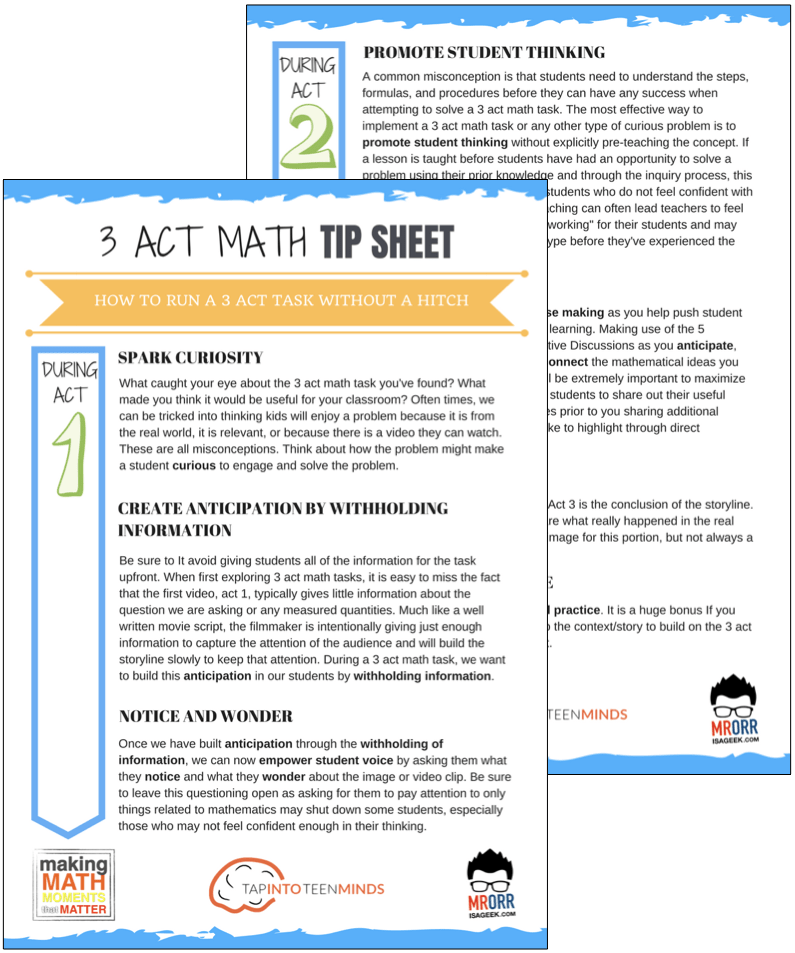
DOWNLOAD THE 3 ACT MATH TASK TIP SHEET SO THEY RUN WITHOUT A HITCH!
Download the 2-page printable 3 Act Math Tip Sheet to ensure that you have the best start to your journey using 3 Act math Tasks to spark curiosity and fuel sense making in your math classroom!
LESSONS TO MAKE MATH MOMENTS
Each lesson consists of:
Each Make Math Moments Problem Based Lesson consists of a Teacher Guide to lead you step-by-step through the planning process to ensure your lesson runs without a hitch!
Each Teacher Guide consists of:
- Intentionality of the lesson;
- A step-by-step walk through of each phase of the lesson;
- Visuals, animations, and videos unpacking big ideas, strategies, and models we intend to emerge during the lesson;
- Sample student approaches to assist in anticipating what your students might do;
- Resources and downloads including Keynote, Powerpoint, Media Files, and Teacher Guide printable PDF; and,
- Much more!
Each Make Math Moments Problem Based Lesson begins with a story, visual, video, or other method to Spark Curiosity through context.
Students will often Notice and Wonder before making an estimate to draw them in and invest in the problem.
After student voice has been heard and acknowledged, we will set students off on a Productive Struggle via a prompt related to the Spark context.
These prompts are given each lesson with the following conditions:
- No calculators are to be used; and,
- Students are to focus on how they can convince their math community that their solution is valid.
Students are left to engage in a productive struggle as the facilitator circulates to observe and engage in conversation as a means of assessing formatively.
The facilitator is instructed through the Teacher Guide on what specific strategies and models could be used to make connections and consolidate the learning from the lesson.
Often times, animations and walk through videos are provided in the Teacher Guide to assist with planning and delivering the consolidation.
A review image, video, or animation is provided as a conclusion to the task from the lesson.
While this might feel like a natural ending to the context students have been exploring, it is just the beginning as we look to leverage this context via extensions and additional lessons to dig deeper.
At the end of each lesson, consolidation prompts and/or extensions are crafted for students to purposefully practice and demonstrate their current understanding.
Facilitators are encouraged to collect these consolidation prompts as a means to engage in the assessment process and inform next moves for instruction.
In multi-day units of study, Math Talks are crafted to help build on the thinking from the previous day and build towards the next step in the developmental progression of the concept(s) we are exploring.
Each Math Talk is constructed as a string of related problems that build with intentionality to emerge specific big ideas, strategies, and mathematical models.
Make Math Moments Problem Based Lessons and Day 1 Teacher Guides are openly available for you to leverage and use with your students without becoming a Make Math Moments Academy Member.
Use our OPEN ACCESS multi-day problem based units!
Make Math Moments Problem Based Lessons and Day 1 Teacher Guides are openly available for you to leverage and use with your students without becoming a Make Math Moments Academy Member.
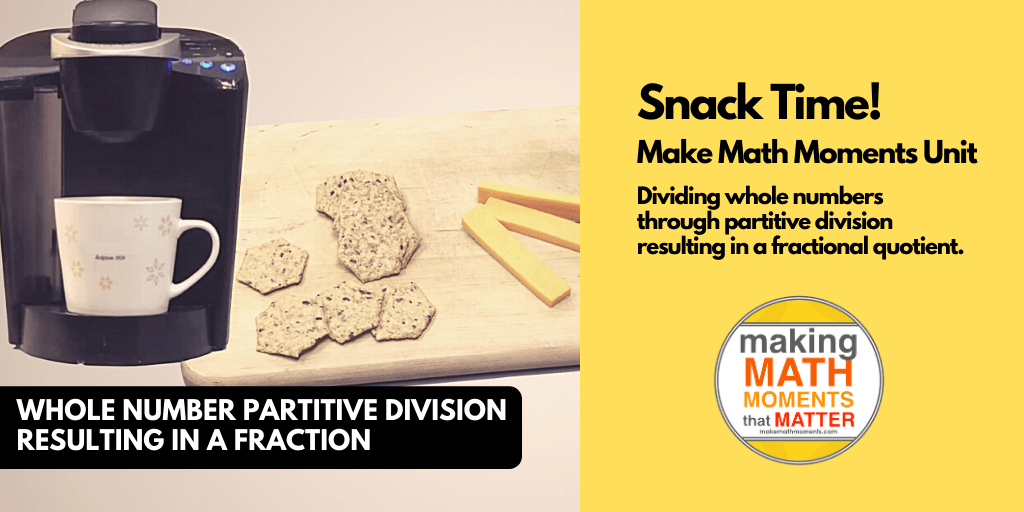
Partitive Division Resulting in a Fraction
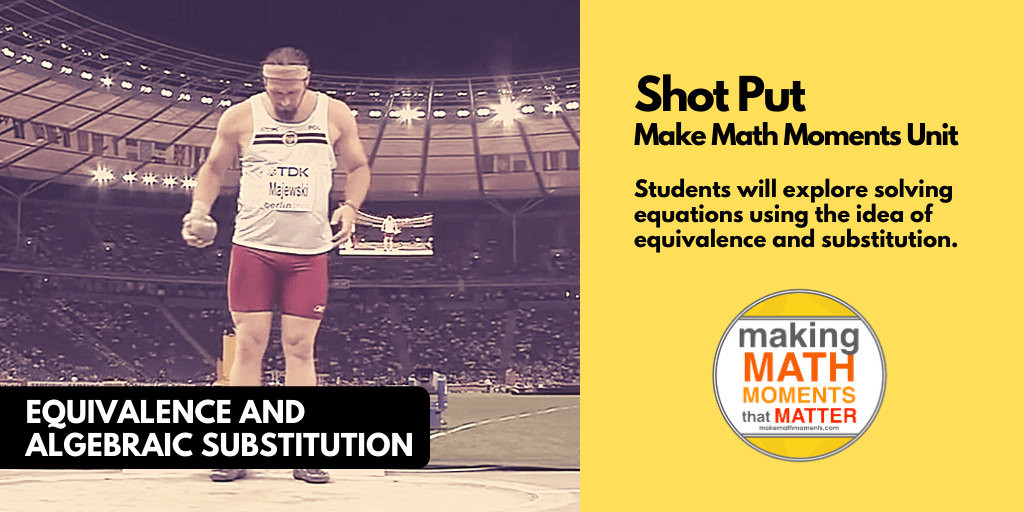
Equivalence and Algebraic Substitution
Represent Categorical Data & Explore Mean
Downloadable resources including blackline masters, handouts, printable Tips Sheets, slide shows, and media files do require a Make Math Moments Academy Membership.
ONLINE WORKSHOP REGISTRATION
Pedagogically aligned for teachers of K through Grade 12 with content specific examples from Grades 3 through Grade 10.
In our self-paced, 12-week Online Workshop, you'll learn how to craft new and transform your current lessons to Spark Curiosity, Fuel Sense Making, and Ignite Your Teacher Moves to promote resilient problem solvers.
0 Comments