
Episode #476: A Better Approach to Small Group Tier 2 Math Intervention
LISTEN NOW HERE...




WATCH NOW...
Small group instruction is a common part of math classrooms—but when it comes time to actually sit down with a group of students, many teachers are left wondering what they should be doing. Should you reteach the lesson? Provide more practice? Or try something completely different?
The answer isn’t about creating a whole new lesson. Instead, effective tier 2 instruction is about helping students access the same rigorous math as their peers—but with the right supports in place. By using formative assessment to understand where students are along the concrete, representational, and abstract continuum, teachers can provide targeted scaffolds that move students forward. The key is not lowering expectations, but removing barriers so every student can engage with the learning.
In this episode, you’ll explore:
- What tier 2 math instruction should (and shouldn’t) look like
- Why small group time isn’t about reteaching the same lesson
- How to use the CRA (concrete, representational, abstract) model effectively
- What it means to provide “access” to grade-level math
- How to decide when students are ready to move on
- The role of high-quality instructional materials and manipulatives
If you’ve ever wondered what to actually do during small group time in math, this episode will give you a clear and practical way to support students without lowering expectations.
Attention District Math Leaders:
We built a simple Math Coherence Compass to help district and school leaders make aligned decisions around math—without adding another initiative. Get your free copy and training here: https://makemathmoments.com/compass/
Not sure what matters most when designing math improvement plans? Take this assessment and get a free customized report: https://makemathmoments.com/grow/
Ready to design your math improvement plan with guidance, support and using structure? Learn how to follow our 4 stage process. https://growyourmathprogram.com
Looking to supplement your curriculum with problem based lessons and units? Make Math Moments Problem Based Lessons & Units
Be Our Next Podcast Guest!
Join as an Interview Guest or on a Mentoring Moment Call
Apply to be a Featured Interview Guest
It will take less than two (2) minutes to book your Math Mentoring Moment call.
Book a Mentoring Moment Coaching Call
Take two (2) minutes to book your Math Mentoring Moment call and let's work together to shake that math pebble out of your shoe!
Are You an Official Math Moment Maker?
Ensure that you follow, rate and review on Apple Podcasts, Spotify and other platforms to show your support and ensure other math educators can find the show.



FULL TRANSCRIPT
Jon Orr: A few episodes ago — episode 466 — we unpacked why tier two instruction is not just reteaching the same math lesson. We talked about what purposeful practice can look like, and how to build a classroom where students support each other. We talked about how to group students for that tier two small group work. Then we got an email from a listener — and we love those emails, we read every single one. This teacher said: I've grouped my students based on the CRA model — concrete, representational, abstract. I know which group needs more support at the concrete level, which needs more at the pictorial, and which is working at the abstract level. But when I sit down with a small group, I'm not always sure exactly what I should be doing with them. Am I reteaching the lesson? Giving more practice? What am I actually doing there? That's what we want to unpack today.
Jon Orr: We've got our resident experts Yvette Lehman and Beth Curran here to help us. What are we doing during this small group time?
Yvette Lehman: I'm going to let Beth jump in first and share some big-picture recommendations that are relevant whether you're teaching first grade or eighth grade.
Beth Curran: Sure. Generally speaking, you've done some formative assessment throughout your lesson — student thinking has been visible to you — and you've determined you have a group still functioning at the concrete level, some at the pictorial, and some ready to work abstractly. Now what?
Beth Curran: I would recommend you look first to your instructional resources and dig into what materials are available to you there. Am I reteaching the lesson? Probably not. What I'd recommend is looking at what the follow-up practice is going to look like. You've done your learning, you've given an exit ticket or somehow determined where students are. If you're going to create a small group, you'll also have a larger group working independently. So during that small group time, you'd work through the same problems the students are doing independently — but you provide access to those problems for the students who are still at the concrete or pictorial level. As students work through those practice problems with your support, you're helping them move from concrete to pictorial, because maybe they didn't fully get that in the whole group lesson.
Beth Curran: Your instructional materials might also include additional practice resources. A lot of high-quality materials now provide things like that — extra scaffolded practice you can have at the ready for students who move through the phases more slowly. But the big idea is this: whatever the students are doing independently in the classroom, you're going to be doing those same problems in your small group — just supporting students concretely or pictorially, helping them through those phases to reach the abstract.
Jon Orr: Right. So what I'm hearing is: don't necessarily go and recreate a whole new activity or lesson for the small group. Leverage the same activity or practice that the rest of the class is doing, and then make the adjustments based on where you've identified each student is in their understanding. And logistically — am I bouncing between groups the whole time? What does this actually look like in the classroom? And how do I know when a group is ready to move on independently?
Yvette Lehman: Let me answer that through an actual lesson rather than speaking in vague terms. I'm going to put my teacher hat on and we'll use a real example. I'm a grade three teacher using the Common Core standards, and the learning objective for today's lesson is: I will understand a fraction as a number, and I will represent fractions on a number line. We're talking about magnitude — knowing that a fraction represents a quantity that exists between whole numbers and can be plotted on a number line to represent its value.
Yvette Lehman: Imagine I've done my lesson and given this exit ticket: identify one-tenth on the number line. I provide an open number line marked at zero and one. I ask, is one-tenth closer to zero or to one? And how do you know? I'm looking for them to justify — some language, a verbal representation alongside the visual. As a follow-up, once students have answered the first parts, I'd ask, can you write me a fraction that would be closer to one? I want them to name and justify another fraction. So I'm gathering this information relative to my learning objective through what students have written and through observation and conversation as I circulate.
Yvette Lehman: Now I'm ready to send everyone off to purposeful practice, and I want to pull some targeted groups. Let's talk about the group who was not successful — the ones who said things like, I think one-tenth is close to one because there's a one in it. I'm not sure how to partition this number line. I'm not clear on what one-tenth means. That's a group I've identified.
Beth Curran: So I'm taking this group to my small group table. Looking at the follow-up practice questions — which would likely be similar to the exit ticket — maybe the next question is, is two-fifths closer to zero or one? Well, they couldn't identify where one-tenth was. So let's start with a unit fraction — let's go back to one-fifth. Let's build it. I have my fraction tiles out. Find your tile that says one-fifth. How many of those will we need to make one whole? Let's stack them and create that line. Then we have our open number line available and we help students see that one of those tiles represents one equal interval between zero and one. We'd put a mark there and say, that's where one-fifth lives on the number line.
Beth Curran: We walk through it — helping them build it with hands-on concrete materials, then compare it to a drawing on the number line. We scaffold from concrete to pictorial. At some point I'd say, on this next one, we're not going to build it — we're going to go straight to the number line. Can you visualize what it would look like? We're working them through those phases.
Yvette Lehman: And to answer your question about how I know I'm done with this group — I'd feel like they're ready to move on if they can use that strategy independently enough to access the rest of the practice. So if they still need fraction tiles to partition the number line, but that approach unlocks the practice for them, I'm comfortable. They might not have moved all the way to pictorial independently yet, but they can access the problems now. Whereas before, when I left them at the end of the exit ticket, they had no strategy and no model — sitting in front of practice questions they couldn't access isn't time on task.
Jon Orr: Right. Now they've got tools. They can physically move the fraction tiles, they can access the practice questions, and they could work through most of those problems at the concrete stage. So I'm looking to see: can they do this independently? Great — keep going with that strategy. Then let's say I have another group at the pictorial level but I want to move them toward abstract. What does that group look like?
Yvette Lehman: For that group, what I likely saw is that they knew roughly where one-tenth was on the number line, but they couldn't justify it in any other way. They could visualize it — I know it's closer to zero — but when asked, how do you know, can you explain it, can you use a verbal or symbolic representation — they struggled. Do they understand that one-tenth is missing nine more tenths to get to one? Do they know it's equivalent to 10%? Do they have any other way of justifying their answer beyond I know it's about here?
Beth Curran: Right. So maybe on their open number line they just put one tick mark and labeled it one-tenth, and it appears closer to zero, but there's no justification for why they chose that position — the number line isn't partitioned equally.
Jon Orr: How do I modify the practice at that point?
Yvette Lehman: For this group, I probably just need more information from them, which is why I'm pulling them to the table. I want to confirm they've solidified the size of the unit fraction — that they understand because it's one-tenth, the line needs to be partitioned into ten equal parts. The exit ticket just didn't give me enough information to be confident this group is ready to move on. Equipartitioning is a difficult skill to develop, and sometimes students need explicit instruction or confirmation that they understand the numerator is a count and the denominator tells them the number of equal parts between the whole numbers.
Jon Orr: Let me zoom out. As a teacher planning this lesson, what are some prerequisites — what work do I need to do in advance to prepare for engaging with students this way?
Yvette Lehman: I'll start with what I think we all believe fundamentally: I need clarity around my learning objective and the success criteria for today. What are my indicators that a student has internalized the learning objective? What am I looking for? What should students be able to do and say for me to feel confident they've met the goal?
Jon Orr: And I think a lot of times as we plan our lessons, we feel like we know what that looks like — maybe because we've taught it before, or we have a mental picture. But the real question we have to ask ourselves is, do we really? Without writing it down? Without sharing it with the teacher next door? Without getting feedback on it? Because that can reframe how you designed the exit ticket, how you interact with students in tier two, and even what the purposeful practice looks like. Saying it out loud, sharing it with someone next to you — that's sometimes the push that makes you confident in what tier two should actually look like. It's dedicated work. You may not be able to do it every day, but you can do it sometimes. And the more you do it, the better you get at it.
Beth Curran: Absolutely. What I heard you say, Jon, is really anticipating student responses. If your tier two is going to focus on the CRA progression, then as you're planning your lesson you need to be thinking: what are the indicators I'm looking for in a student at the concrete level? What are the indicators at the pictorial, and at the abstract? Whether you're giving a formal exit ticket or some other form of formative assessment — whiteboards, student conversation, posing good questions — you're gathering that information throughout the lesson. Maybe it's not a formal exit ticket you're scoring; maybe it's just that you've been looking for those indicators of a concrete learner throughout the lesson and you've identified exactly who needs that support. So it's really anticipating and watching: what indicators would I expect from students at the concrete, pictorial, or abstract level?
Jon Orr: For sure. And that anticipation work — looking at the learning goals, thinking through success criteria at each phase — is connected to the five practices and that anticipation stage. You have to know what you're looking for before you can see it. And that's sometimes hard to build in, but it is the thing that makes tier two feel purposeful rather than reactive.
Yvette Lehman: I would argue that without high-quality instructional material, this is a very heavy lift — even for an experienced and proficient math educator. If I'm making all of my practice questions from scratch, designing the tasks every day, creating my own centers — that is an enormous time demand. Particularly for an elementary teacher teaching more than one content area, or a middle or high school teacher with multiple grade levels. We're asking for a level of cognitive load and time commitment that simply isn't realistic.
Yvette Lehman: The other barrier people need to address is access to concrete materials. I can't work with five students on fractions if I only have one set of fraction tiles. That's a barrier. If I don't have fraction tiles, am I cutting up construction paper to substitute? How am I removing that barrier so students can actually have the manipulatives in their hands?
Beth Curran: And if you're an administrator listening to this — if you've adopted a high-quality instructional material that requires a lot of concrete understanding, then you also have to provide teachers with those manipulatives. The resource only works if teachers have what they need to deliver it.
Jon Orr: And building off that — having that high-quality instructional material and having the resources is the starting point, not the finish line. Think about everything that goes into designing good tier two instruction: clarity on learning goals, success criteria, understanding the CRA progression, and knowing what to look for at each stage. Teachers who have been in the classroom for their whole careers are still growing in those skills. We can't assume everyone will just pick this up because a quality resource is available. The resource is the floor to build from, but there's so much more that needs to happen. We have to set aside time in PLCs to take these lessons, unpack them, link them to learning goals, look at the tasks, and talk through the moves. That has to be a routine part of what we do — not a one-time fix. The high-quality resource is an important starting line, but it is not the finish line.
Yvette Lehman: To summarize my big takeaway: when people ask what small group looks like, small group looks like the same purposeful practice assigned to the whole group — but with scaffolds for access. I'm not changing the practice. I'm not going down grade levels to meet students where they are. I'm saying, this is the practice based on our rigorous tier one instruction model. But I need to make sure every child can access it and be successful. So what am I going to put in place — what strategy, what model — to give them that access?
Beth Curran: She summed it up perfectly.
Jon Orr: Well said. And hopefully we've addressed this question from our listener. We welcome all questions, pushbacks, and thinking — hit reply on our emails or reach out through your podcast platform. One tool we've been using with teams to help create clarity and alignment around what tier one, tier two, and beyond looks like in classrooms is the math coherence compass. We've created a downloadable training and a template you can use if you're a leader, department head, or administrator to create your own coherence compass — to guide the work you're doing in PLCs or professional development. Head over to makemathmoments.com forward slash compass, or click the link in the show notes. That's makemathmoments.com forward slash compass.
Your Customized Improvement Plan For Your Math Classroom.
Take the 12 minute assessment and you'll get a free, customized plan to shape and grow the 6 parts of any strong mathematics classroom program.
District leader/math coach? Take the District Assessment
Thanks For Listening
- Book a Math Mentoring Moment
- Apply to be a Featured Interview Guest
- Leave a note in the comment section below.
- Share this show on Twitter, or Facebook.
To help out the show:
- Leave an honest review on iTunes. Your ratings and reviews really help and we read each one.
- Subscribe on iTunes, Google Play, and Spotify.
The Making Math Moments That Matter Podcast with Kyle Pearce & Jon Orr
Weekly interviews, strategy, and advice for building a math classroom that you wish you were in.
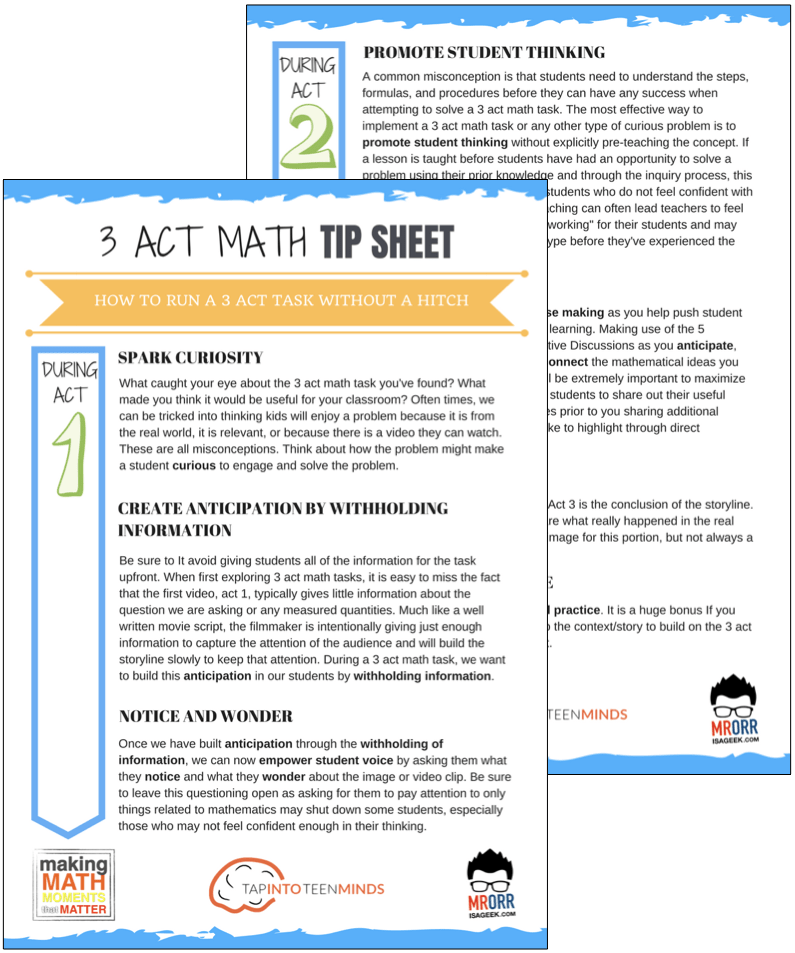
DOWNLOAD THE 3 ACT MATH TASK TIP SHEET SO THEY RUN WITHOUT A HITCH!
Download the 2-page printable 3 Act Math Tip Sheet to ensure that you have the best start to your journey using 3 Act math Tasks to spark curiosity and fuel sense making in your math classroom!
LESSONS TO MAKE MATH MOMENTS
Each lesson consists of:
Each Make Math Moments Problem Based Lesson consists of a Teacher Guide to lead you step-by-step through the planning process to ensure your lesson runs without a hitch!
Each Teacher Guide consists of:
- Intentionality of the lesson;
- A step-by-step walk through of each phase of the lesson;
- Visuals, animations, and videos unpacking big ideas, strategies, and models we intend to emerge during the lesson;
- Sample student approaches to assist in anticipating what your students might do;
- Resources and downloads including Keynote, Powerpoint, Media Files, and Teacher Guide printable PDF; and,
- Much more!
Each Make Math Moments Problem Based Lesson begins with a story, visual, video, or other method to Spark Curiosity through context.
Students will often Notice and Wonder before making an estimate to draw them in and invest in the problem.
After student voice has been heard and acknowledged, we will set students off on a Productive Struggle via a prompt related to the Spark context.
These prompts are given each lesson with the following conditions:
- No calculators are to be used; and,
- Students are to focus on how they can convince their math community that their solution is valid.
Students are left to engage in a productive struggle as the facilitator circulates to observe and engage in conversation as a means of assessing formatively.
The facilitator is instructed through the Teacher Guide on what specific strategies and models could be used to make connections and consolidate the learning from the lesson.
Often times, animations and walk through videos are provided in the Teacher Guide to assist with planning and delivering the consolidation.
A review image, video, or animation is provided as a conclusion to the task from the lesson.
While this might feel like a natural ending to the context students have been exploring, it is just the beginning as we look to leverage this context via extensions and additional lessons to dig deeper.
At the end of each lesson, consolidation prompts and/or extensions are crafted for students to purposefully practice and demonstrate their current understanding.
Facilitators are encouraged to collect these consolidation prompts as a means to engage in the assessment process and inform next moves for instruction.
In multi-day units of study, Math Talks are crafted to help build on the thinking from the previous day and build towards the next step in the developmental progression of the concept(s) we are exploring.
Each Math Talk is constructed as a string of related problems that build with intentionality to emerge specific big ideas, strategies, and mathematical models.
Make Math Moments Problem Based Lessons and Day 1 Teacher Guides are openly available for you to leverage and use with your students without becoming a Make Math Moments Academy Member.
Use our OPEN ACCESS multi-day problem based units!
Make Math Moments Problem Based Lessons and Day 1 Teacher Guides are openly available for you to leverage and use with your students without becoming a Make Math Moments Academy Member.
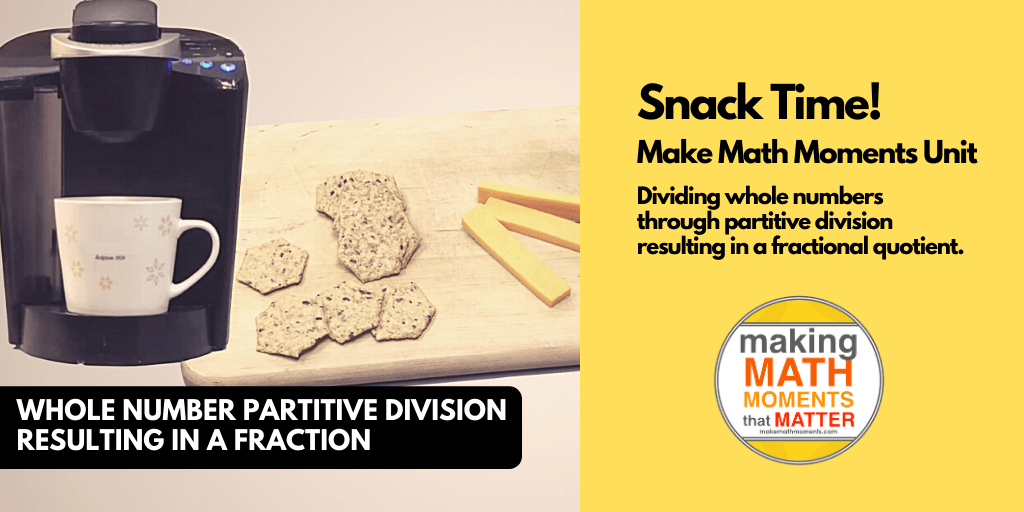
Partitive Division Resulting in a Fraction
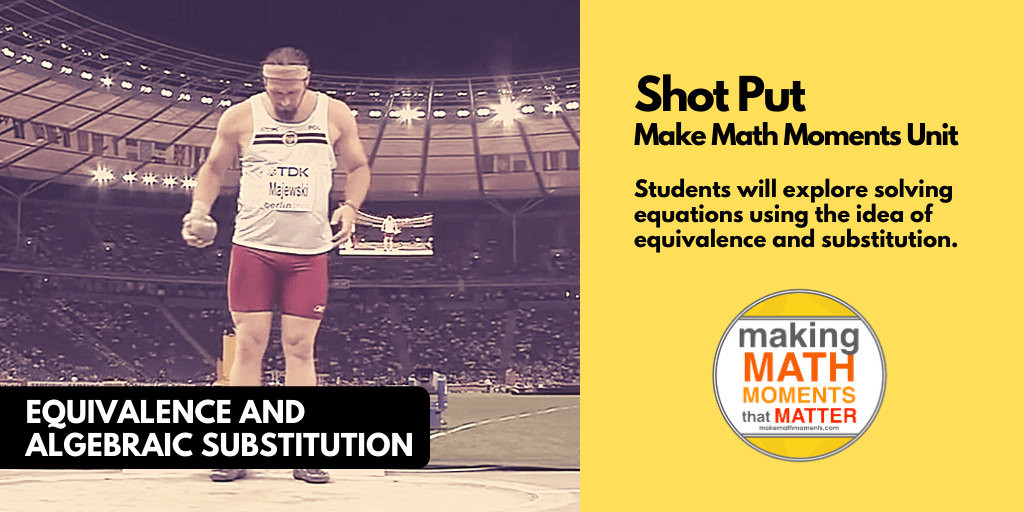
Equivalence and Algebraic Substitution
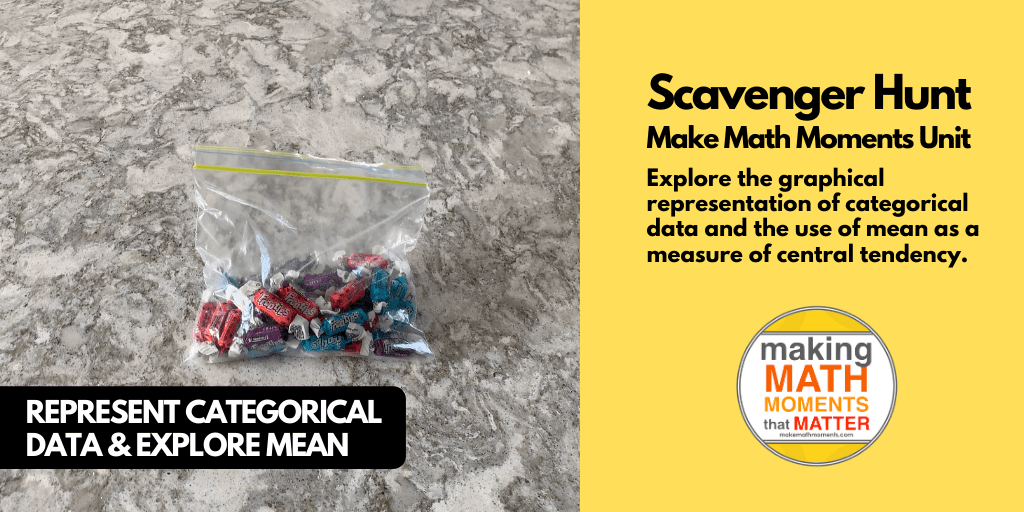
Represent Categorical Data & Explore Mean
Downloadable resources including blackline masters, handouts, printable Tips Sheets, slide shows, and media files do require a Make Math Moments Academy Membership.
ONLINE WORKSHOP REGISTRATION

Pedagogically aligned for teachers of K through Grade 12 with content specific examples from Grades 3 through Grade 10.
In our self-paced, 12-week Online Workshop, you'll learn how to craft new and transform your current lessons to Spark Curiosity, Fuel Sense Making, and Ignite Your Teacher Moves to promote resilient problem solvers.
0 Comments