Episode #456: How to Help Students With Word Problems in Math—and Coach Teachers to Do the Same
LISTEN NOW HERE…



WATCH NOW…
If your students can calculate but collapse in math word problems, the issue often isn’t the numbers—it’s the structure.
Many schools default to keyword hunts, graphic organizers, and “pick the operation” routines. But those tools can accidentally train students to guess instead of model what’s happening. The result: multi-step math problems feel like a maze.
In This Episode, You’ll Learn
- Why “keywords/highlighters” often fail (and what they train students to do instead)
- How focusing on math problem types (join/separate/compare, fair share, measured, etc.) strengthens multi-step thinking
- What to assess when students miss word problems (structure breakdown, not just computation)
- How to build cumulative practice so word problems improve all year—not in one unit
- A simple, curriculum-anchored move leaders can run next week
If word problems are your team’s pebble, this episode gives you a clean first step to build shared language, stronger instruction, and better student math outcomes—without adding another program.
Attention District Math Leaders:
Not sure what matters most when designing math improvement plans? Take this assessment and get a free customized report: https://makemathmoments.com/grow/
Ready to design your math improvement plan with guidance, support and using structure? Learn how to follow our 4 stage process. https://growyourmathprogram.com
Looking to supplement your curriculum with problem based lessons and units? Make Math Moments Problem Based Lessons & Units
Be Our Next Podcast Guest!
Join as an Interview Guest or on a Mentoring Moment Call
Apply to be a Featured Interview Guest
Book a Mentoring Moment Coaching Call
Are You an Official Math Moment Maker?


FULL TRANSCRIPT
Yvette Lehman: week I was on a call with a school team. They had their math task force at the table, their principal, their coach, and some teacher leaders who are, you know, leading the charge around math improvement. And they’ve been working on defining their one thing. You know, rather than trying to tackle everything about math improvement simultaneously, they were like, you know, what’s our pebble right now? What’s the one thing that we can strategically strengthen this year? And the pebble is, they said, our students can compute well when we just give them the numbers, but they struggle to solve word problems. They struggle to identify the operator, particularly when they’re working through multi-step word problems. So that is the pebble we’re going to unpack today in this episode.
Jon Orr: sure. Okay, I know we’re gonna get into it. Beth is smiling like big smiles, because she knows that she wants to, she’s ready to sink her teeth into this. Before we do, wanna, we used to, when we talk about this, I think if you go back in the history of the archives of this show, this is a huge topic that we talk about often. It how do we help kids with word problems?
Jon Orr: And how do we help them persevere through problem, you know, challenging and solving challenging problems. And I remember here’s what I remember when I was first beginning teachers, that is how my school district or my coaches used to help you with like, how do you help a kid with word problems? Like what are the moves the teacher should do to help with word problems? And I’m going to say two things or three things. And then this might derail us. I don’t know, but one of those things was highlighters. Another one of those things was anchor charts. And then another one of those things were problem solving frameworks. And so what I mean by all three of these was like there was a time where we spent time in work, you know, professional development sessions that if we want to help kids with work problems that we should be, highlighters were the fix all.
Jon Orr: this tool, this highlighter was going to solve our problems because we’re gonna highlight keywords, we’re gonna look for the operations. Like this was a place, like that was all we were focusing on. And so for a time it was like highlighters were on every desk. And I think while there’s some merit there, I think some of the pieces of that were like good, but then it was like, but the focus was highlighters. So it was like, that was gonna be the fix all. Which was the same for the problem solving framework. So it’s like, yeah, there’s four boxes here.
Just fill in the key information, the four boxes and voila problem will be solved. And it was like, this will just lead you to naturally solve every single word problem there is, which I think for a lot of us in those early years, we’re like, thinking, wait a minute, every like, let’s follow the word problem, you know, framework, and we should be able to solve these problems. Same with our anchor charts. Let’s just put as many anchor charts across the room as we can. We’ll just look at which one’s the right one. And those were the ways that we, in the old days, attempted to solve or help kids with word problems. But I wanted to bring those up because our views over the years as we learn, my views specifically changed on those three tools significantly, not as tools themselves, but how we use those tools and how they became the focus or less of a focus over time. So let’s unpack. That’s why I wanted to kind of present what we used to do, but maybe Beth’s gonna share what we should do.
Beth Curran: Well, I think that it gets back to this big idea that when we know better, we do better. Right. So, I mean, we’ve all been in a situation where we’ve tried to really proceduralize problem solving. And I think the big idea here is why do we why do we have students work through word problems? What’s the why behind it? Well, it’s because we want to create resilient problem solvers. Right. So, you know, when I hear things like when my students can calculate, they have no problem with calculating piece. You they can compute if I give them numbers and I tell them what operation to use, they can calculate, but they can’t solve a word problem. Well, what’s our goal of math instruction? It’s to create problem solvers and logical thinkers and critical thinkers.
And so problem solving needs to shift. You know, the way that we approach it needs to shift. you know, I can jump into a few suggestions. I will share a couple of ah-has with you. So as I was going through my own journey of trying to figure out how to best support my students, I was at a conference. This was probably, gosh, probably going on 15, 20 years ago now. And the speaker said something that just resonated with me and I’ve held onto it ever since. And the speaker said that the numbers are the least important part in a word problem. And I know for a lot of teachers, that’s really scary because the first thing we do is we point students right to the numbers, highlight the numbers. We to know what numbers we’re working with, right? But if you think about it, the problem in and of itself, the situation is what’s most important. Once we have the situation figured out and we have a plan, maybe a sketch or drawing a chart, we know how to enter into the problem. We could put any numbers into that problem and then be able to solve it. So it’s shifting our thinking away from focusing on the numbers most to focusing on the problem in and of itself. And so that’s one big aha for me. So Yvette, I’m let you jump in here and then I’ll chime back in again.
Yvette Lehman: interesting, John, because you were talking about, you know, I’m guessing 10, 15 years ago, 20 years ago, what we were doing. But it’s interesting because at the time here in our Ontario curriculum, they didn’t have a problem solving model in elementary. They basically said, you need to model the problem. Like it wasn’t this like proceduralized structure. And so then they gave recommendations. It’s like act it out, like actually get the items in the problem and model the behavior through physical actions, draw a picture of it, create a visual representation of what’s actually happening here in the problem. And so I love this.
So it’s interesting that although our curriculum at the time was not telling us to use this kind of proceduralized four-part problem-solving structure, that was still a move that we were using as teachers or that was being presented to us in professional development when our curriculum was actually telling us all along, focus on what’s happening. Like actually focus, this a joining problem? Is this a separating problem? Are we comparing? Are we looking at fair sharing scenarios? And so that I think that Beth and I are obviously and John as well, we’re all on the same page that it’s like we have to actually understand the behavior of the problem and then ultimately help students match that behavior with the operator. And Cathy Fosno has done a ton of work on this, right around models. And she says, the job of the teacher is once the students have revealed the behavior, the teacher’s job is to show them the mathematical language to describe what they just did and then to help them bridge the connection between their model or their actions to that symbolic representation.
Jon Orr: go back to also thinking about how we think about the, that what you just said, Yvette, it was like, we wanna shift from like, let’s focus on the operation to focusing on what’s happening here, but I think what happens naturally is when we get to that place where we’re focusing on the operation because of, in a way, the order you’re teaching problem solving. And I think that it plays a huge factor into this idea of like kids struggle with problem solving and because we’re like starting with the, we call them here on the podcast all the time, is like the naked problems. Like you’re teaching naked problems, you’re teaching operations, and then when you get to word problems, it’s a different world. And it’s all of a sudden now you’re, so now you’re trying to proceduralize.
Why the highlighter makes sense because it’s like, well, we’ve focused on numbers and operations so much to get to this point. Now we’re gonna apply this. And so now we have to go like, well, look for the numbers and then we’ll figure out the operation. And then it’s like the naked problem. And that is in a way is not gonna help with problem solving because what you’re trying to do is like fit molds to things again. This is why those frameworks are introduced. This is why we try to proceduralize problem solving. It’s cause like we’re coming at it from a naked problem, an application problem, and not the other way around.
We all, like the three of us know that when we teach our problem like teach math now, we teach through context. Like you talked about Cathy Fosno, it’s context for learning. Like we want to teach through this so that we can see the behaviors. We want to teach through this so that the naked problems are the problems maybe we do after. And it becomes now we have to bridge that gap. And so we’re not going to see the problems that we’re seeing about like word problems because you’re teaching them through word problems, which is harder. In a way it’s harder, but you’re gonna have a different set of hard problems. You’re not gonna have the hey maybe I don’t have the I don’t know how to do word problems anymore because that’s just what kids are understanding this is what math is.
The harder problem might be like how do I make the connection to the naked problem now and how do I help them move over to that side or your problem you might experience is like I don’t know how to do that yet and that’s okay and that’s the problem that you’re gonna have to solve. Sometimes I just look at it as like you have problems on both sides of every decision you have to make you just have to choose which problem you want and what problems help guide the big why of why you’re trying to do things.
So back to why we do what we do is to help kids struggle through problems so that they can have resilience well then that makes sense to teach through problems because you’re battling that problem versus another problem. So I’ve been rambling back to you guys.
Beth Curran: So yeah I mean John everything that you just said right there 100 percent agree with that. In an ideal world we would introduce students to a concept through a real life situation so conceptually understanding something first and then working through maybe practice to fluency with the operation. So I mean that would be I think again in an ideal world we would say everyone shifts.
Everyone shifts and starts introducing if I’m introducing addition to kindergartners the idea of adding we’re going to start with a real life situation. We’re going to talk about how we put these objects together and anytime we put things together or we join objects we’re going to call that addition and here’s what it looks like mathematically right so working through that that way.
When we talk about fractions let’s bring a real life situation into it. I have a pizza and I’m sharing with eight friends each one if each person gets one piece what does that look like.
So we start with a real life situation and then to develop that conceptual understanding of the mathematical concept then we layer in the naked problems if you will to practice for fluency.
And so I think that that’s one shift that we can all try to make.
Another thing that I would say that I hear often from teachers is that maybe on the assessment that my kids took there was this zinger problem and I never taught it. I never taught them how to go through this type of problem before.
And I often explain this as those problems are there intentionally to get students seeing that they can take their understanding and apply it in an unfamiliar situation.
Because again if we get back to real life math nobody out there listening to this podcast right now goes to work or has a significant other that goes to work and is handed a sheet of naked problems to do.
They’re always solving a problem and they’re not solving the same problem over and over and over again.
They’re solving a new unfamiliar problem where they’re having to look back and take everything that they learned from solving previous problems and apply it to this new situation.
And so that’s why those zingers show up and we have to let our students learn to persevere through those.
And the best way to do that is to get them understanding those situations having the tools to be able to visualize what’s happening in this problem maybe draw a quick sketch or a model and then focusing on the operations in order to solve it.
Jon Orr: For sure. Because I think the reality is that if I’m still teaching that way the epiphany hasn’t shifted in me as a teacher to what we’re really doing in math class.
Because like you said Beth it comes down to what you fundamentally believe about what you’re doing in math class with students. If you believe math is about calculating right answers quickly then that is how you will structure your lessons. If you believe math is about resilience and problem solving then you will structure lessons around that. If you believe it is both then your lessons will reflect that balance. So it is important to step back and ask what are we really doing here. What is the big idea I want my students to leave with and then structure lessons to support that. If I fundamentally believe math is about resilience and problem solving then I will teach through problems. If I believe math is about quick calculation then I will structure lessons around calculation. That decision drives everything.
Beth Curran: Yeah. And just listening to you John I have one quick thought about curriculum and resources. It is easy to fall into the trap of saying we are in the addition chapter so everything will be addition. And then students stop thinking. They say why subtract because we have been practicing subtraction. So sometimes curriculum resources unintentionally push us toward procedural thinking rather than deep understanding.
Jon Orr: Right. Exactly. And that is part of why Kyle and I developed spiralling curriculum years ago. We believed math instruction should develop problem solving resilience so we teach through problems. And we mix the order. If today’s problem is about area tomorrow’s might be ratios. Because we want students to look at context first. Then decide what math applies. Then we connect it at the end. If you want to learn more about spiralling you can head to makemathmoments.com forward slash spiralling. There is a course there that explains the research and resources. Okay Yvette how do leaders support teachers in making this shift.
Yvette Lehman: I think where many teams struggle is the first move. They identify the pebble and the solution but then ask what do we do at the next PLC or staff meeting. So here is what I recommended to this team. Students struggle with word problems. The solution is to model the behaviour in the problem and name the operator after. So I suggested starting with subtraction. Rather than tackling everything start with one operator. Subtraction is high leverage. Many teachers discover they do not fully understand subtraction behaviour themselves. Subtraction is not one thing. Some researchers say it has four behaviours or more. So I asked them to bring subtraction word problems from their curriculum to the next staff meeting. Then remove the numbers and group the problems by behaviour. Are they separating problems. Comparison problems. Missing addend problems. Because teachers often assume students will recognize subtraction automatically but subtraction represents many different situations. That was the first step.
Jon Orr: What you described is very different from how professional development used to work. Before it was here are the steps here are the tools. But your approach steps back and asks what is the big mathematical idea we need teachers to understand. Then you design learning around that. Instead of proceduralizing professional learning you help teachers experience the thinking.
Yvette Lehman: And I always recommend starting narrow before going broad. When teachers strengthen their own mathematical understanding they need manageable entry points. Subtraction is simple but powerful. And the team realized something interesting. Even though grades differ the behaviours of subtraction stay the same. Kindergarten might subtract single digits. Grade eight might subtract fractions. But the behaviour is the same. That makes the learning relevant across the entire school. And another important point is using their own curriculum resources. When we bring outside resources teachers disconnect. But when they analyze problems they will teach next week it becomes immediately meaningful.
Jon Orr: Exactly. My big takeaway is step back and ask what enduring understanding you want students to develop. If resilience and problem solving matter then structure lessons to move from unfamiliar to familiar. That process is the art of problem solving. And we should design professional learning the same way.
Beth Curran: My takeaway is go slow and start simple. Focus on something manageable. Build gradually rather than overwhelming teachers.
Jon Orr: And what Yvette described is exactly the work we do with school teams every day. Helping teams design systems structures and professional learning to reach their math goals. If you want us to look at your situation head to makemathmoments.com forward slash discovery. We would love to support you.
Thanks For Listening
- Book a Math Mentoring Moment
- Apply to be a Featured Interview Guest
- Leave a note in the comment section below.
- Share this show on Twitter, or Facebook.
To help out the show:
- Leave an honest review on iTunes. Your ratings and reviews really help and we read each one.
- Subscribe on iTunes, Google Play, and Spotify.
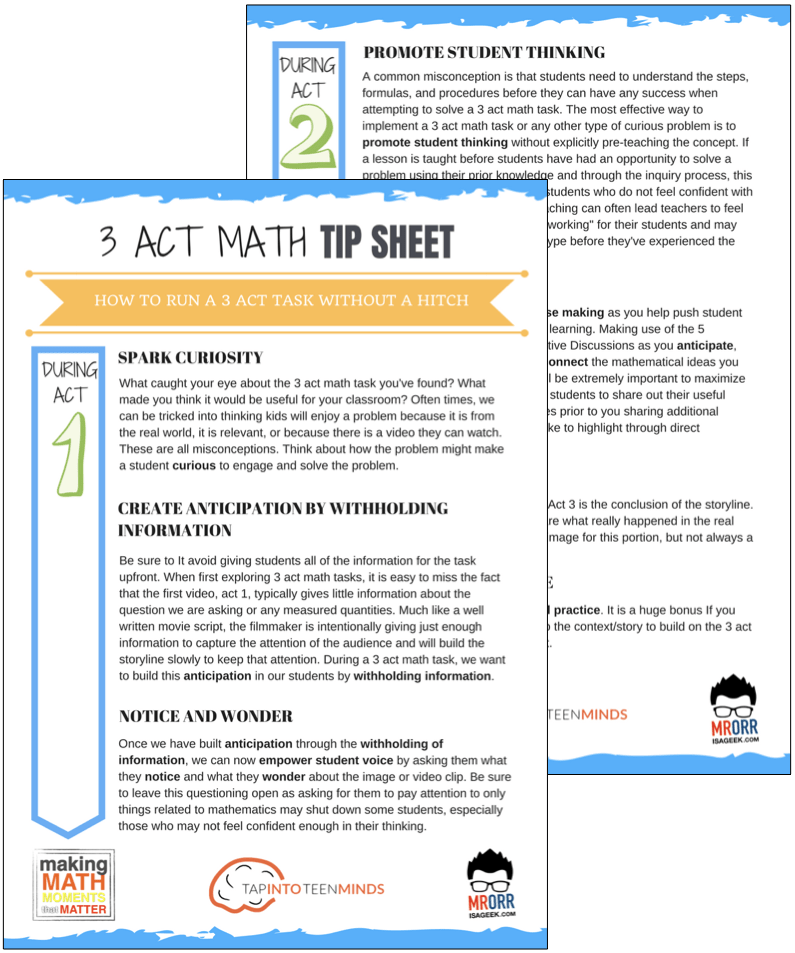
DOWNLOAD THE 3 ACT MATH TASK TIP SHEET SO THEY RUN WITHOUT A HITCH!
Download the 2-page printable 3 Act Math Tip Sheet to ensure that you have the best start to your journey using 3 Act math Tasks to spark curiosity and fuel sense making in your math classroom!
LESSONS TO MAKE MATH MOMENTS
Each lesson consists of:
Each Make Math Moments Problem Based Lesson consists of a Teacher Guide to lead you step-by-step through the planning process to ensure your lesson runs without a hitch!
Each Teacher Guide consists of:
- Intentionality of the lesson;
- A step-by-step walk through of each phase of the lesson;
- Visuals, animations, and videos unpacking big ideas, strategies, and models we intend to emerge during the lesson;
- Sample student approaches to assist in anticipating what your students might do;
- Resources and downloads including Keynote, Powerpoint, Media Files, and Teacher Guide printable PDF; and,
- Much more!
Each Make Math Moments Problem Based Lesson begins with a story, visual, video, or other method to Spark Curiosity through context.
Students will often Notice and Wonder before making an estimate to draw them in and invest in the problem.
After student voice has been heard and acknowledged, we will set students off on a Productive Struggle via a prompt related to the Spark context.
These prompts are given each lesson with the following conditions:
- No calculators are to be used; and,
- Students are to focus on how they can convince their math community that their solution is valid.
Students are left to engage in a productive struggle as the facilitator circulates to observe and engage in conversation as a means of assessing formatively.
The facilitator is instructed through the Teacher Guide on what specific strategies and models could be used to make connections and consolidate the learning from the lesson.
Often times, animations and walk through videos are provided in the Teacher Guide to assist with planning and delivering the consolidation.
A review image, video, or animation is provided as a conclusion to the task from the lesson.
While this might feel like a natural ending to the context students have been exploring, it is just the beginning as we look to leverage this context via extensions and additional lessons to dig deeper.
At the end of each lesson, consolidation prompts and/or extensions are crafted for students to purposefully practice and demonstrate their current understanding.
Facilitators are encouraged to collect these consolidation prompts as a means to engage in the assessment process and inform next moves for instruction.
In multi-day units of study, Math Talks are crafted to help build on the thinking from the previous day and build towards the next step in the developmental progression of the concept(s) we are exploring.
Each Math Talk is constructed as a string of related problems that build with intentionality to emerge specific big ideas, strategies, and mathematical models.
Make Math Moments Problem Based Lessons and Day 1 Teacher Guides are openly available for you to leverage and use with your students without becoming a Make Math Moments Academy Member.
Use our OPEN ACCESS multi-day problem based units!
Make Math Moments Problem Based Lessons and Day 1 Teacher Guides are openly available for you to leverage and use with your students without becoming a Make Math Moments Academy Member.
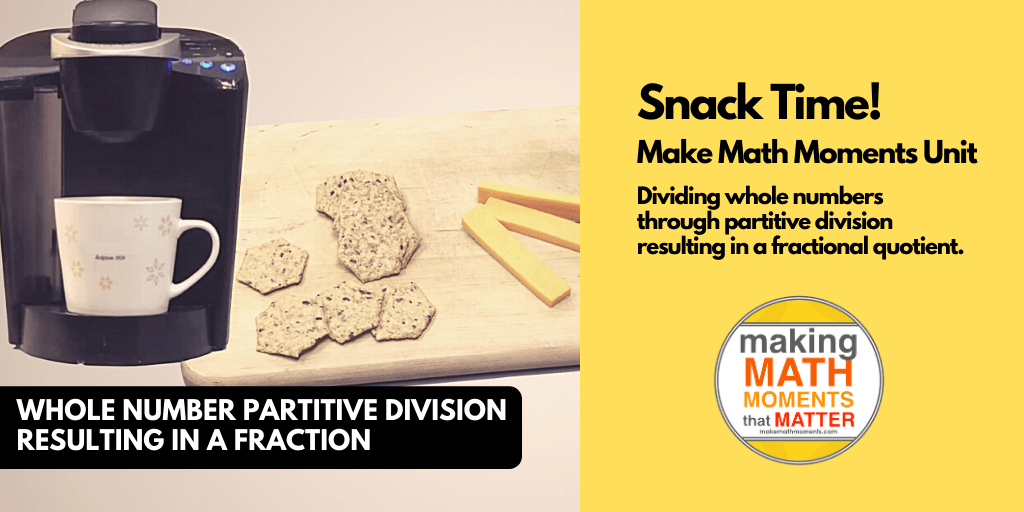
Partitive Division Resulting in a Fraction
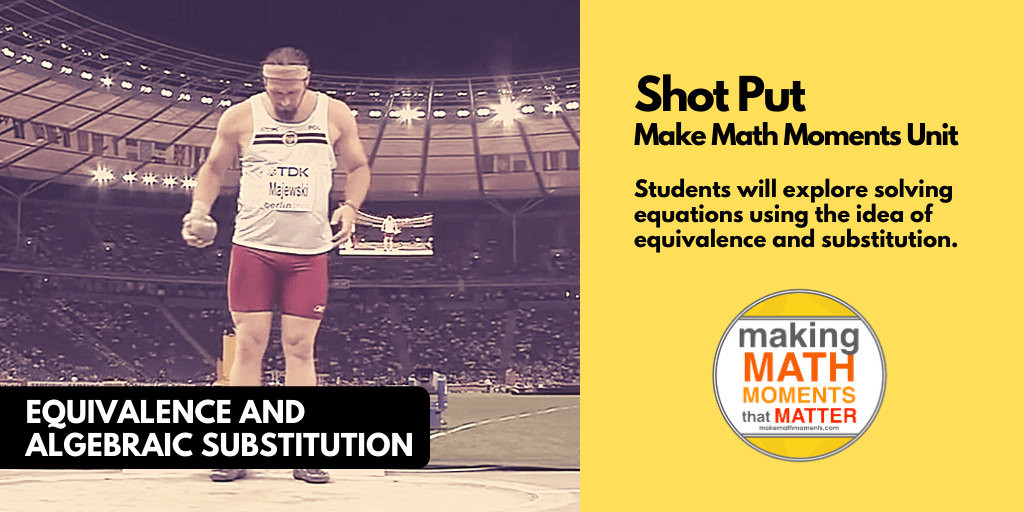
Equivalence and Algebraic Substitution
Represent Categorical Data & Explore Mean
Downloadable resources including blackline masters, handouts, printable Tips Sheets, slide shows, and media files do require a Make Math Moments Academy Membership.
ONLINE WORKSHOP REGISTRATION

Pedagogically aligned for teachers of K through Grade 12 with content specific examples from Grades 3 through Grade 10.
In our self-paced, 12-week Online Workshop, you'll learn how to craft new and transform your current lessons to Spark Curiosity, Fuel Sense Making, and Ignite Your Teacher Moves to promote resilient problem solvers.

0 Comments