Episode #478: How to Design Math Improvement That Survives Staff Turnover
LISTEN NOW HERE...



WATCH NOW...
Every school system wants sustainable improvement in math instruction. But in education, there’s one reality we can’t ignore: people are constantly stepping on and off the system. Teachers change roles, leaders move positions, and new staff enter every year. So how do you build improvement efforts that actually last?
For years, many educators have thought about improvement through the idea of a flywheel—something that takes significant effort to get moving, but gains momentum over time. But what if education systems are less like flywheels and more like Ferris wheels? In a Ferris wheel system, people are always coming and going. And that means improvement can’t live only inside individuals—it has to live within the system itself. Sustainable change requires structures that preserve learning, distribute leadership, and continuously support people as they enter and move through the system.
In this episode, you’ll explore:
- Why sustainable improvement can’t depend on individual people alone
- The role of hubs, networks, and distributed leadership in math improvement
- What it means to “learn fast and implement slow”
- How systems can preserve and share learning over time
- Why continuous improvement must be built into the system itself
If you’re leading math improvement in a classroom, school, or district, this episode will challenge you to think differently about sustainability—and help you design systems that continue to grow even as people come and go.
Attention District Math Leaders:
Not sure what matters most when designing math improvement plans? Take this assessment and get a free customized report: https://makemathmoments.com/grow/
Ready to design your math improvement plan with guidance, support and using structure? Learn how to follow our 4 stage process. https://growyourmathprogram.com
Looking to supplement your curriculum with problem based lessons and units? Make Math Moments Problem Based Lessons & Units
Be Our Next Podcast Guest!
Join as an Interview Guest or on a Mentoring Moment Call
Apply to be a Featured Interview Guest
It will take less than two (2) minutes to book your Math Mentoring Moment call.
Book a Mentoring Moment Coaching Call
Take two (2) minutes to book your Math Mentoring Moment call and let's work together to shake that math pebble out of your shoe!
Are You an Official Math Moment Maker?
Ensure that you follow, rate and review on Apple Podcasts, Spotify and other platforms to show your support and ensure other math educators can find the show.


FULL TRANSCRIPT
Yvette Lehman: Jon, I've been doing some deep thinking — it's exciting and it does hurt my brain. We talk a lot about this idea of the flywheel as an analogy for the challenge of change within our education system — how the first initial push can feel really heavy, but over time we build momentum through clarity, coherence, and clear targets. But then I had this wonder recently: is the education system we're designing for actually more like a Ferris wheel than a flywheel?
Jon Orr: Tell me more.
Yvette Lehman: It's the nature of the system we're designing for — a complex system where you constantly have people getting on, getting off, and some staying. In the flywheel approach, if we're focusing on the right components — strengthening mathematical understanding across all key players, thinking about the goals and measures that drive improvement, putting structures in place, and building distributive leadership — then the flywheel keeps chugging along. But what the flywheel metaphor doesn't capture is that people are leaving your system and coming into it. New grade level teams arrive. Coordinators become superintendents. Principals shift roles. The comings and goings very much resemble a Ferris wheel.
Jon Orr: People change seats on a regular basis — your math coordinator is now your superintendent, your principal is now your math coordinator, or vice versa. So really, you've got a flywheel that is also a Ferris wheel. And the question becomes: how do we design for both at the same time?
Yvette Lehman: Exactly. So I dug into some research to find out who's been thinking about this problem. I landed on a book published by Harvard called Learning to Improve: How America's Schools Can Get Better at Getting Better, published in 2015. One of the big ideas it surfaces around durability — how do you keep the work alive when people are constantly getting on and off and changing seats — is the concept of a networked improvement community centered around a hub.
Yvette Lehman: The hub is essentially the group of individuals responsible for keeping the system aligned, collecting evidence of what's working, and documenting and sharing that learning across the larger network. They're the knowledge keepers — the people who codify what's consistently and effectively happening across all the individual schools or sites, and communicate it throughout the system. In a district context, think of it like your math task force. These are the individuals who hold the working theory of the problem and maintain the evidence of what's working.
Jon Orr: And that connects directly to one of our biggest recommendations to teams — you cannot be the sole owner of the flywheel. You need a team. You need distributive leadership. The image I got when you described this hub is almost like a seed vault — there's a real one off the coast of Antarctica where the world stores seeds of plants and vegetables in case of catastrophe. The hub functions similarly: it stores what we know and how we do it, protects that knowledge, and then shares it out to anyone who's new to the system. And critically, it's also growing that knowledge at the same time. We've called these people the bridges in our work — they hold the math coherence compass, the vision, the understanding of what this looks like in classrooms, and they share that out.
Yvette Lehman: I want to be clear though — I don't want to misrepresent the research. The hub doesn't hold the solutions and send them out. The learning happens in the networks — in school teams, in leadership teams — and they bring it back to the hub. The hub codifies it, makes it shareable, and creates communication across the system. It's not centralized expertise radiating outward. It's distributed learning being captured, organized, and recirculated.
Jon Orr: Right. The hub curates and amplifies what the networks are learning. It's not top-down.
Yvette Lehman: Another big idea from this research that really resonated with me was: learn fast, implement slow and well.
Jon Orr: Tell me more.
Yvette Lehman: Imagine you have a problem of practice. You're going to send different teams out to find solutions — immediately. So for example, you identify the problem: students are leaving kindergarten without understanding counting principles. You send the problem out to a school team and say, work on finding solutions, bring back what you're learning. You provide support if needed, a knowledgeable other. Then once that team has figured out what works, for whom, and under what conditions, the hub is responsible for scaling and communicating that learning across other networks working on the same problem. If you have multiple early years teams testing approaches to the same problem, you bring those teams together to learn from their shared experiences — and then the hub collates that, codifies it, and makes it available to the rest of the network.
Yvette Lehman: So rather than sending everyone a prescribed solution, you have teams in the field defining what works, for whom, and under what specific conditions — knowing that conditions across every site won't be identical.
Jon Orr: What you're describing is a scientific approach to improvement. When we say "learn fast," we mean get into pilots quickly. When we say "implement slow and well," we mean don't roll it out to everyone before you understand the conditions that made it work. In education, we tend to do the opposite — we see something that works somewhere and we blast it out to the whole system without asking: what conditions created those results? Was it that school had one coach per two teachers? Was it that this lesson structure was designed for high-achieving ninth graders, not fifth graders with learning differences? We don't tend to think about conditions. We just say it works, so let's scale it everywhere.
Jon Orr: The scientific approach says: have a hypothesis, test it with a small group, learn what the conditions were, then see where those conditions exist elsewhere in your system and try it there too. That's going fast to learn and going slow to scale. And critically — the focus isn't to get it right. The focus is to understand what makes it right.
Yvette Lehman: To summarize the recommendation from the research: pick a problem. Get a small group of schools committed to working on it. Agree on common measures — what are the indicators that tell you this move is working? Meet regularly to compare what you're trying and what's happening. And critically, document the learning somewhere durable. There are great pilots happening all the time, but what happens to that learning afterward? How is it collected and shared in a way that doesn't disappear when someone leaves the room?
Jon Orr: That's a huge gap in how we currently approach improvement design. We get obsessed with needing this to work rather than focusing on understanding what makes it work. And documenting conditions is the piece that actually allows us to replicate — to take what worked in one context and assess whether those same conditions exist somewhere else. That's the part we skip. We treat research like a recipe and apply it everywhere without testing whether our kitchen has the same ingredients.
Yvette Lehman: Going back to our original question — how do we plan for the Ferris wheel? How do we design with that reality in mind? Here's a stress test for any leader or lead teacher listening: if 20% of your staff turned over this year, what would remain constant across classrooms? What would degrade quickly? And where does the work currently live — in people, or in the system? Because it really needs to be in both.
Yvette Lehman: Think about a small school we're currently supporting. They're working on strengthening their PLCs through the lens of the five practices. They're testing whether consistent five-practice planning increases students' mathematical discourse and sense-making. Now imagine a new teacher steps into that system. Because the hub exists, because the work is documented, because the team owns it together, it becomes very clear what learning that new teacher needs to join the conversation. They can be absorbed into the PLC work without disrupting it. The system continues. The Ferris wheel keeps spinning and people can step on and off without the whole thing grinding to a halt.
Jon Orr: And that's exactly the point about distributive leadership. This team's work wasn't led by any one person. It was built together — teachers and leadership team alike — so that if any one person leaves, the rest of the team still holds the thread. The new teacher coming in doesn't have to start from zero because the knowledge lives in the system, not just in individuals.
Yvette Lehman: Now scale that to a large system — 200-plus schools. In Ontario, think about when we rolled out Growing Success, our assessment and evaluation policy. It was a one-year or two-year rollout. And then the rollout was over. But the policy isn't over. Assessment evaluation is iterative every single year. Everybody stepping onto the Ferris wheel needs to deeply internalize that policy — not because there was a rollout five years ago, but because it's what we live and breathe, it's part of our best practice, and the work never goes away.
Yvette Lehman: So we need systems that can be replicated over and over again — systems that go deeper and deeper with each iteration, but that are designed to absorb new people and new contexts without being disrupted. It's not a rollout. It's a permanent, fractal structure from the district office to school leadership to classroom teachers, designed to constantly address problems of practice and share that accumulated learning from the networks back to the hub and from the hub back out.
Jon Orr: Two big ideas I want to land on. First: the hub. A central place that houses your core beliefs, your vision, your resources, your processes — but maintained by distributed leadership, not by one or two people. As one person leaves, the hub doesn't collapse because ownership is shared. The question for every system is: where does that hub live, and how do I make it real if I want my flywheel to keep running on a Ferris wheel?
Jon Orr: Second: learn fast, implement slow and well. Take the scientific view of continued improvement. Pilot with a small group, understand the conditions, document the learning, then scale thoughtfully to the places where those conditions exist. Those are the two big ideas we've unpacked today.
Jon Orr: One tool we help our teams with specifically around the hub is the math coherence compass — a living document and process that houses your core beliefs, vision, one-to-two-year objectives, and strategic strengths. You can get a free copy of the compass along with a training that accompanies it — just scroll down in your podcast platform and click the link. And if you want to talk through what your system looks like, we'd love to hop on a call. There's a link in the show notes to book time with us. We help design math improvement plans that are sustainable — and that's exactly what this kind of work is all about.
Your Customized Improvement Plan For Your Math Classroom.
Take the 12 minute assessment and you'll get a free, customized plan to shape and grow the 6 parts of any strong mathematics classroom program.
District leader/math coach? Take the District Assessment
Thanks For Listening
- Book a Math Mentoring Moment
- Apply to be a Featured Interview Guest
- Leave a note in the comment section below.
- Share this show on Twitter, or Facebook.
To help out the show:
- Leave an honest review on iTunes. Your ratings and reviews really help and we read each one.
- Subscribe on iTunes, Google Play, and Spotify.
The Making Math Moments That Matter Podcast with Kyle Pearce & Jon Orr
Weekly interviews, strategy, and advice for building a math classroom that you wish you were in.
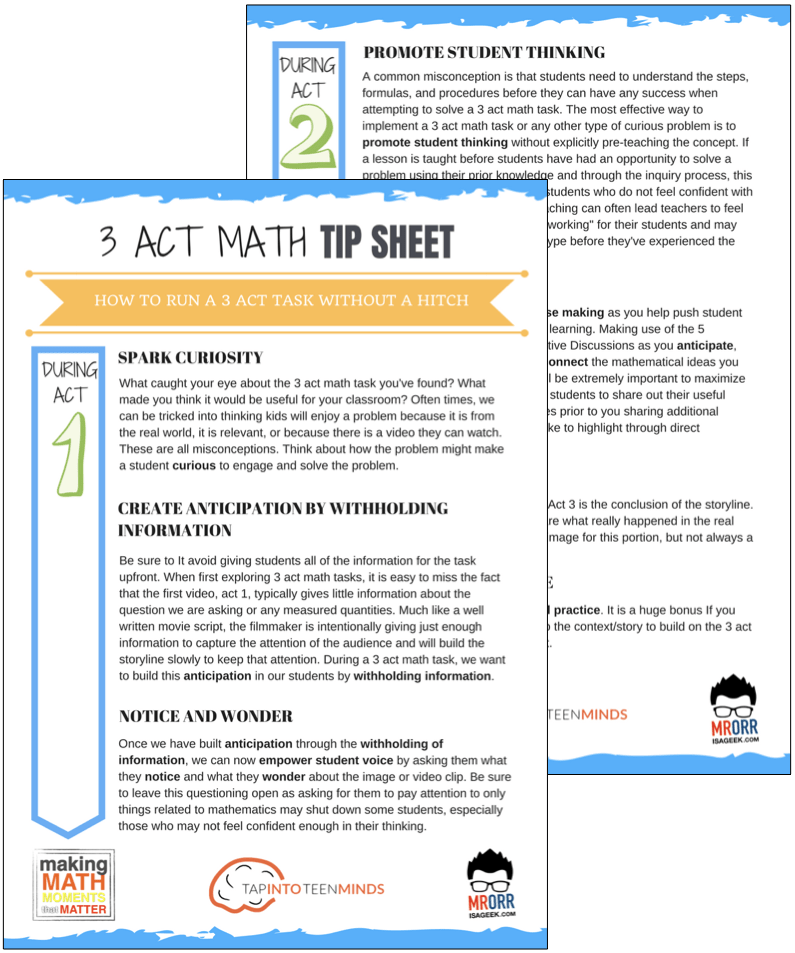
DOWNLOAD THE 3 ACT MATH TASK TIP SHEET SO THEY RUN WITHOUT A HITCH!
Download the 2-page printable 3 Act Math Tip Sheet to ensure that you have the best start to your journey using 3 Act math Tasks to spark curiosity and fuel sense making in your math classroom!
LESSONS TO MAKE MATH MOMENTS
Each lesson consists of:
Each Make Math Moments Problem Based Lesson consists of a Teacher Guide to lead you step-by-step through the planning process to ensure your lesson runs without a hitch!
Each Teacher Guide consists of:
- Intentionality of the lesson;
- A step-by-step walk through of each phase of the lesson;
- Visuals, animations, and videos unpacking big ideas, strategies, and models we intend to emerge during the lesson;
- Sample student approaches to assist in anticipating what your students might do;
- Resources and downloads including Keynote, Powerpoint, Media Files, and Teacher Guide printable PDF; and,
- Much more!
Each Make Math Moments Problem Based Lesson begins with a story, visual, video, or other method to Spark Curiosity through context.
Students will often Notice and Wonder before making an estimate to draw them in and invest in the problem.
After student voice has been heard and acknowledged, we will set students off on a Productive Struggle via a prompt related to the Spark context.
These prompts are given each lesson with the following conditions:
- No calculators are to be used; and,
- Students are to focus on how they can convince their math community that their solution is valid.
Students are left to engage in a productive struggle as the facilitator circulates to observe and engage in conversation as a means of assessing formatively.
The facilitator is instructed through the Teacher Guide on what specific strategies and models could be used to make connections and consolidate the learning from the lesson.
Often times, animations and walk through videos are provided in the Teacher Guide to assist with planning and delivering the consolidation.
A review image, video, or animation is provided as a conclusion to the task from the lesson.
While this might feel like a natural ending to the context students have been exploring, it is just the beginning as we look to leverage this context via extensions and additional lessons to dig deeper.
At the end of each lesson, consolidation prompts and/or extensions are crafted for students to purposefully practice and demonstrate their current understanding.
Facilitators are encouraged to collect these consolidation prompts as a means to engage in the assessment process and inform next moves for instruction.
In multi-day units of study, Math Talks are crafted to help build on the thinking from the previous day and build towards the next step in the developmental progression of the concept(s) we are exploring.
Each Math Talk is constructed as a string of related problems that build with intentionality to emerge specific big ideas, strategies, and mathematical models.
Make Math Moments Problem Based Lessons and Day 1 Teacher Guides are openly available for you to leverage and use with your students without becoming a Make Math Moments Academy Member.
Use our OPEN ACCESS multi-day problem based units!
Make Math Moments Problem Based Lessons and Day 1 Teacher Guides are openly available for you to leverage and use with your students without becoming a Make Math Moments Academy Member.
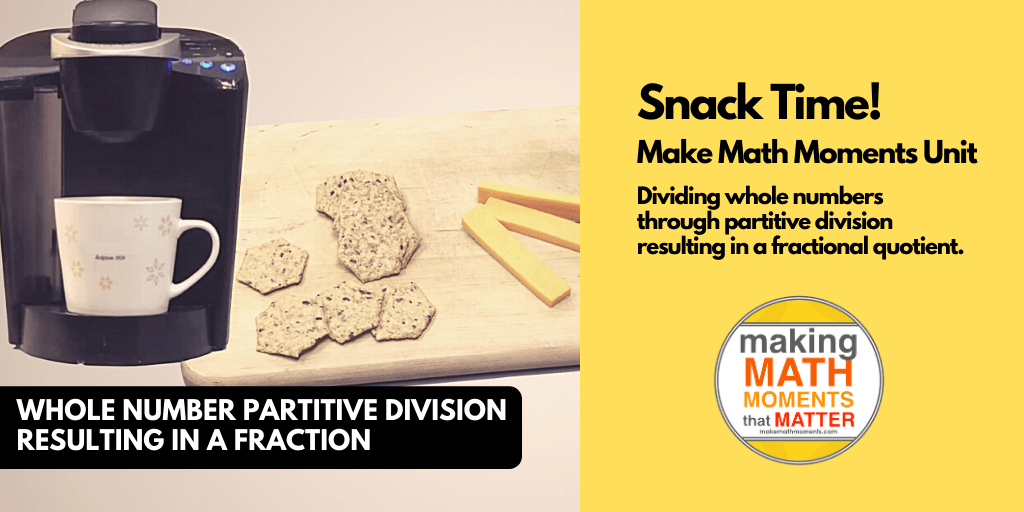
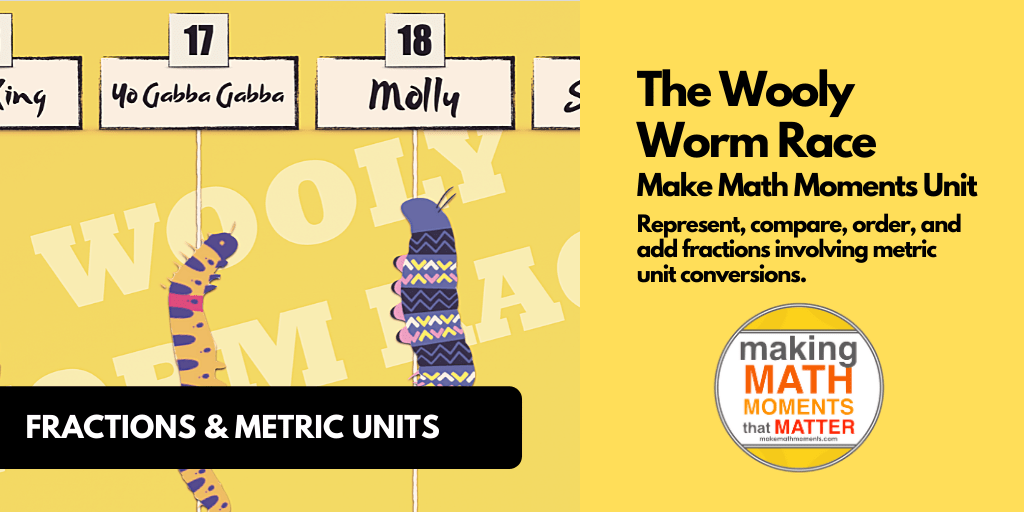
Partitive Division Resulting in a Fraction
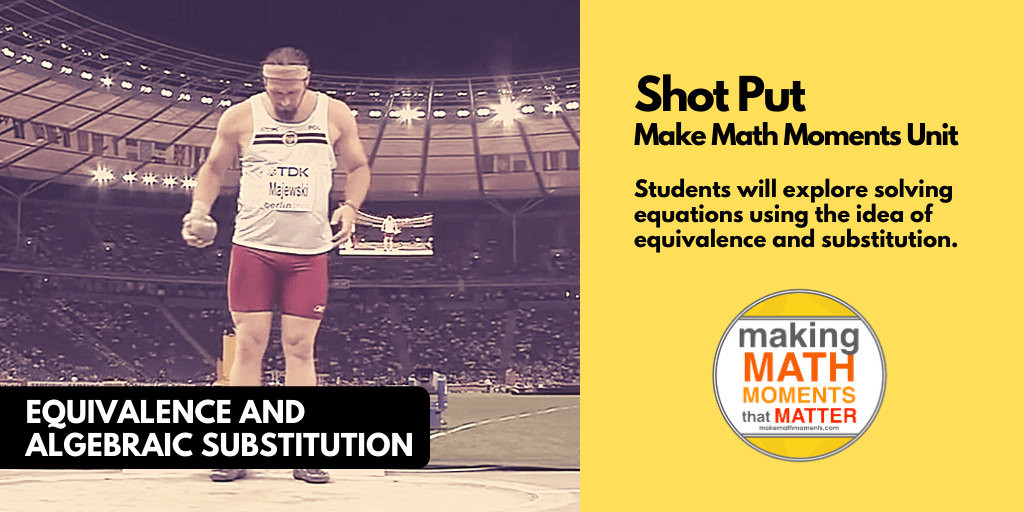
Equivalence and Algebraic Substitution
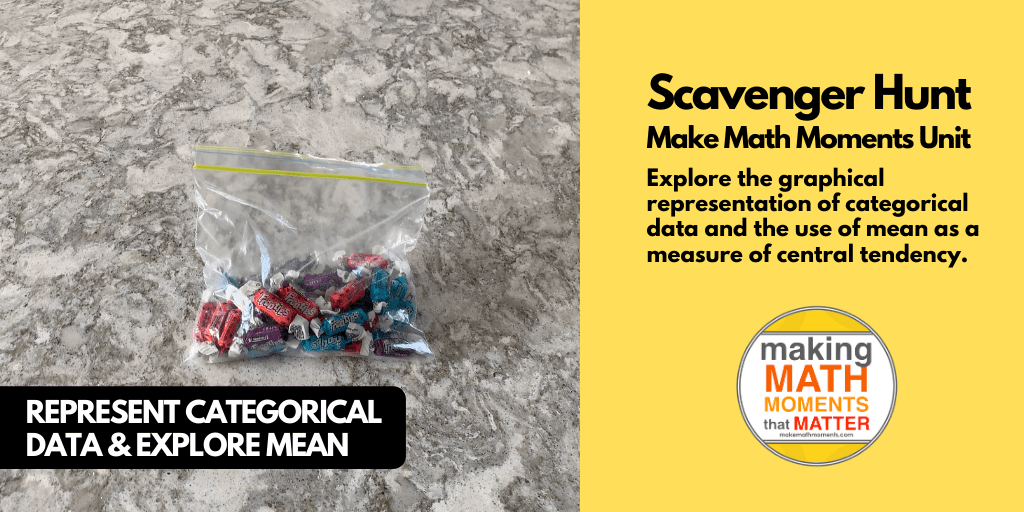
Represent Categorical Data & Explore Mean
Downloadable resources including blackline masters, handouts, printable Tips Sheets, slide shows, and media files do require a Make Math Moments Academy Membership.
ONLINE WORKSHOP REGISTRATION
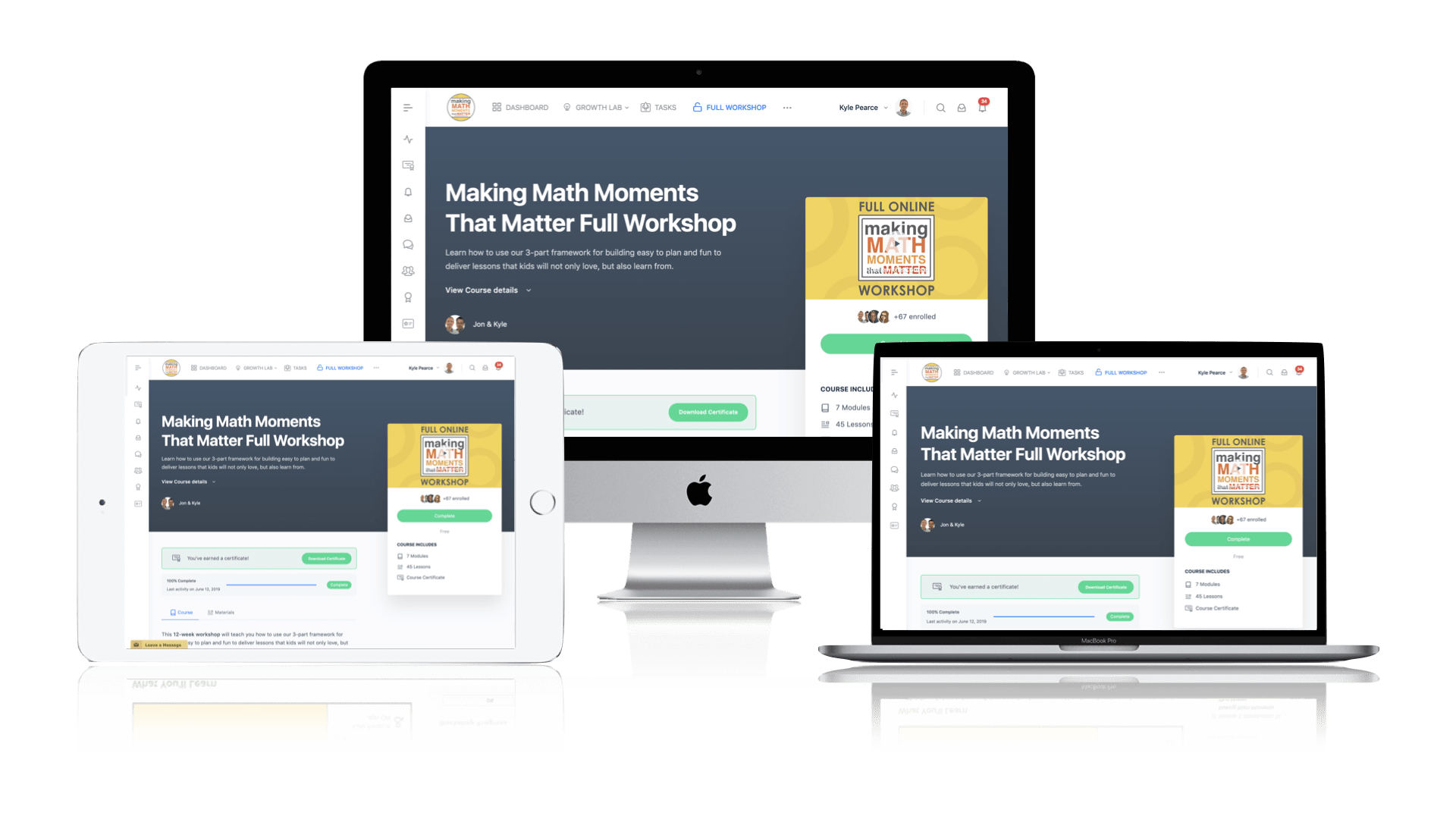
Pedagogically aligned for teachers of K through Grade 12 with content specific examples from Grades 3 through Grade 10.
In our self-paced, 12-week Online Workshop, you'll learn how to craft new and transform your current lessons to Spark Curiosity, Fuel Sense Making, and Ignite Your Teacher Moves to promote resilient problem solvers.
0 Comments