Episode #452: Learning Goals In Math Aren’t Working—Because You’re Using Them Wrong
LISTEN NOW HERE…




WATCH NOW…
If math learning goals are so important, why do they feel like a checkbox?
Research tells us that learning goals are critical for effective math instruction—but in classrooms and professional learning, they’ve become compliance: restated math standards, chapter titles, or “I can” statements posted for visibility but disconnected from the mathematics of the lesson. The result? Task-based math lessons that feel unfocused, weak mathematical consolidation, and students who leave math class unsure what they actually learned. In this episode, Jon and Yvette explain why math learning goals are the glue that holds meaningful math instruction together—and what happens when they’re misunderstood.
In This Episode, You’ll Learn:
- Why math learning goals drifted from instructional clarity to compliance
- The difference between a math performance goal and a true math learning goal
- How math learning goals anchor task-based and problem-based math lessons
- Why poor lesson consolidation in math is often a learning-goal problem
- How math learning goals guide teacher moves, questioning, and assessment
- What it means to write math learning goals around big ideas and behaviors of mathematics
- Why educators need mathematical epiphanies to design better math learning goals
- How math learning goals apply to both classroom instruction and math professional development
If your system is struggling with math lesson consolidation, formative assessment in mathematics, or task-based math instruction, this episode will help you rethink math learning goals—and identify where math capacity-building work needs to happen.
Attention District Math Leaders:
Download the Math Coherence Compass here.
Not sure what matters most when designing math improvement plans? Take this assessment and get a free customized report: https://makemathmoments.com/grow/
Ready to design your math improvement plan with guidance, support and using structure? Learn how to follow our 4 stage process. https://growyourmathprogram.com
Looking to supplement your curriculum with problem based lessons and units? Make Math Moments Problem Based Lessons & Units
Be Our Next Podcast Guest!
Join as an Interview Guest or on a Mentoring Moment Call
Apply to be a Featured Interview Guest
Book a Mentoring Moment Coaching Call
Are You an Official Math Moment Maker?



FULL TRANSCRIPT
Yvette Lehman: In today’s episode, we’re going to talk about why learning goals are not just about compliance or, you know, my principal told me I’m supposed to post the learning goal on the board for transparency and that the learning goals are not just restating the standards or expectations. They’re far more nuanced and impactful from that than that. And also so critical to any type of learning you’re doing, whether that’s in the classroom with students or in professional development with educators.
Jon Orr: Reddit on the board.
Yvette Lehman: learning you’re doing, whether that’s in the classroom with students or in professional development with educators.
Jon Orr: True, true. I think it’s been glossed over the whole write it on the board because the research says learning goals are important for students to understand and connect their learning to what the big purpose was here today. That’s an important component of learning.
You’ve got Hattie stating that that’s an important component. You look at the eight effective principles from principles to action. It’s in there. You know, like it’s learning goals is one of those those practices.
And so it was like, well, that’s we better make sure everybody writes a learning goal or tells everyone the learning goal. But really, what you end up seeing was like, they’re just writing the expectation from the curriculum documents or they’re they’re writing like what the chapter title was, or they’re writing something like, can calculate or solve two step equations like, like, these are the learning goals that typically get written.
But then it’s like you said, compliance. It’s like, the research says we should do it, so I’ll write it up, but then I don’t actually use it in my lesson, or I don’t connect it, or I’m not doing any sort of other things that are essential to why the research is saying that that’s an important, and you’ve used the word before we hit record, it’s critical point of the lesson.
Yvette Lehman: think it can be emphasized enough, truthfully, how important it is to, particular, a task-based lesson. Like if you are going to dip your toe into a task-based lesson, and we don’t want it to get the bad reputation of being discovery or aimless or totally student directed, it’s like the learning goal is the glue that holds that lesson together that allows you, and we often hear this from our district partners where we have coaches and leaders saying, you know, teachers aren’t consolidating the lesson. Teachers aren’t landing the lesson.
You know, kids are going in doing things, but then they’re not bringing them back together and emerging the big idea and then doing formative assessment around that big idea. And I think we can probably diagnose that the reason that the lesson is not being consolidated or landed is because the teacher has not internalized the learning objective or outcome for that lesson.
And so they’re just not well positioned to consolidate. And that goes back to like capacity building and doing lesson study and using PLC time to understand what the learning objective or outcome or goal is for today or the unit.
Jon Orr: Right, right. just totally.
For sure. Because I think you’re still relying on like what you remember from you flip the page to this chapter, or you look it up on you download the teacher guide and, and it says the title, but then you’re like, okay, I got this because I remember what the general outcome is going to be here about this procedural approach.
But, you know, if that’s the case, again, if you’re teaching from from a task based perspective, or a problem based perspective, perspective or lesson plan, you’re you’re absolutely right is critical because you give off the impression that it’s like, this is this is a free for all.
And sometimes you think it’s a free for all because you’re like, I’m going to immerse them in this experience. And they’re just going to learn it. And kids go home and go like, I don’t know what was going on in math today. And the parents start calling and complaining it’s mostly because you didn’t tie it with a bow.
And if you’ve listened to this podcast, this is going to sound like we started this podcast in 2018. This is episode, four, four 52. So it’s like, we haven’t done a math mentoring moment episode in quite some time. Like we, but we, it was a regular part of the early episodes. And mostly because, you know, our work, if you’ve, you know, you’re listening now, our work has shifted in supporting schools, school districts, doing system wide planning and professional development planning.
But we were coaching teachers through problem-based lessons on the podcast in those mentoring moment episodes pretty regularly.
If you were listening back then, or if you listened to some recently, because you’re scrolling and you’re saying, hey, I want to load the answer to that problem and you listen to that episode, you probably are hearing Kyle and myself talk about intentionality because that is the biggest theme when we are coaching teachers that they were going into these types of lessons, whether it was a building thinking classrooms lesson, you know a number talk lesson a math talk lesson a problem string lesson.
And they just didn’t first take the step to go well, what is my true intention with this lesson and whatever we really want to uncover like what behaviors of math do I really want to uncover here today? What is the essential learning that they what we want to carry forward today?
It’s usually we didn’t do that pre work. They didn’t do that pre work. They’re like we’re go in and do this but then I didn’t tie it with a bow, we left before it was over and kids are wondering what was this point of this?
And we coach those folks to say like, you gotta tie it up, you gotta tie it with a bow. You gotta make sure that the intentionality is there for you, but also them.
And that’s an important component because it helps guide the next move, it helps guide all the moves that you’re gonna be making, but also makes it clear, it’s like what is the intention here today? So.
You’ll also hear us probably say back then, it like, don’t write the learning goal on the board. Reveal it later.
And that was one of the moves that we made early on in our work, whether you’re right at the beginning or the end, to me, it didn’t matter as long as it was very clear to everyone in the room, what the purpose was and the intentionality. And how do you know?
Like, how do we know that we hit that learning goal here today? And so that we can make adjustments moving on. So I agree. Absolutely critical.
Yvette Lehman: You also mentioned, you know, this is not new. You know, we like learning goals came out here in Ontario with growing success, which is I think 2010. It, or yeah, like 2010 when they were released and you know, that same time around the same time as the effective teaching practices, establishing learning goals is one of the practices.
So, you know, this is not new, but I will tell you that my understanding of learning goals has evolved since then.
When I think back to myself in 2010, 2011, 2012, I think I was probably just writing the curriculum expectation in student-friendly language. So it’s like, okay, just take this expectation and make it more student-friendly, less education jargon, make sure students can understand it, see themselves in it.
But I feel like since then, and I think heavily influenced by five practices for orchestrating productive mathematical discussions, I understand now that a learning goal is not just taking a curriculum expectation and restating it.
It’s really connected to big ideas or generalizations or conjectures that you can make about the behaviors of mathematics.
Okay, perfect. So we have a session this Friday and I want to restate that this is important not only for classroom teachers who are engaging in task-based lessons in the classroom, but also for people who are delivering PD.
Right, so it’s like, you know, we are delivering PD on Friday to principals, coaches, and teachers. And we are going to start with a task.
And 10 years ago, I would have written the learning goal for the task that we’re doing as we will calculate the mean.
Okay? It’s like an action, something that we will do. It’s a performance task.
Now I’m going to write the learning goal for Friday session as we will understand that mean is the process of redistributing the values in a data set evenly.
Jon Orr: Big difference.
Yvette Lehman: huge difference.
Because what I want from Friday’s session is for people to understand the behavior of finding the mean. Like what are we actually doing beyond just, you know, add up the numbers and divide by the number of numbers.
I want them to visualize the idea that like we’re going to use a graphical representation. So like stacked bar graphs to start a bar graph to show that, you know, we can actually imagine these were linking cubes.
And we could actually take the quantities and redistribute them so that every one of those bars was the same height.
And that’s the learning goal. That’s the epiphany. That’s the aha. That’s the conjecture that I want people to walk away with. The lasting, enduring understanding.
Jon Orr: Yeah, think of the difference that your lesson takes knowing one goal versus the other.
Yvette Lehman: They’re totally different lessons.
Jon Orr: Exactly, so it’s like they could be the same.
My point though is that they could be the same lesson on paper from here to here, but if you knew one versus the other, the moves you make during that lesson are gonna be, in my opinion, completely different.
Because you have to keep asking yourself, this is what we do when we deliver any sort of learning to any group, is you have to continually ask yourself, did we hit the learning goal now? Did we hit the learning goal now? How do I know?
How do I know that I hit the learning goal? Like, you have to also answer that beforehand so you know when you hit it.
Right, so like, this is the important part of when you unpack a lesson.
My old self would have said like, well, I’ll just tell them the learning goal at the beginning.
I will teach it to them straight up.
And that will be, I’ll know because my only success criteria here was like I delivered and not actually like, you know, went around and made sure or I’ll quiz them two days later.
That was the way I used to do it.
But think about the moves that you make because you know one learning goal versus another while you’re delivering that lesson because you’re saying like, did we make it clear to now that we’ve had the epiphany that this is what mean is, and this is what we’re trying to uncover here today versus like, did they just calculate it?
Because it’s completely different.
Now, let’s go one step meta, right?
Because what is your learning goal to deliver this PD to this group of people?
Because I’m gonna argue that you’ve got a learning goal, that is a learning goal for this group for sure in that task.
But what about the entire session?
Yvette Lehman: Well, and I think that my, and it’s a great question.
It goes back to the objectives that they’ve identified as a system, right?
So they said, you know, they want reasoning, they want discourse, they want conceptual understanding and procedural fluency.
These are things that they want for their students that they’re working toward.
And so I think about my own journey.
It’s like, how did I evolve from we will calculate the mean to, we will understand the behavior of mean as the redistribute.
Like what was the journey?
Because if that’s, if we want students to be able to, you know, engage in productive struggle and reasoning and mathematical discourse and, you know, explain their thinking and use a variety of connect representations, all of the practices in practice, I feel like my learning was twofold.
It’s like I needed to learn the content.
And so that’s what we’re also trying to do for the educators participating in this professional development.
It’s like every, every chance we get, how are we building our own mathematical proficiency?
Like as mathematicians ourselves, like are we interacting with math in a meaningful way that we are having these epiphanies and making conjectures and almost shaking our belief of what we knew.
This procedure that everyone’s like, we’ll just memorize the steps. And then the next year the kids forget it and they have to be retaught it every single year, you know.
So I think that part of the PD on Friday is to just engage in the mathematics.
But then also when I think about my own journey, it’s like I had to build up my own mathematical proficiency around the concepts that I taught, but I also needed like five practices, I needed to understand that the learning goal wasn’t just about being able to do something.
It wasn’t about like, I can calculate mean.
It was about big ideas lasting and during understanding, which is how they define learning goals.
And they give examples in that book.
But you know, if you read five practices, they say, they show you the distinction between like a performance task and an actual true learning goal.
Jon Orr: Right, yeah.
And think another goal, you know, learning, understanding for this group that we’re, you know, like not only are we trying to give them this specific math epiphany, is that we want them to have the continued reinforcement that epiphanies in math actually matter because of the experience you just described, is that you needed to have epiphanies before you could think this way, right?
So which means like you want leaders, and this is why we’ve designed the professional development this way as an important outcome.
It’s like we need to design some professional development so that we create epiphanies for everyone.
Cause we’re speaking mostly to leaders and we want leaders to realize that I need to also create epiphanies for my teachers because I can’t, I can’t get them to create learning goals in this way without that experience.
Like they need to ask themselves, what is the big understanding what is the continued learning, the big idea that I want them to carry forward.
We’re not going to have that.
Like, we’re going to continue to write learning goals that say I can calculate the mean because I need to have that epiphany first.
And that’s a big part of this session is to help leaders realize that they have to actually plan for this.
They have to build that in.
That was the lasting understanding that we want the system to think about and system to design moving forward because that isn’t just a one time thing, it’s a bigger thing than one.
Yvette Lehman: So for our listeners today who are like, okay, we agree, you know, we agree that learning goals are important and learning goals, where is the opportunity to do this work within your system?
So that’s kind of our call to action.
It’s like looking at where are your opportunities to have networks of educators come together to engage in math, to co-construct learning goals, to talk about the big idea of the lasting and enduring understanding from a particular lesson or high priority standard.
Does that opportunity exist within the system that you support?
And if not, where can we create that opportunity?
Because this is the work.
If you’re saying to yourself, my teachers aren’t consolidating, my teachers aren’t landing the lessons, my teachers aren’t engaging in meaningful formative assessment of student learning, it’s likely part of the areas that needs to be strengthened is our understanding of learning goals and how they guide our practice in the classroom, our facilitation, the questions we ask, how we consolidate, how we assess.
And so if that’s the maybe pebble in your shoe right now, or the problem that you’re seeing across your system, the other problem you likely have is you don’t have a professional development lever to be able to engage teachers in this type of thinking and build their capacity for it.
It’s not likely going to happen for the masses if there isn’t time and space to get into this really important work.
Jon Orr: I prioritize it for sure.
Now some inside info is we had to think about what is the learning outcome for this podcast episode, because you have to do this work anytime you’re trying to convey a message or teach someone anything.
And that is the same message we’re trying to convey in this Friday session that we’re going to be doing with leaders is helping you realize that there’s these epiphanies that need to happen and we need to plan for them.
So those are good. Next step moves, Yvette.
Another next step is to think about your tree, your leadership tree, your classroom tree.
We hinted on learning goals, which to us is a branch of your tree. This is the pedagogical moves that you have to do the pre-planning, you have to think about what that lesson’s gonna look like.
But also on the leadership side and also the teacher’s side, an important limb of the tree is your capacity building, understanding that.
It’s almost impossible for us to do some of the moves that we really want to do in our classroom to create these types of experience if we’re not continually strengthening our own capacity around mathematics.
And that’s how we want to strengthen that tree.
One last move here for you is we’ve put together 50 different principles understanding and creating math improvement plans.
These are the principles that we help our teams with.
These are the principles that we help, that teach through our courses.
And here on the podcast, if you want access to all 50 of those principles and how they can help you structure your math improvement planning, you can head on over to makemathmoments.com forward slash ebook, makemathmoments.com forward slash ebook and grab our free ebook on the 50 principles that strengthen math improvement planning.
Thanks For Listening
- Book a Math Mentoring Moment
- Apply to be a Featured Interview Guest
- Leave a note in the comment section below.
- Share this show on Twitter, or Facebook.
To help out the show:
- Leave an honest review on iTunes. Your ratings and reviews really help and we read each one.
- Subscribe on iTunes, Google Play, and Spotify.
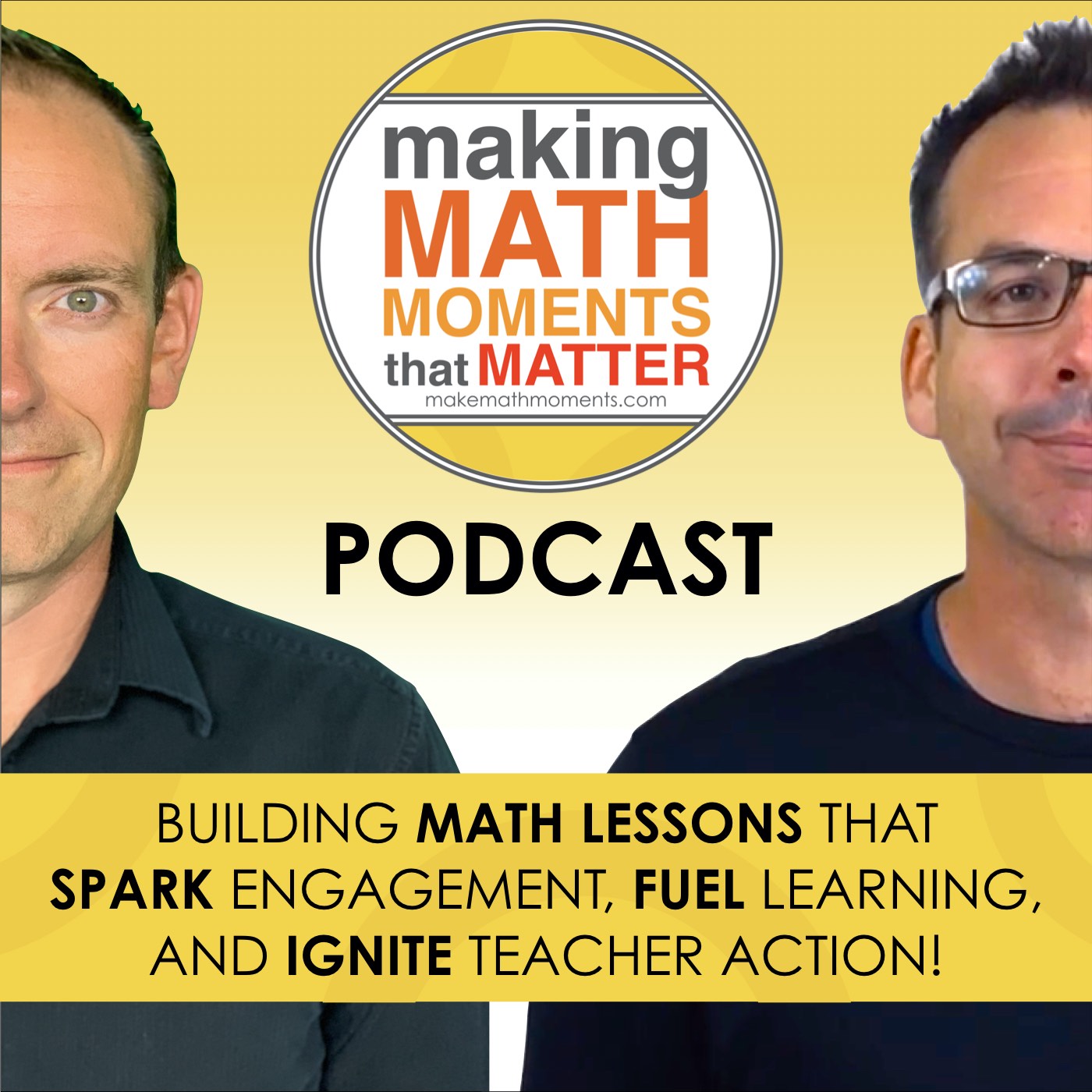
DOWNLOAD THE 3 ACT MATH TASK TIP SHEET SO THEY RUN WITHOUT A HITCH!
Download the 2-page printable 3 Act Math Tip Sheet to ensure that you have the best start to your journey using 3 Act math Tasks to spark curiosity and fuel sense making in your math classroom!
LESSONS TO MAKE MATH MOMENTS
Each lesson consists of:
Each Make Math Moments Problem Based Lesson consists of a Teacher Guide to lead you step-by-step through the planning process to ensure your lesson runs without a hitch!
Each Teacher Guide consists of:
- Intentionality of the lesson;
- A step-by-step walk through of each phase of the lesson;
- Visuals, animations, and videos unpacking big ideas, strategies, and models we intend to emerge during the lesson;
- Sample student approaches to assist in anticipating what your students might do;
- Resources and downloads including Keynote, Powerpoint, Media Files, and Teacher Guide printable PDF; and,
- Much more!
Each Make Math Moments Problem Based Lesson begins with a story, visual, video, or other method to Spark Curiosity through context.
Students will often Notice and Wonder before making an estimate to draw them in and invest in the problem.
After student voice has been heard and acknowledged, we will set students off on a Productive Struggle via a prompt related to the Spark context.
These prompts are given each lesson with the following conditions:
- No calculators are to be used; and,
- Students are to focus on how they can convince their math community that their solution is valid.
Students are left to engage in a productive struggle as the facilitator circulates to observe and engage in conversation as a means of assessing formatively.
The facilitator is instructed through the Teacher Guide on what specific strategies and models could be used to make connections and consolidate the learning from the lesson.
Often times, animations and walk through videos are provided in the Teacher Guide to assist with planning and delivering the consolidation.
A review image, video, or animation is provided as a conclusion to the task from the lesson.
While this might feel like a natural ending to the context students have been exploring, it is just the beginning as we look to leverage this context via extensions and additional lessons to dig deeper.
At the end of each lesson, consolidation prompts and/or extensions are crafted for students to purposefully practice and demonstrate their current understanding.
Facilitators are encouraged to collect these consolidation prompts as a means to engage in the assessment process and inform next moves for instruction.
In multi-day units of study, Math Talks are crafted to help build on the thinking from the previous day and build towards the next step in the developmental progression of the concept(s) we are exploring.
Each Math Talk is constructed as a string of related problems that build with intentionality to emerge specific big ideas, strategies, and mathematical models.
Make Math Moments Problem Based Lessons and Day 1 Teacher Guides are openly available for you to leverage and use with your students without becoming a Make Math Moments Academy Member.
Use our OPEN ACCESS multi-day problem based units!
Make Math Moments Problem Based Lessons and Day 1 Teacher Guides are openly available for you to leverage and use with your students without becoming a Make Math Moments Academy Member.
Partitive Division Resulting in a Fraction
Equivalence and Algebraic Substitution
Represent Categorical Data & Explore Mean
Downloadable resources including blackline masters, handouts, printable Tips Sheets, slide shows, and media files do require a Make Math Moments Academy Membership.
ONLINE WORKSHOP REGISTRATION
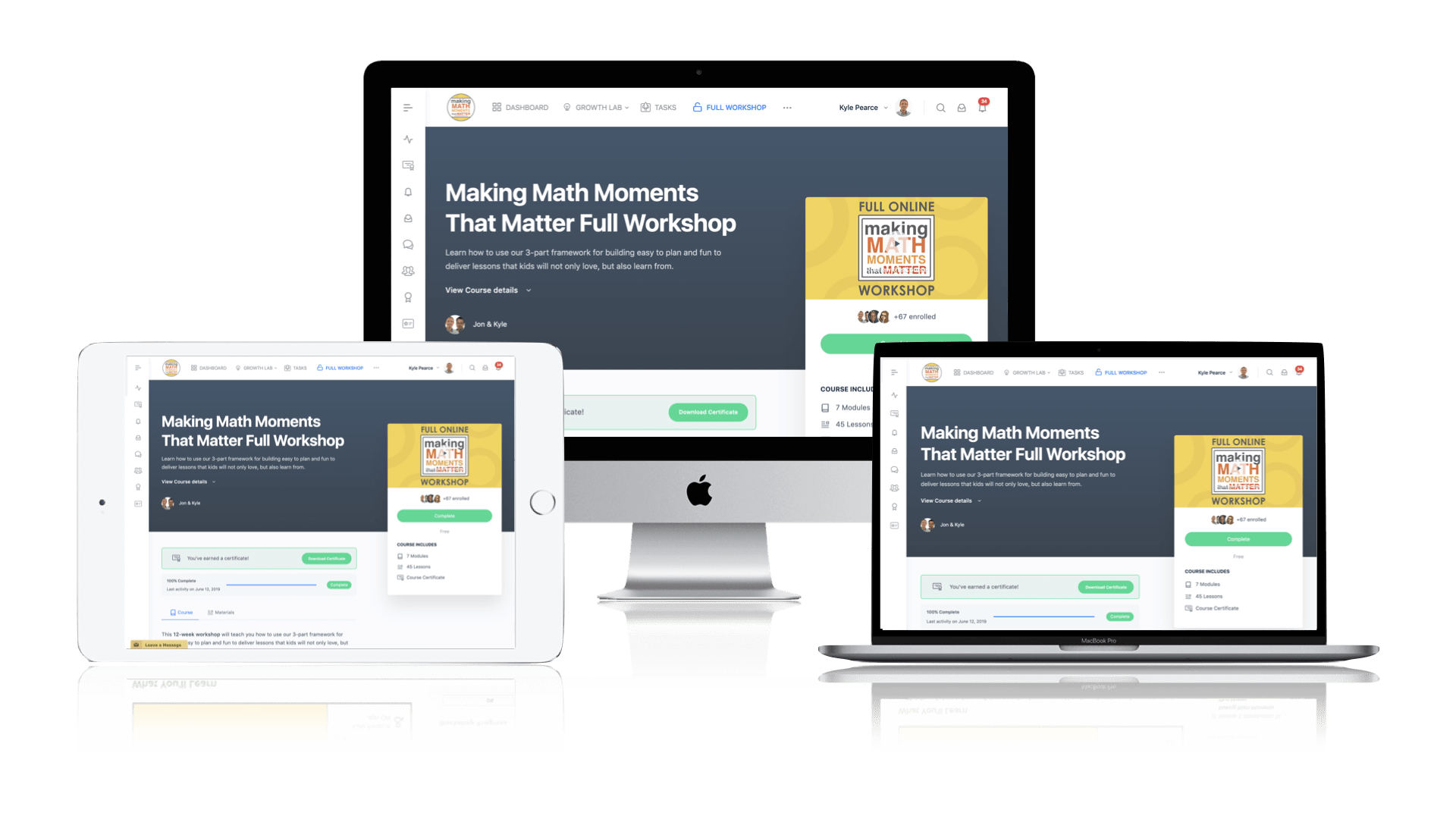
Pedagogically aligned for teachers of K through Grade 12 with content specific examples from Grades 3 through Grade 10.
In our self-paced, 12-week Online Workshop, you'll learn how to craft new and transform your current lessons to Spark Curiosity, Fuel Sense Making, and Ignite Your Teacher Moves to promote resilient problem solvers.

0 Comments