Episode #477: How to Design High Quality Low Floor High Ceiling Math Tasks
LISTEN NOW HERE…




WATCH NOW…
Not all math tasks are created equal. Some lead to deep thinking, rich discussion, and meaningful learning—while others fall flat. So what actually makes a math task effective?
It’s easy to assume that a “good” task is just one that students can complete. But truly powerful mathematical experiences go beyond that. They provide access for all learners while still offering meaningful challenge. They invite multiple strategies and solutions, encouraging students to think, question, and engage with the math in different ways. And they require careful design—not just of the task itself, but of how it’s facilitated in the classroom.
In this episode, you’ll explore:
- The key criteria of a high-quality math task
- What “low floor, high ceiling” really means in practice
- Why multiple strategies and solutions matter
- How teacher moves impact the effectiveness of a task
- The role of high-quality instructional materials
- How to reflect on and improve the tasks you’re already using
If you want to create more engaging and meaningful math experiences for your students, this episode will give you a clear lens for evaluating and improving the tasks in your classroom.
Attention District Math Leaders:
Not sure what matters most when designing math improvement plans? Take this assessment and get a free customized report: https://makemathmoments.com/grow/
Ready to design your math improvement plan with guidance, support and using structure? Learn how to follow our 4 stage process. https://growyourmathprogram.com
Looking to supplement your curriculum with problem based lessons and units? Make Math Moments Problem Based Lessons & Units
Be Our Next Podcast Guest!
Join as an Interview Guest or on a Mentoring Moment Call
Apply to be a Featured Interview Guest
Book a Mentoring Moment Coaching Call
Are You an Official Math Moment Maker?




FULL TRANSCRIPT
Yvette Lehman: We recently read an article that was digging into the five practices — specifically at the upper high school into college level — and really understanding the moves we make when designing a five practice lesson. For those listening who aren’t familiar, we’re talking about the framework for lesson design called Five Practices for Orchestrating Productive Mathematical Discussions.
Yvette Lehman: The article we were reading was specific to upper secondary into college level courses. As we were engaging in a reading protocol, I circled a section about the criteria for a strong task — or let’s call it a strong mathematical experience. I thought it was a great springboard for conversation about what we want to see consistently happening in the experiences we design for students in the math classroom.
Yvette Lehman: Here’s what the article said — and I’m paraphrasing. The first criterion was essentially: it needs to be low floor for the purpose of engagement and access. Everybody needs to be able to take the first step to get in, to have the tools to connect to their prior knowledge and enter the learning. The second was that it also has to have a high bar for success — there’s room for it to go somewhere significant and meaningful; it’s not limited. That’s the low floor, high ceiling idea. And lastly, it has to be amenable to a variety of solutions and strategies. There needs to be more than one way to tackle this mathematical experience. I really felt that becomes almost like a filter through which I look at experiences I create — not only for students, but also for teachers when we’re engaging in professional development.
Jon Orr: You may have heard the term low floor, high ceiling tasks before, but I think it starts to desensitize you to what it really could and should look like around creating experiences that all students can access. Because that itself opens up a lot of interpretation — what does it mean for all students to engage? Is it starting with yesterday’s problem? Is it starting with a concrete representation of something? There’s an important design element there that we need to carefully think about.
Jon Orr: I was your elbow partner when you circled that section, and I agree — these are good filters for selecting tasks. Beth, thoughts, wonders, extensions on task criteria? What makes a good math task?
Beth Curran: I want to caution any listener who’s hearing us talk about choosing or creating tasks: we’re not saying you need to abandon your high-quality instructional material and start building your own tasks from scratch. First and foremost, look at the materials you currently have and the tasks within those curricular materials. Then think: do I need to slightly tweak this? What manipulatives should I have on hand so it’s accessible at different levels? How am I going to encourage students to draw a picture, build a model, or approach the task in different ways? Think about those three big indicators of a good solid task that Yvette shared — and then think about how you can promote that in your classroom, maybe using tasks that already exist within your curricular materials.
Jon Orr: And I want to flag something around the word “task” — it sometimes gives off the impression of a full, drawn-out activity that takes up an entire lesson or a large portion of it. What we’re really talking about are mathematical experiences for students. Task is just a short word for that, but we need to make sure we define what it is.
Jon Orr: I want to point to another resource here. There’s a book I often go back to by Jeff Kral called Necessary Conditions — about teaching secondary math with academic safety, quality tasks, and effective facilitation. He’s got five look-fors or criteria for a good mathematical experience. He says: quality tasks spark curiosity and foster engagement; quality tasks yield creativity; quality tasks promote access for all students; quality tasks require and convey deep, crucial mathematical content; and quality tasks connect and extend content. There are real similarities between these and the criteria from the five practices article, and I think they pair together nicely.
Yvette Lehman: Those two sets of criteria together start to paint a picture for me of what I would see in student behavior if I walked into a room where students were engaged in this type of mathematical experience. I would picture students leaning in. They’ve got tools in their hands. They’re trying things, testing, making conjectures, questioning each other. It wouldn’t be obvious who “has it” and who doesn’t, or who is engaged — because everybody would be drawing meaning from the experience. Their body language would demonstrate curiosity, investment, and willingness to persevere. Even if they were stuck, they’d be willing to try a different way. And I would see a mathematical community where people are learning from and with each other — decentralized, not just teacher-student-teacher-student. There’d be a sense of collectively building a shared understanding by leveraging the expertise of the whole room through this common experience.
Jon Orr: What you just described, Yvette, is a visual representation of the Standards for Mathematical Practice. When you said community — that’s students constructing viable arguments and critiquing the reasoning of others. When you described perseverance — that’s making sense of problems and seeing them through. And when we talk about the task criteria of allowing multiple strategies and multiple solutions, that aligns with using appropriate tools strategically. These criteria, taken together, create the conditions for more of those mathematical practices to show up consistently in student experience.
Yvette Lehman: I want to get into a concrete example. Let’s take a standard and talk about how we’d approach it through this criteria. The one I wanted to tackle is something I saw recently in an Algebra 1 class — factoring trinomials with a leading coefficient of one or greater than one. I left wondering: if I wanted students to understand standard form and factored form, how could I create a mathematical experience that was accessible, engaging, had a low floor, created curiosity, went somewhere meaningful, had a high ceiling, and allowed for multiple pathways?
Jon Orr: What Beth would say is that you’d turn to your high-quality instructional material first — there’s probably already a task there that you can leverage, tweak, or modify. But let me describe how I’ve approached this specific standard, because I think it’s a really good example of what this can look like in practice.
Jon Orr: The traditional approach to factoring trinomials — whether the leading coefficient is one or greater than one — is typically broken into two separate lessons using an “I do, we do, you do” model. The teacher unpacks what a trinomial looks like, explains what factoring is and why it matters, then teaches the steps. Maybe there’s a look at the last term and the middle term, maybe a pattern-noticing prompt. But it usually ends up as: follow these steps in this order.
Jon Orr: What I want to point out is that what we’re really unpacking when we factor trinomials is the power of equivalent expressions. Some expressions are more valuable than others, and factored form lets us do things with an expression that standard form doesn’t. That’s the heart of it — two expressions that are equivalent no matter what value you substitute in for X. I think we often gloss over that big idea.
Jon Orr: So here’s the low-floor entry point I’ve used. Dust off the algebra tiles. Give each pair of students a set — say, one X squared tile, five X tiles, and six unit tiles — and say: make me a rectangle. That’s it. They’ll start arranging. Some will make a long skinny thing that isn’t a rectangle. You say: no gaps, filled in, a true rectangle. And eventually, every student can arrange that specific collection of tiles into a rectangle — because those tiles factor. If you took one tile away, it wouldn’t make a rectangle. And that’s the first big idea: some trinomials are factorable and some aren’t.
Jon Orr: Once they’ve made the rectangle, ask: what are the dimensions? What’s the length? What’s the width? Write them down. Then reverse it — here’s a length and a width, what area do you get? Over a series of short examples, students start to notice patterns. They figure out that the last term tells them something about the factors, and that the X tiles need to line up to make the rectangle. They’re essentially self-developing the algorithm you were going to teach them anyway. And the beauty is, they always have that concrete model to fall back on. If they forget the algorithm, they can draw the rectangle or grab the tiles. They’ve got a low-floor, accessible strategy they can return to.
Jon Orr: And here’s the high-ceiling extension: once students are ready, ask them to make a square. That’s the visual representation of completing the square — a concept that naturally follows in that course or the next. You’re giving students another model to unpack a very abstract idea before they ever encounter the symbolic version. I wrote a post about this on my website and called it “Sneaking in Factoring” because really, what I did was take 10 minutes at the start of class every day for a few weeks — get the tiles out, make a rectangle, put them away — and by the end, students had developed how to factor various types of trinomials without ever having a full formal lesson on it. I’ll put the link in the show notes.
Yvette Lehman: What I loved about it as a learner in that experience is that it wasn’t intimidating. I could do it. And even just having the tiles to make sense of the three terms was helpful for me to visualize what I was actually doing. Then it was so exciting when we started to make that conjecture — that we just need to decompose the middle term additively into two factors of the last term. And then we were fast. I could visualize the rectangle without even needing the tiles anymore, because we’d done enough reps. The cognitive demand kept increasing, but we were always leveraging the conjectures we’d built from previous experiences.
Yvette Lehman: Here’s my question to both of you though. That’s a beautiful example of taking a concept traditionally taught as “follow these rules, don’t ask why” and creating a visual, a model, more access, more meaning. But I’m a teacher listening and I think — I wouldn’t have known to do that. My own experience of learning math wasn’t that. So what’s our recommendation to listeners who are saying, I want to do that, but where do I even begin?
Beth Curran: She’s going to say look to your high-quality instructional material — and I will! But more importantly: do the math. Be curious about the models your curriculum is already presenting. If your school has adopted a newer curriculum in the last 10 years, it’s going to have these representations built in. It’s easy to gloss over them and head straight to the abstract. But when you see an algebra tile model or a rectangle model show up in the curriculum, don’t skip it — be curious. Why is that there? How does it connect to the abstract steps I know how to do? How is it helping students understand the why before they get to the how?
Jon Orr: Right. And I’d add that part of this is about owning what you don’t know. You owe it to yourself and your students to go after the why — not necessarily all at once and not for every lesson simultaneously. Make a commitment: on this topic, this year, I’m going to understand the why behind this model. And then follow through. When I first saw algebra tile examples at the beginning of my textbook, I skipped past them. It wasn’t until I committed to asking, what’s really going on here? — and started asking why the box method worked and how it connected to rectangles and area — that things clicked. Make that commitment, and know that over your career, you’ll get stronger one understanding at a time.
Jon Orr: Yvette, what about as leaders, coaches, and coordinators? What do we do when our teams don’t know what they don’t know?
Yvette Lehman: Two things come to mind. First, get a high-quality instructional material into the hands of educators — one that surfaces all five mathematical representations: verbal, physical, pictorial, contextual, and abstract. If we have that baseline, the opportunity to connect meaningful representations is already built into the curriculum design. That’s the starting point for all leaders. Second, this work is not easy to do alone. We need collaborative spaces where teachers can interact meaningfully with each other and with the content — unit unpacking, lesson planning together, looking at student work. How are we structuring PLC time around those things?
Jon Orr: Exactly. And we’ve talked about this before — what teachers need to actually shift their practice isn’t just a good resource. They need four things. First, they need to believe this is the right approach — the professional learning has to make the case. Second, they need to see it in action. You can’t just describe it. They need to observe a video or watch someone model it live. Third, they need to believe they can do it themselves — which comes from repetition and confidence over time. And fourth, they need consistent follow-up support through coaching and PLCs. The data suggests it takes about 49 professional development hours to get to the point where a practice shows up routinely in the classroom and produces consistent results with students. That’s a serious commitment, but it’s what actually moves the needle.
Yvette Lehman: The indicators we shared today are a framework — a lens through which to step back and look at what’s happening. If I’m a teacher and I look around my room and ask: did this create access? Was it engaging enough to get students in? Was there opportunity for robust learning around meaningful mathematical ideas? Were there multiple pathways? — awareness is the first step. And that’s the same recommendation for leaders and coaches. If you’re walking around classrooms and you know what a strong mathematical experience looks like, ask yourself: do I have student evidence that this is happening? And if not, what are we prepared to do about it?
Jon Orr: Well said. If you’re a math coordinator, coach, or administrator looking to shape math instruction and improve how your team uses PLC time, we’ve been supporting teams with what we call the math coherence compass. It’s a tool that helps teams get clear and create coherence around the mathematical experiences you want for students. It leans on your vision, your core beliefs, your strategic strengths, and your objectives as a system. We’ve been going into schools and helping them build that compass — and shaping what PLC time can look like around it.
Jon Orr: If you want a compass to take and run with, we have a blank version plus a training around how to fill it out and use it. Head on over to makemathmoments.com forward slash compass, get a copy, engage in that training, and start creating more clarity around what you’re trying to do for student mathematical experiences — and what tools and processes could support that in your school or district. That’s makemathmoments.com forward slash compass. We’ll see you in the next episode.
Thanks For Listening
- Book a Math Mentoring Moment
- Apply to be a Featured Interview Guest
- Leave a note in the comment section below.
- Share this show on Twitter, or Facebook.
- Leave an honest review on iTunes. Your ratings and reviews really help and we read each one.
- Subscribe on iTunes, Google Play, and Spotify.
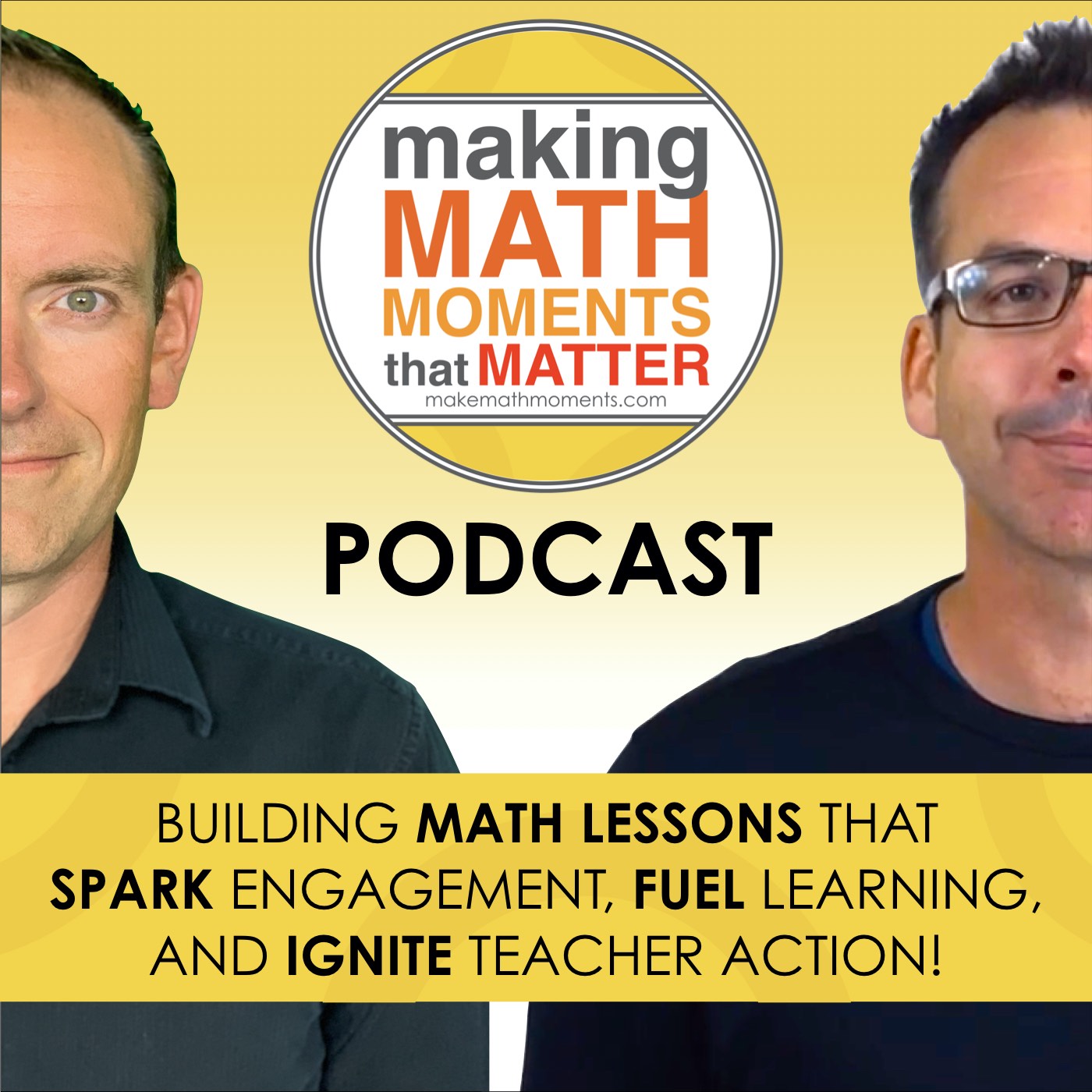
DOWNLOAD THE 3 ACT MATH TASK TIP SHEET SO THEY RUN WITHOUT A HITCH!
Download the 2-page printable 3 Act Math Tip Sheet to ensure that you have the best start to your journey using 3 Act math Tasks to spark curiosity and fuel sense making in your math classroom!
LESSONS TO MAKE MATH MOMENTS
Each lesson consists of:
Each Make Math Moments Problem Based Lesson consists of a Teacher Guide to lead you step-by-step through the planning process to ensure your lesson runs without a hitch!
Each Teacher Guide consists of:
- Intentionality of the lesson;
- A step-by-step walk through of each phase of the lesson;
- Visuals, animations, and videos unpacking big ideas, strategies, and models we intend to emerge during the lesson;
- Sample student approaches to assist in anticipating what your students might do;
- Resources and downloads including Keynote, Powerpoint, Media Files, and Teacher Guide printable PDF; and,
- Much more!
Each Make Math Moments Problem Based Lesson begins with a story, visual, video, or other method to Spark Curiosity through context.
Students will often Notice and Wonder before making an estimate to draw them in and invest in the problem.
After student voice has been heard and acknowledged, we will set students off on a Productive Struggle via a prompt related to the Spark context.
These prompts are given each lesson with the following conditions:
- No calculators are to be used; and,
- Students are to focus on how they can convince their math community that their solution is valid.
Students are left to engage in a productive struggle as the facilitator circulates to observe and engage in conversation as a means of assessing formatively.
The facilitator is instructed through the Teacher Guide on what specific strategies and models could be used to make connections and consolidate the learning from the lesson.
Often times, animations and walk through videos are provided in the Teacher Guide to assist with planning and delivering the consolidation.
A review image, video, or animation is provided as a conclusion to the task from the lesson.
While this might feel like a natural ending to the context students have been exploring, it is just the beginning as we look to leverage this context via extensions and additional lessons to dig deeper.
At the end of each lesson, consolidation prompts and/or extensions are crafted for students to purposefully practice and demonstrate their current understanding.
Facilitators are encouraged to collect these consolidation prompts as a means to engage in the assessment process and inform next moves for instruction.
In multi-day units of study, Math Talks are crafted to help build on the thinking from the previous day and build towards the next step in the developmental progression of the concept(s) we are exploring.
Each Math Talk is constructed as a string of related problems that build with intentionality to emerge specific big ideas, strategies, and mathematical models.
Make Math Moments Problem Based Lessons and Day 1 Teacher Guides are openly available for you to leverage and use with your students without becoming a Make Math Moments Academy Member.
Use our OPEN ACCESS multi-day problem based units!
Make Math Moments Problem Based Lessons and Day 1 Teacher Guides are openly available for you to leverage and use with your students without becoming a Make Math Moments Academy Member.
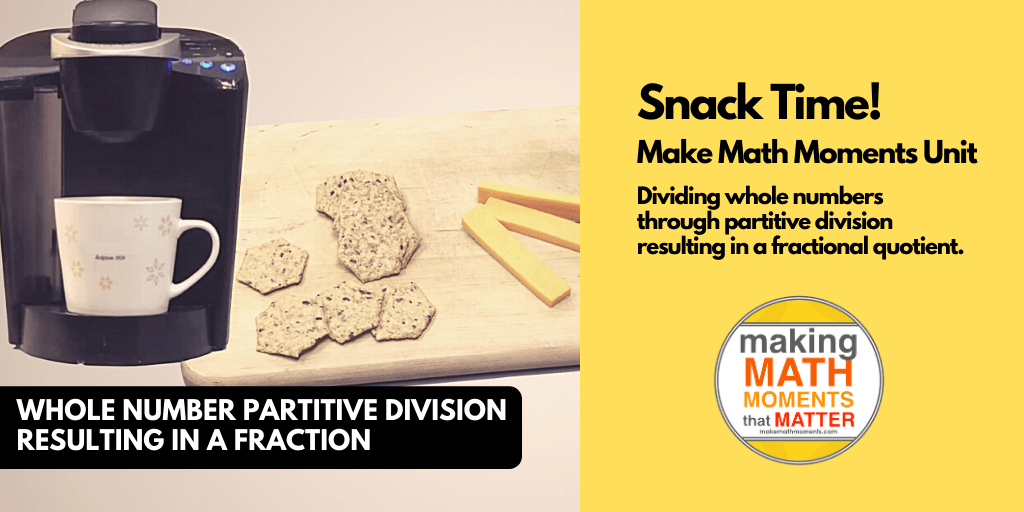
Partitive Division Resulting in a Fraction
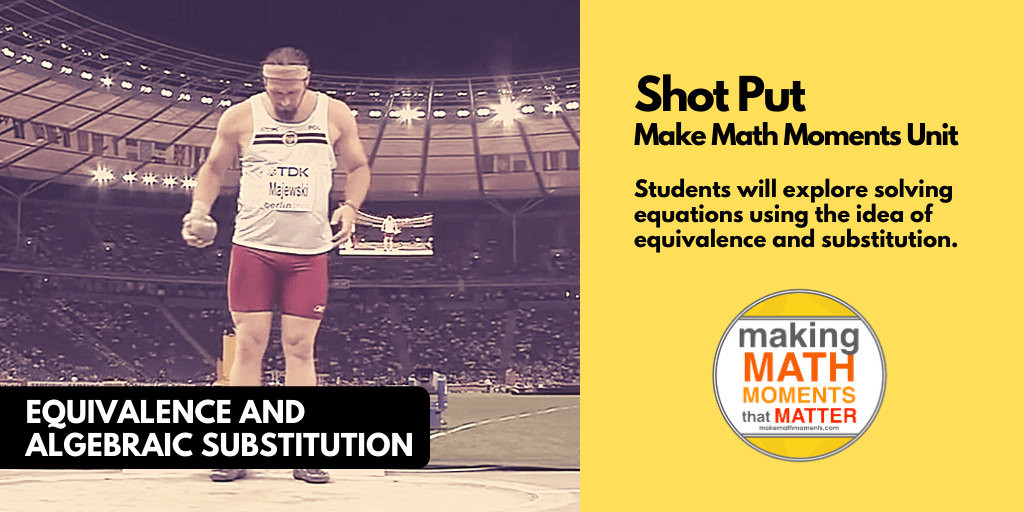
Equivalence and Algebraic Substitution
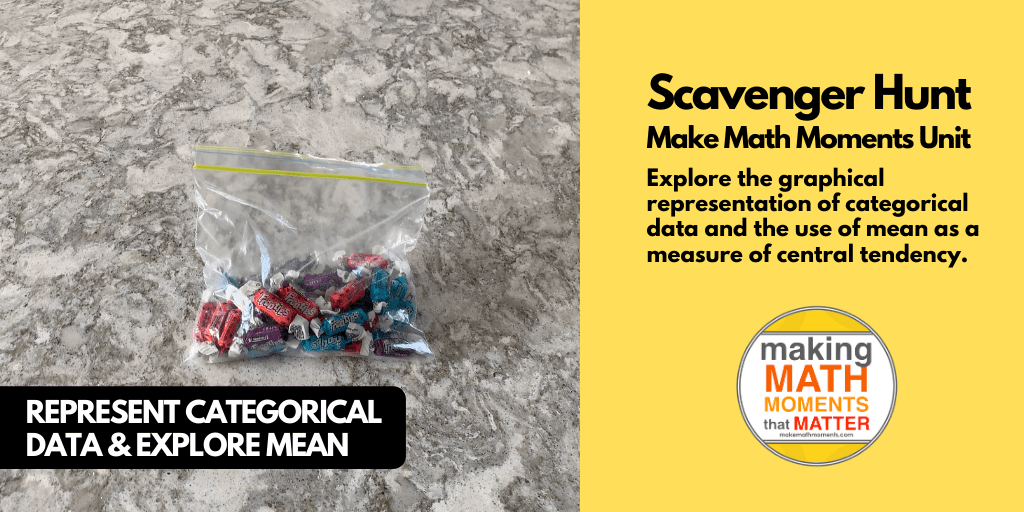
Represent Categorical Data & Explore Mean
Downloadable resources including blackline masters, handouts, printable Tips Sheets, slide shows, and media files do require a Make Math Moments Academy Membership.
ONLINE WORKSHOP REGISTRATION
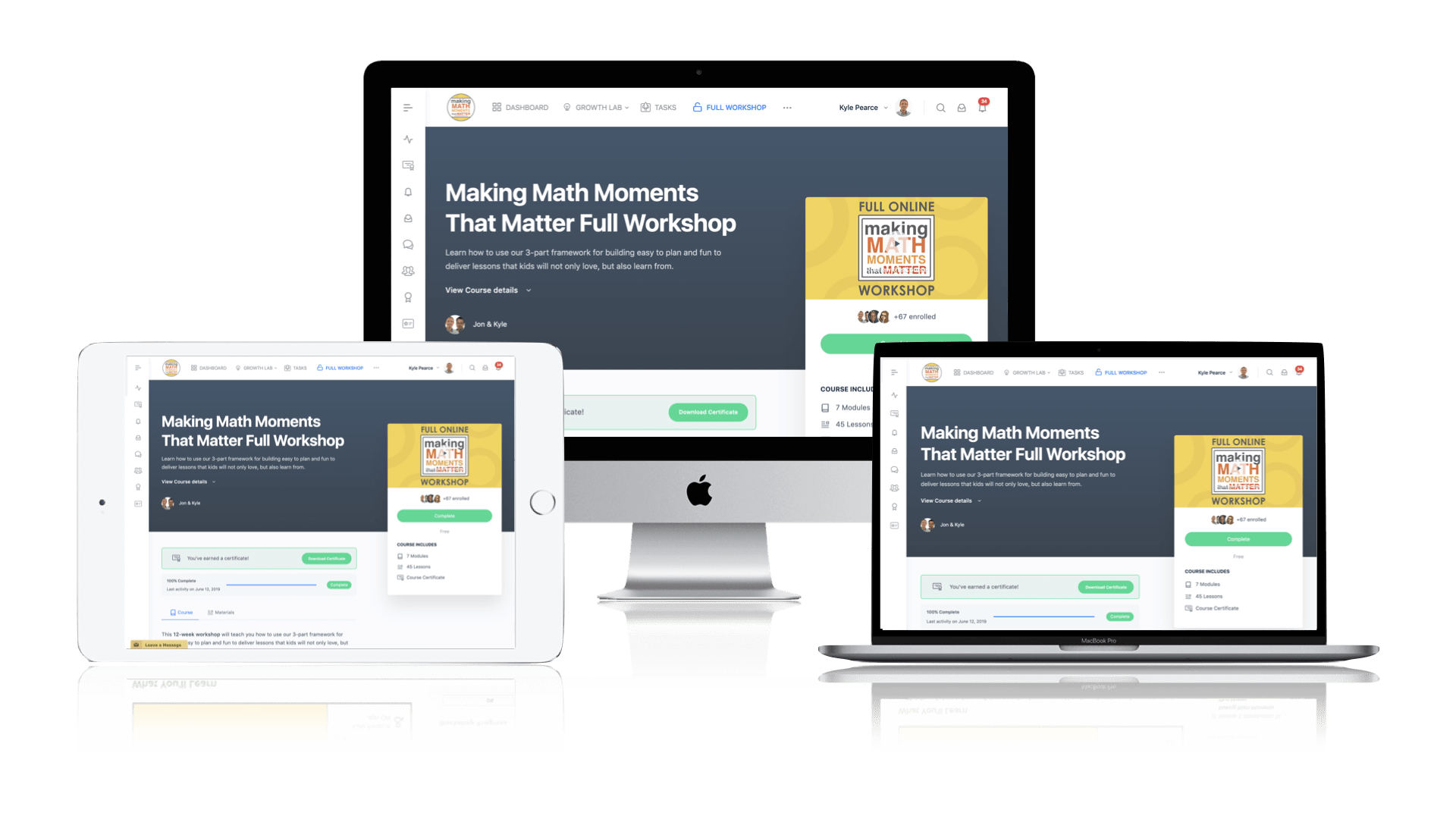
Pedagogically aligned for teachers of K through Grade 12 with content specific examples from Grades 3 through Grade 10.
In our self-paced, 12-week Online Workshop, you'll learn how to craft new and transform your current lessons to Spark Curiosity, Fuel Sense Making, and Ignite Your Teacher Moves to promote resilient problem solvers.
0 Comments