Episode #504: Are You Setting The Wrong Math Improvement Goals?
LISTEN NOW HERE...
WATCH NOW...
In this episode, Jon Orr and Yvette Lehman tackle a common problem in math improvement planning: leaders setting key results for teachers. They explain why year-long targets are often too far away to drive action, why quarterly milestones keep momentum going, and why the people creating the change should be the ones setting the targets.
Yvette walks through a K–12 school that chose the first Standard for Mathematical Practice as its objective, then had each PLC commit to its own short-term change, including a key result focused on just three students. Jon and Yvette also share advice for system leaders supporting many schools: learn the conditions for success in one place before trying to scale.
In this episode, you'll explore:
- Why key results should be set by the people who will create the change
- Why six- or nine-month targets are too far out, and why quarterly milestones work better
- How key results differ from end-of-year achievement scores
- How a K–12 school used the first Standard for Mathematical Practice as its shared objective
- How each PLC chose its own short-term change based on what students were showing
- A real key result focused on three students retelling a problem without the numbers
- What makes a strong key result: a baseline, a clear bar, a date, and multiple sources of evidence
- The leader’s role in protecting PLC time and connecting every team back to the objective
- Why system leaders should learn the conditions for success in one school before scaling to many
Look at the key results or targets your team is working toward right now and ask: Who wrote these? If they were set at the leadership level, consider bringing your PLCs together to choose their own short-term change instead. Ask each team what they’re seeing in students, what one move they could realistically commit to this quarter, how they’ll gather evidence, and when they’ll bring it back to share.
Attention District Math Leaders:
K-12 Math Leaders: Download our free Math Coherence Compass to help your teammates, system leaders, and educators create aligned instructional practices—without adding another initiative.
K-12 Math Leaders: Not sure what matters most when designing math improvement plans? Take this assessment and get a free customized report: https://makemathmoments.com/grow/
K-12 Math Leaders: Ready to design your math improvement plan with guidance, support and using structure? Learn how to partner with us and follow our 4 stage process. https://growyourmathprogram.com
Looking to supplement your curriculum with problem based lessons and units? Make Math Moments Problem Based Lessons & Units
Be Our Next Podcast Guest!
Join as an Interview Guest or on a Mentoring Moment Call
Apply to be a Featured Interview Guest
It will take less than two (2) minutes to book your Math Mentoring Moment call.
Book a Mentoring Moment Coaching Call
Take two (2) minutes to book your Math Mentoring Moment call and let's work together to shake that math pebble out of your shoe!
Are You an Official Math Moment Maker?
Ensure that you follow, rate and review on Apple Podcasts, Spotify and other platforms to show your support and ensure other math educators can find the show.



FULL TRANSCRIPT
Jon Orr: Each week I probably talk with three to five math coordinators, superintendents, district leaders who are typically trying to structure math improvement in their school systems. You know, this time of year is the let's make sure that we hit the ground running in terms of math improvement. What are we working on? And a lot of times we end up helping them think about coherence and thinking about when you say you want to focus on fluency and number sense and operation, or when you say you want students to be more resilient in math class and put problem solving into, see more problem solving happening in our classrooms, coherence is the idea that when you say that and someone else says it, you're imagining completely different things.
And so if you're a longtime listener to this podcast, we've talked about that idea many, many times. And what we do regularly is consult and help schools and school districts and teams and teachers battle against that and create more coherence. And one of the moves that we always do with every single one is to what we call create your math improvement plan, which is let's get a vision for math improvement, basically saying let's point the North Star where we want to go. Let's set an objective. Like what is the one thing that's gonna be non-negotiable this year? Like what's that one thing that we're gonna be focusing on to create that coherence around?
And then from that one thing, we set targets. Like what is the thing, the items, the operations, the content or the instructional practices that are going to change this year? And so you can say goals. Most schools, most schools have math improvement goals. Most districts do. And then goals, sometimes what we call them in our system is key results. And key results specifically are those short-term targets.
And I think what we want to talk about here today is when you hear goals, when you hear targets, the worry is how we're creating those goals and how those targets. So, like I've said before, if you're a longtime listener, you've heard us talk about vision and objectives and key results and targets because that's an important component of creating this coherence of like we're all moving towards ensuring that we're strengthening the same things that matter because our, that can allocate resources and optimize resources.
But what we're seeing is that when we're setting goals, we probably aren't setting the right goals. But then even more important is who is setting those goals and who is setting those key results. So you might understand what a key result is and we'll talk about that here today. But if you're the leader, if you're the coordinator, the math coach, and you're setting teacher key results, that's an issue. And what we want to talk about today is who should set what key results, why you should set them that way, and what it actually solves for your system. Let's get into it.
Yvette: I feel like I've had a really great opportunity over the past six months to really study this OKR process, you know, objective key result process at the smallest system size I can access, which is a school, a single school. And so I think that when we understand the conditions to create a really effective process at the school level to support change, we can take those conditions and we can scale them to larger systems. You know, so now take that, go up a tier and now we're at the district level and we're supporting multiple schools. Go up a tier, now we're at the state level and we're supporting or the provincial level.
So here's what I've learned about key results this past year. Key results are really critical for keeping the momentum going and creating accountability. And what I've also discovered in the past year is that even setting a key result that's six months, nine months down the road is too far out. We need short little milestones that we're going to monitor frequently. And so what I've been finding most effective as far as a cadence with the schools we're supporting is quarterly. You know, so right about now, October, it's like less, it's less than a term, right? So like it's not
Jon Orr: Like term, like a term, like a like a school term. Right.
Yvette: a semester. It's like halfway through first semester.
Jon Orr: Got it.
Yvette: You know, so like right now we're kind of getting to the Q1 key results in a lot of the districts that we supported that were August starts or September starts. And then we'll hit another one by January and then so on. So having these more short-term targets or milestones are really helpful because otherwise when we give ourselves too much time, we feel like there's time and everything else is going to get in the way.
So that's one of the moves that we've made this year is to really make sure that our key results or that milestone that we've set is really right in front of our nose and we're going to be accountable to it. The other thing that we wanted to talk about today is now who sets the key results. And I think that perhaps an error that we've made as a team or systems that we support have made is that the key results are being set at the top. You know, it's like it's the director.
Jon Orr: Right. It's like, I'll set the direction of where we're trying to go. And it's like, I'll do a little bit of that thing. I'll get it. And I think what you've heard over the years that we're supporting teams do this work is that we'll go get the feedback from the teachers. Like we'll survey them, or we'll say, here's our objective, here's our main focus, but then here's what we're targeting as benchmarks throughout the year to hit. And I think one of the shifts that we made early on with teams years ago was moving away from standards-based assessments.
So you're your end of year tests that everyone is measuring against. Yes, those are fine, those are fine to measure long-term trending data. It's maybe specifically to target certain content areas, but they're not, they're not the key results we're talking about. Like that's not the, the key result is to say, well, we got a three percent achievement score across grade three by the end of the year. Like that's not the key result we're talking about.
And I think we've made significant gains with teams to shift away from that to be more look for like key results in the things that we want to see change in live time, instead of say that lagging data that comes at the end of the year. So I think that's been a great part, but still teams were saying, okay, well I want to see 80% of my teachers, you know, using number talks twice a week, right? And it's
Yvette: Implement right. Right.
Jon Orr: like, so now you're you're still at the leadership level outside of the classroom, outside of the school, even setting these targets. And it's like, can they set that target? And is it realistic for you to set that target? And the short answer is you shouldn't set that target if you keep saying the word buy-in.
Yvette: for sure. Yeah. For like there's resistance. We don't have buy in. Absolutely.
Jon Orr: Right. Right.
Yvette: So let's paint a picture of what we're seeing right now in one of our successful systems, which is a K-12 school. So this K-12 school did the vision work together. They had a full day release day where all math teachers from K to 12 were available. And so they did the magic wand wishlist. They created their vision. They wordsmithed the language that they could build some coherence around where they are collectively trying to go. Big picture of what does the, you know, ambitious and equitable teaching, that's language from systems for instructional improvement, you know, defining that vision.
Then they chose an objective and it was interesting. They were really leaning into perseverance and problem solving. And then finally somebody just said, why don't we just pick the first standard of mathematical practice? Like, why create new language? Why create our own, like the first standard for mathematical practice is make sense of and persevere through problems. They're like, let's just focus there. That's gonna be the zone that we can all K-12 agree that we need to strengthen and target over the next three to five years. We wanna see a shift in our students' ability to make sense and persevere through problems.
So that was kind of the starting point of their journey is to get that coherence, get grounded in this shared outcome that they're collectively striving for and that they're gonna commit to strengthening for students. They created a look for document for their walkthrough tools so that when they go into classrooms, they can look for evidence of students demonstrating this mathematical practice.
Today we want to talk about their key results. So then the leadership team, which in this situation, there are no coaches. So the instructional leaders in the building are the administrators. They have an assistant principal and a principal. They are the instructional leaders in the building. They also have a leadership team, a math team with representation from one lead teacher from every division who they consult with and get feedback from. But basically, the next move was to bring all of their teachers together in their PLC teams. Which were organized by grade band. So it was like a K-1 team, a 2-3 team, a 4-5 team, and then a 6 to 12 team, because they only have one middle school and one high school teacher.
Jon Orr: Okay. Yep.
Yvette: And basically the question they said is if we want to strengthen our students' ability to make sense of and persevere through problems, what's the first move? What's the most, what is how do we clear that path? What do we need to target in the short term to see gains in the long term? And so every PLC group talked through what they were seeing. Like, and that's the idea of what's your starting point. So that's the idea of like what's happening currently that's preventing students from making sense of and persevering. And so each group talked about their own students, the behaviors they're observing, what they're seeing, how it connects, how it disconnects for perhaps from the walkthrough tool. And each of the grade bands decided on a change that they were willing to commit to in the short term. And so I'll talk about one of the groups, for example.
Jon Orr: Okay.
Yvette: So they had traditionally been using cubes as their kind of problem solving strategy. But they were seeing, you know, a lot of so it's like
Jon Orr: Cubes. Tell me tell us like I know some of us it's like inside baseball, right? So it's like we know what cubes mean, but like somebody listening maybe like, I don't know what that means. It's not a strategy I'd have used.
Yvette: I don't even know that well, to be honest. It's not a strategy I'm super familiar with it. I understand it's like it's like circle the numbers, underline the key terms. I'm not sure the rest. Like it's basically a systematic approach to pulling information
Jon Orr: Right. Right, very. Yeah. A systematic approach to a thing that shouldn't be systematic. Right.
Yvette: from a problem. And so we're like, well, how is that working for you? You know, like is that helping your students? Because what we are trying to address, the behavior was kids are shutting down before they've even tackled the problem. They're waiting for the teacher to come and tell them. They're saying, I can't do it. They're, you know, like a lot of work refusal was the behavior that the teachers wanted to address. Like they were like, we want to see students at least willing to try, like having some type of entry into the problem.
And so we talked about, well, how is your current strategy working for you? And who does it work for? And is it helpful for the students that you're envisioning? So then we explored other approaches, and one of them was like wordless problems and visualizing, and basically, you know, can we act out the problem before we even look at the numbers? Like let and that's where cubes does the opposite, right? It's like go right to the numbers, which might immediately shut down some students who are not comfortable with the mathematics, but it's like, can we start by covering the numbers and describing what's happening and acting out the context?
And so they were like they the team agreed that that would be a good first step for these students who are shutting down immediately and feel as though they have no access to the problem. So then they essentially wrote a key result that basically they were gonna look at between now and the end of the next quarter. They're gonna identify some students of interest. Like who are these students that they're concerned about not demonstrating this mathematical practice? Okay, we wanna shift those students from refusal. So things like I don't get it, shutting down, waiting for the teacher to come and rescue them, to independently starting a protocol that's actually built into their curriculum, which is Eureka Math Squared.
That's the curriculum this team uses, and basically built into their curriculum is a read, draw, write protocol. And so in the read component, that's like, let's start by covering the numbers. Let's act it out. Let's retell what's happening in our own words. And so the key result that they set for this very short term was: could those students, those students of interest, demonstrate a willingness or ability to engage in the read process by covering the numbers where they're really just making sense of the problem first?
Jon Orr: Mm-hmm. Okay.
Yvette: So that's one team. Like one team amongst this group was like, we're gonna focus on that behavior.
Jon Orr: Like, right. And their actual key result, and I'm gonna read it, says three students. Like, hear that, right? Like hear that right there. Three students in our class will retell a word problem without the numbers in at least two or three attempts. It's measured with a co-constructed checklist observation and notes every two to three weeks from a September baseline. And so why we think about this, the strength here like you've heard the term smart goals in and you know like and you've you know the acronym is basically trying to push you to say like is it time bound, is it measurable, like can you measure these things.
Like that's what we're talking about in terms of key results. Why this one's strong is it has a date, it sets something that's reasonable, it's got that clear bar, it's got the baseline like it's saying let's go figure this out right now and where we, what does it look like for us now? What do and then we can compare it to where we are going to be at the quarter, right? The halfway point of the semester. It's got multiple sources of evidence that you can be looking at to collect.
And I think when you think about comparing what people are writing for key results, especially at the leadership level, that you're writing these achievement score baselines is yes, you can make it smart goal at that point as well. But what's happening here is that we're looking at using different forms of evidence to tell us what we're looking for instead of saying what the end result will be. Because yes, you hope that this key result influences that achievement key result that will come out anyway. Like you've got to decide as what key like this is what I like about key results.
It's like, what will the success look like now that I can cause change in immediately and see the immediate results or see the immediate effect. Because thinking about those other key results or those other goals, it feels like I okay, I'm going to do a bunch of stuff this year and then I'm going to make a bunch of changes or a bunch of implementation, but then I don't know which one of those things caused that thing to change down there. Whereas if I make it very narrow, like this team has done, and I can see and measure it directly, then I know that I've improved on that one thing, which is helping kids make sense of problems and persevere through them, right? You're saying, this is the change I want to see. Here's how I can create that change. And I actually get to see if I created that change or not. And we just want to do that repeatedly. And that's why key results should be set in short term and set by the people who are going to be creating that change.
Yvette: Well, and that's where what I was excited about being a participant in this PLC is that we on multiple occasions checked in with the teachers to say, like, is that reasonable? Where do you see this living? When will you model for students how to use these wordless retells as a strategy to engage in the read part of the problem solving process? You know, like getting really specific. You know, is it in whole group? Is it once a week? Is it twice a week? Is it during small group? You know, where can this live? Is it reasonable to collect this data every two to three weeks with your three target students? And like they're the ones who had to say, yes, we can commit to this, or no, we cannot. It's too much on our plate.
Jon Orr: Hmm. Right.
Yvette: And again, we have a due date for when they're going to come back with this evidence that we can build from there and continue to move. Like I always use the analogy of it's like downs in football. It's like another 10 yards, another 10 yards, another 10 yards. Where do we go from here? If this is successful, how do we build off of it? How do we extend it? Who are we targeting in the next term?
And what you'll notice though is that there were some similarities across PLC groups. Some groups were using like the two, three group and the four-five group had a pretty comparable strategy where they were gonna lean into the read, draw, write protocol and really understanding what that means and how to position students to leverage it to unlock some of that problem solving. Where kindergarten was gonna focus on explicitly having students model scenarios using concrete tools to show the start, the change, and the result from a problem story. And you know, high school looked different. Like high school was like, well, in order for me to do this work, I want to make sure that I'm launching every big idea or every new unit with an explore type task where I can gather formative assessment that's student-centered.
Her commitment was to do at least, she was only gonna focus on her algebra course to start because that felt reasonable. And she's like, that's something I can commit to. I can't commit to putting this into all of my courses this quarter, but I will do it with my algebra course. I'll make sure every unit is launched with a student-centered task where I can gather formative assessment data. I'll bring back photos, I'll bring back their chart papers, I'll take video to our next PLC and show you how students interacted with that.
So the idea here is that every PLC might be going down a different path, but the goal is the same at the end. And the leader's role is to allow the autonomy of teachers to commit to their own short-term next steps and the change that they're willing to see. But the role of the leader is to now keep it all really tightly connected to the objective and to create the, I see how what you're working on here is going to help us get closer to what we defined as our three to five year objective.
Jon Orr: But also you're at the same time, your own key result as the leader is helping and ensuring one, that the key results we're making in the PLCs are good key results, which means that we need sometimes training on that and support and time and space to think about them and reflect on them and plan for them. And basically you're ensuring that the training that the people get or on the learning journey you're trying to create for them, which is saying, like if I look at my different PLC groupings and grade level teams, if my own key result is to help each one of those hit their own key results, how do I do that?
I have to provide the right support about key results to start with and make sure that we understand what that means. Okay, I have to provide the opportunity and the structures, the repeated structures to build upon and strengthen their own work towards those key results, which is like protecting that PLC time, right? Like sometimes it's like, I want these goals and therefore I'm going to download goals to people. First of all myself and then I download them to people, but then I don't create time and space for anyone to think about it.
You said this the other week. It was like, if we don't honor or help teams think, create space for them to think about instructional practice, what hope are they actually going to take that and run with it? It's like you've got a certain percentage of people that you know are your go-getters, they're gonna go and take that. But if you're not creating the repeatable structures, time and space, PLC time, and create the structure for that PLC time and not let it go to logistics, then you're just putting a goal into the air. Right. Whereas this team specifically said, the leader said, I'm gonna protect this time, I'm gonna help them with that time. So it's structured. We're gonna use that time to get better at that key result week to week to week to week to week to week. And that's what I love about seeing the what this team is doing.
Yvette: I think from, you know, now we said let's zoom out. So this is a single site, you know, a single admin team, single group of PLCs. Let's zoom out to another system that we support, which has, you know, a regional team supporting 20 schools. So now they're trying to create these conditions across 20 sites. What would be our advice to that next tier one remove from the school level.
Jon Orr: Yeah. Yeah. Cause I think I think your default, and we've talked about this before too, is like the default is I want I could create the objective and then we then again I could create the key results and then say go and figure out how to make this key result better. And then your other instinct is to say, but if I want each school to own their key result, then how do I do that across twenty schools and it's only me. And that's the question comes up all the time.
And we say, you can't like it, you can't expect to have the same impact you have across 20 schools if you had picked one. And so what we always recommend is can you create the conditions in one school and commit to the work that is required? Like what I just said, if the lead, if there's a leader that understands how to use key results and write them as support, support teachers to make their own so that they feel empowered to do that work and own that work. We talk about buy-in, that's how we get it.
And if we can't do that for one, how are you gonna do that for 20? You can't. And so what we always recommend is prove to yourself that you could commit to time and support to one. And then what you're looking for is the conditions in place. Does this school have the coach to honor some of this thinking? And or do they have a bright spot teacher who's now acting as a leader to the PLC group, or maybe there's a coach across the system that is your sidekick and all of a sudden now we can start doing this.
What we have to do is learn the conditions that make this possible and then go, can I replicate that somewhere else? Which means if I have not even started with one, I can't start with 20. I have to start with looking at one. Maybe it's two. I remember talking with a teacher a couple of years or a coordinator a couple of years ago and saying, and saying, like, I know you're trying to stretch yourself too thin, but pick let's pick one school and say, can you get there to coach those teachers to get to give them the support that you know is required? And and the question is, how much time can you allocate there to give them that type of support?
And if you can't do that, then why are we trying to do it for twenty? When you know you can't. And what you do is you spread yourself too thin, and then you think this actual practice isn't working, but it's not that. It's just you just didn't allocate the right commitment level across the system. So go narrow to learn the conditions, and then you go, look, by implementing this type of structure at the school, at this team had PLCs that were organized. That school over there doesn't. So how are we going to make that work? Okay, first step, let's make sure PLCs are functioning the way that we know they could.
How did that happen over the other school? Each PLC had like a teacher leader or a teacher coach. Sometimes it's like schools have those like grade captains where you know you're the math coach or the math lead in the building for that grade level. Some schools don't, many schools don't, but there are other conditions that help make successes. And your job is to look for those successes and figure out can I replicate that success somewhere else and what it takes to get that success? And so that's the job of the leader, isn't to go and make a bunch of goals for people that don't want to buy into them. The job is where can I create the conditions for success, knowing what it takes for that success, and then try to organize that grouping to create their own conditions for success.
Yvette: It reminds me, and we've referenced this book before, but Learning to Improve, How America's Schools Can Get Better at Getting Better. So the lead author is Bryk on that, 2015, and they talk about that idea of implementing like learning fast to implement well or implement slow. So I think that's what you're recommending, Jon, is like get, take your, give yourself the privilege that I've had, which is study how this works in the smallest system you can access. Go to that one site, that one PLC team, understand the conditions before you're gonna just now blanket your entire system with this work. I love it.
Jon Orr: I love that you shared those, you know, that specific group that you had, you know, ventured out to work with. We do this, you know, this is the work that we do day in and day out. If you're looking to say, how do I get narrow and what schools should I pick, or how do I help us, how do I even get organized around this? This is the work that we do. We help teams, schools, districts, larger organizations, regional teams design math improvement plans with these principles in mind. We are there side by side to do this so that at the end you have a sustainable math improvement plan. We do that in in-person sessions or we do that across a series of virtual sessions with your leadership team. If you are looking for getting started in that, you're saying, I just need a second set of eyes on this, head on over to the link below in this to book a call with our team. We do have some space available to help you see what that could look like for your school or your school district. Take care.
Your Customized Improvement Plan For Your Math Classroom.
Take the 12 minute assessment and you'll get a free, customized plan to shape and grow the 6 parts of any strong mathematics classroom program.
District leader/math coach? Take the District Assessment
Thanks For Listening
- Book a Math Mentoring Moment
- Apply to be a Featured Interview Guest
- Leave a note in the comment section below.
- Share this show on Twitter, or Facebook.
To help out the show:
- Leave an honest review on iTunes. Your ratings and reviews really help and we read each one.
- Subscribe on iTunes, Google Play, and Spotify.
The Making Math Moments That Matter Podcast with Kyle Pearce & Jon Orr
Weekly interviews, strategy, and advice for building a math classroom that you wish you were in.
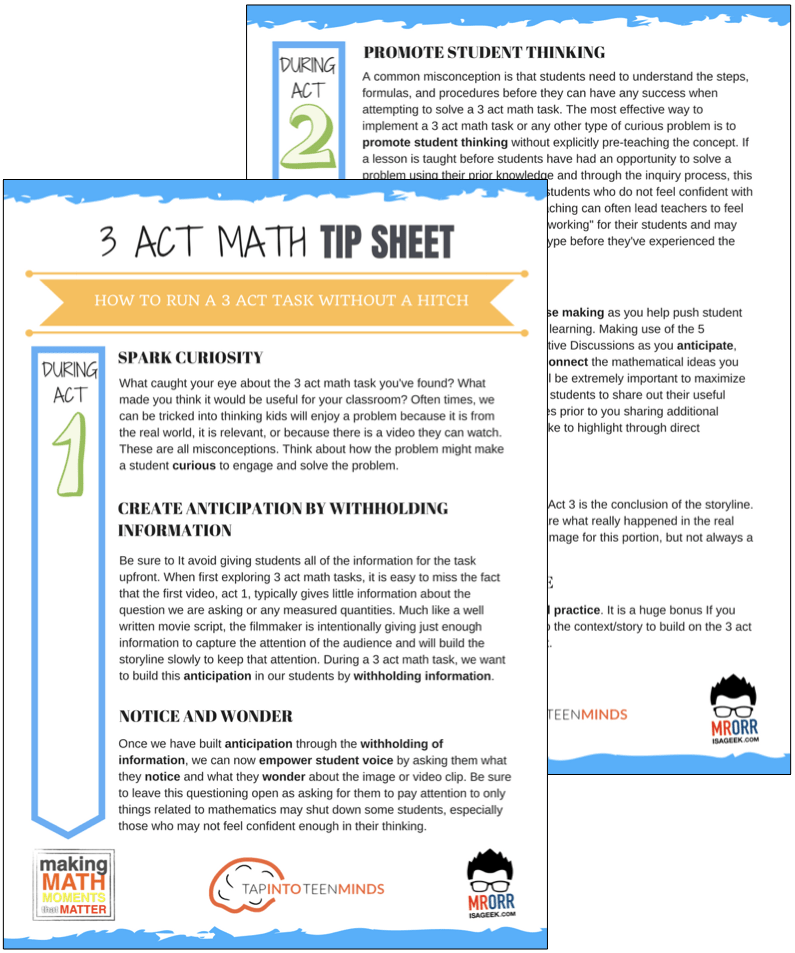
DOWNLOAD THE 3 ACT MATH TASK TIP SHEET SO THEY RUN WITHOUT A HITCH!
Download the 2-page printable 3 Act Math Tip Sheet to ensure that you have the best start to your journey using 3 Act math Tasks to spark curiosity and fuel sense making in your math classroom!
LESSONS TO MAKE MATH MOMENTS
Each lesson consists of:
Each Make Math Moments Problem Based Lesson consists of a Teacher Guide to lead you step-by-step through the planning process to ensure your lesson runs without a hitch!
Each Teacher Guide consists of:
- Intentionality of the lesson;
- A step-by-step walk through of each phase of the lesson;
- Visuals, animations, and videos unpacking big ideas, strategies, and models we intend to emerge during the lesson;
- Sample student approaches to assist in anticipating what your students might do;
- Resources and downloads including Keynote, Powerpoint, Media Files, and Teacher Guide printable PDF; and,
- Much more!
Each Make Math Moments Problem Based Lesson begins with a story, visual, video, or other method to Spark Curiosity through context.
Students will often Notice and Wonder before making an estimate to draw them in and invest in the problem.
After student voice has been heard and acknowledged, we will set students off on a Productive Struggle via a prompt related to the Spark context.
These prompts are given each lesson with the following conditions:
- No calculators are to be used; and,
- Students are to focus on how they can convince their math community that their solution is valid.
Students are left to engage in a productive struggle as the facilitator circulates to observe and engage in conversation as a means of assessing formatively.
The facilitator is instructed through the Teacher Guide on what specific strategies and models could be used to make connections and consolidate the learning from the lesson.
Often times, animations and walk through videos are provided in the Teacher Guide to assist with planning and delivering the consolidation.
A review image, video, or animation is provided as a conclusion to the task from the lesson.
While this might feel like a natural ending to the context students have been exploring, it is just the beginning as we look to leverage this context via extensions and additional lessons to dig deeper.
At the end of each lesson, consolidation prompts and/or extensions are crafted for students to purposefully practice and demonstrate their current understanding.
Facilitators are encouraged to collect these consolidation prompts as a means to engage in the assessment process and inform next moves for instruction.
In multi-day units of study, Math Talks are crafted to help build on the thinking from the previous day and build towards the next step in the developmental progression of the concept(s) we are exploring.
Each Math Talk is constructed as a string of related problems that build with intentionality to emerge specific big ideas, strategies, and mathematical models.
Make Math Moments Problem Based Lessons and Day 1 Teacher Guides are openly available for you to leverage and use with your students without becoming a Make Math Moments Academy Member.
Use our OPEN ACCESS multi-day problem based units!
Make Math Moments Problem Based Lessons and Day 1 Teacher Guides are openly available for you to leverage and use with your students without becoming a Make Math Moments Academy Member.

Partitive Division Resulting in a Fraction

Equivalence and Algebraic Substitution
Represent Categorical Data & Explore Mean
Downloadable resources including blackline masters, handouts, printable Tips Sheets, slide shows, and media files do require a Make Math Moments Academy Membership.
ONLINE WORKSHOP REGISTRATION
Pedagogically aligned for teachers of K through Grade 12 with content specific examples from Grades 3 through Grade 10.
In our self-paced, 12-week Online Workshop, you'll learn how to craft new and transform your current lessons to Spark Curiosity, Fuel Sense Making, and Ignite Your Teacher Moves to promote resilient problem solvers.
0 Comments