
Episode #503: Sue Looney: Using Stories to Build Resilient Problem Solvers
LISTEN NOW HERE...
WATCH NOW...
In this episode, Jon Orr talks with Sue Looney about her upcoming session at the 2026 Make Math Moments Virtual Summit. Sue, who began her career as an English major, explains why stories are a powerful and often overlooked way to help students build resilience in math. She describes resilient problem solvers as students who aren’t afraid when the fog rolls in, and shares how characters, historical math tasks, and a four-step story lens can help students see those qualities in themselves.
Jon and Sue also tackle the question every teacher and coach will ask: where does this fit in an already busy day? Sue offers practical ways to start small, connect with what’s already happening in ELA, and build toward regular problem solving time.
In this episode, you'll explore:
- What Sue hopes teachers will say about teaching math 15 years from now
- What resilient problem solving looks and sounds like in a math classroom
- Why students need “foggy” problems instead of packaged ones with an obvious path
- How stories help students connect with characters who show resilience
- How an ancient magic squares legend became a children’s book about perseverance
- A preview of the four-step story lens Sue will share at the summit
- Why holding up a mirror to students may be the most important step
- How to find time for stories by starting small and connecting to ELA
- Why human qualities like curiosity and perseverance matter more as technology advances
Think about a story you already love, whether it’s a picture book, a novel, or a classic like The Odyssey. What problem does the main character face, and how do they stay with it when things get hard? Look for one place in the coming week where you could share that story with students, name the resilient qualities you notice, and then ask: Do you see yourself in this character? What would it take to bring those qualities into our math class?
Attention District Math Leaders:
K-12 Math Leaders: Download our free Math Coherence Compass to help your teammates, system leaders, and educators create aligned instructional practices—without adding another initiative.
K-12 Math Leaders: Not sure what matters most when designing math improvement plans? Take this assessment and get a free customized report: https://makemathmoments.com/grow/
K-12 Math Leaders: Ready to design your math improvement plan with guidance, support and using structure? Learn how to partner with us and follow our 4 stage process. https://growyourmathprogram.com
Looking to supplement your curriculum with problem based lessons and units? Make Math Moments Problem Based Lessons & Units
Be Our Next Podcast Guest!
Join as an Interview Guest or on a Mentoring Moment Call
Apply to be a Featured Interview Guest
It will take less than two (2) minutes to book your Math Mentoring Moment call.
Book a Mentoring Moment Coaching Call
Take two (2) minutes to book your Math Mentoring Moment call and let's work together to shake that math pebble out of your shoe!
Are You an Official Math Moment Maker?
Ensure that you follow, rate and review on Apple Podcasts, Spotify and other platforms to show your support and ensure other math educators can find the show.



FULL TRANSCRIPT
Jon Orr: Hey there, Sue. Welcome back to the Making Math Moments That Matter podcast. It's been some time since we last had you on the show and chatted. But we're glad to keep doing this and to keep sharing great math ideas. And I know that you're presenting at the upcoming 2026 Make Math Moments Virtual Summit. We're gonna talk about your session, but how are things over on the East Coast?
Sue Looney: Things are great. We're in my favorite season. Fall is in the air. I bought some mums and some pumpkins, setting up some patterns outside with them and all good. All good.
Jon Orr: Awesome. Awesome. Well, the first question we've been asking every guest in the series leading into the summit is a variation on a question we've asked many guests in the past, which is their math moment. But this is like a future moment, a future moment for people you've influenced. So, in a way, here's the prompt I want us to think about. And this is the prompt that we ask many teachers to think about when we're working with them. But basically saying, imagine you met a student 15 years after they left the system, left your care, left your classroom and you were talking to them about their biggest takeaway from the experience they had. I guess the question, so you're saying like, well, what was your big takeaway? But the question I think we want to talk about or hear from you is, well, what do you want that student to say? Like if you had that opportunity, you're talking to them, what do you hope they say?
Sue Looney: It's such a good question to be forward thinking. And so my work these days is facing teachers predominantly as opposed to children. So I'm gonna talk about the students as the teachers that I work with when I do professional development. And I would love if I came across a teacher that had worked with me and 15 years later. She just said, I love teaching mathematics. It is so much fun. It is the best part of my day. You know, and I used to not feel like that. And as a result of focusing on student thinking. And I remember when we worked together, I just have just fallen in love with teaching mathematics. That would be the mic drop, all done. I've done my job.
Jon Orr: Right, right. And I'm sure you've had experiences like that already, having shifted teachers' perspectives on teaching math and the work that you've done.
Sue Looney: Sure, yeah. I mean, people occasionally I'll run into them or they'll reach out to let me know a particular story in the best or when they talk about shifting a student, right? Like as a result of something that we did, I had this experience with students. So yeah, for sure.
Jon Orr: Yeah. Well, let's dig into the session that you're going to be holding live on Saturday, November 14th, twenty twenty six, coming up in the eighth annual virtual summit. The title you've got here is Using Stories to Build Resilient Problem Solvers. And you're you've talked about in the description stories create opportunities to explicitly notice and name curiosity. I guess tell me why, like you've got years of working with teachers and students and supporting them, specifically in the area of mathematics, and you could have because you've had such a wealth of information and expertise, why stories?
Sue Looney: Well, the topic about building resilient problem solvers sort of led me there. I wanted to think about what are some ways that we can build that resilience that might not be obvious or as talked about as frequently in the math ed realm. And so stories immediately bubbles up to the surface for me. So my first degree is English. So I was an English major. Yes. I was an English major.
Jon Orr: Really, really. So there we go. You're playing into your strengths.
Sue Looney: Yes. And there was a lot of literature and a lot of reading and a lot of writing. And I'm fascinated with language and thinking about characters. So this is an opportunity to bring those together for people.
Jon Orr: Absolutely. Absolutely. Like when you because the theme of the summit is building resilient problem solvers. So what is like what does resilient problem solving look like for you and how specifically do you believe like stories can help us build more of them?
Sue Looney: I think resilience has a lot to do with a willingness to stay with a problem, to enter it fearlessly. I have a quote and I'm not gonna remember it exactly, but it's something about a good problem is when the fog rolls in and the foggier the better. And so getting a resilient problem solver isn't scared when that fog rolls in. They recognize being lost for a little while is part of emerging with a more robust understanding. And in order for that to happen, we've got to present foggy things for kids to do, right? Not these packaged problems where the solution path is obvious. So the question is, what is a resilient problem solver? It's someone who's not afraid to wrestle with a problem and hangs in there with it.
Jon Orr: Right. So if I'm like I walk into my classroom and I've engaged my students in some sort of activity, what does it look like in your mind? Students who are actively engaged in showing, I guess, the act of resilience?
Sue Looney: I think that it's possibly loud. I think that there are kids sitting in various different positions and spaces, huddling together or working individually. So kids are it's like a buzz of working on something where there's resources available to solve that problem and kids really have that ownership. Yeah, it looks and feels like a buzz of excitement, not silent, not heads down, pencil to the paper, quietly plugging away, right?
Jon Orr: Right. Right. In your description you mentioned looking at historical mathematical tasks, memorable characters, sort of the story lens. And you talk about a four step framework that you're gonna unpack. Do you wanna shed some light on this for us to get a little preview to know what's coming up?
Sue Looney: Yeah. Sure. So stories give us an opportunity to illustrate what you just asked me. So you can ask me that question and I can paint a picture for you. But we could also read about somebody who was resilient and connect with that character. Even if they're not out there solving a math problem, every story has a problem. And we have an antagonist and a protagonist and we have that whole arc of a story. So we can illustrate that through literature and then connect to it. And in a really great world, we do have a math problem at the heart of it.
So when we talk historically, the first children's book that I wrote is based on magic squares. And it's ancient, many thousands of years old, out of China, and it's a little short blurb in a textbook about math history or whatever it is. And it's kind of like folklore. It shows up in paintings. It shows up on La Sagrada Familia in Barcelona on the building. But I put story around that and really developed a character who solves this. So there is a story about a turtle and characters, but I really spent a lot of time developing Ying. Yeah. So Ying is resilient. So nobody thinks this can be solved. And this is how it is told in the short couple of paragraphs you'll find out there. But nobody thinks this can be solved, let alone by a young girl who just happens to be out there fishing in the storm.
And so the four step story lens gives teachers a way to use a story so that the character can demonstrate that quality that we're looking for. So in the story of Ying, and in that historical context, we do have a math problem at the middle of it. But either way, we number one, we meet a character, we like that character, we get to know that character, we enter their world, we can start visualizing that. And then we connect to the mathematics in the story, if it's there and it's going to be there, whether it's a pattern, the problem has some context around it that we relate to. And probably the most important step is going to be that final one where we hold up a mirror and say, how do you see yourself? Right. So we identify those qualities and then we hold up a mirror and say, do you see yourself in this? Could you see yourself in this? What would it take for you to have those qualities?
Jon Orr: Sure, for sure. And it's like what comes to mind immediately as you describe the arc here is the hero's journey, which I believe is Joseph Campbell. Is it Joseph Campbell? Correct me if I'm wrong, I can't remember the name, but it's like that's like the hero with a thousand faces. Is that all these stories sound the similar? They're all the same arc. And it's in a way that's the same arc our students go through. And I think that's what you're trying to say, right? Is that we are pushed into a situation that we don't want to be in, like every hero in these stories. And then they have to rise to the occasion and battle the forces of evil. And then along that path, we meet a guide. And then that guide helps us kind of battle those forces so that we, like you said, the mirror, you shine it back to ourselves to see where we've come from and what we've accomplished, and then the climax of the story, and then you return home, but that it's not the same home, you know, it's a different home. You've learned stuff along the way.
Like I guess my immediate thought is where like I think sometimes it's like we don't in classrooms today we don't share what that really is really happening in the background. Like what like I think we always talk about resilience in math. It's like if I 'cause I've asked this question, you know, many times with many teachers over the years to say, like, what do you what is it we're really doing here? Like, what do you think math is really about? And most people are saying problem solving, right? But you know, resiliency is part of that too. But then it's like a lot, I think a lot of times is we don't actually we believe that, but we actually don't share that with kids. Like, what's the real? Like, are we really sharing like the big idea here is for us to go through what the hero's journey is really going through?
And a story like Ying's story is a great example to kick off the school year, to almost like develop like what is it that we're really trying to do here, just like you said, shine the mirror on what's happened in the story to ourselves. And then like I've used not this story, but other types of stories to develop our look fors for building resiliency and saying like these are the things we're looking for because that's what we're really trying to do here. Like I see there's some very powerful things happening here for sure.
Sue Looney: Absolutely. It's a good summary of it. And it's a different, it's like a roundabout approach. It's not the first approach someone thinks about when we think about how are we building this in students in a math classroom. And so storytelling is so appealing and so powerful and is actually very innate in humans, right? Like originally language and stories are how we pass down knowledge verbally. And then we started painting on caves and we went from there. But story of something else is safer sometimes than looking at myself and then connecting to that. So it's a really appealing way to have the conversation that hopefully crosses into other domains of knowledge, right? So now we're we might be reading this in the ELA classroom, we might be in the history classroom studying a time in history, but we're all trying to do the same thing, right? And so we make those connections. Yeah. Teaching. Yeah, that's right.
Jon Orr: Right. Right. Yeah. Teaching kids, you know, teaching kids in front of us. I'm gonna have to ask you this because I think many people who are listening to the podcast are definitely like nodding their heads saying like you're right, storytelling has maybe not been a major part of maybe what I did in the past. I'm completely open to it, but I do and maybe we've got coaches and coordinators listening going, I support so many teachers who aren't seeing the benefit. But I know that if I go to the summit and I attend the session and I get all this four-step framework and I think about where I could put this into my and how can I help my teachers, I know the first question they're gonna ask me is, where do I fit this in? Like where does it, where does it fit in my day-to-day? Is it a one time a week thing? Is it just a one time at the beginning of the year? Is it more regular? Like, where does this really live?
Sue Looney: I feel like that is the question, right? People are so pressed for time. So where does it fit? I mean, this conversation and using those activities really can fit anywhere. It's just being explicit. So I would love the idea of working in collaboration with whoever is teaching English language arts, for example, and this is a story that we're reading. So we're already doing that. We're already telling a story. We're just intentionally making a connection. Or, you know, you referenced things about the beginning of the year. I think we need to carve out time for problem solving in a regular way so that those activities from the beginning of the year continue throughout.
So for example, a long time ago, I was helping a lot of schools with the implementation of a problem solving program. And we started with, can we have one day per month where we really hone in on this, right? And then that grew to one day per week. And so then, you know, kids couldn't wait. And then eventually those protocols spill into every day. So I think, you know, we maybe start small and make connections to what already exists. And once we see the impact, which will be excellent, then we just roll from there.
Jon Orr: Exactly. Exactly. Sometimes the way I look at it is that we said this earlier, it's like we're teaching kids and yes, there is mathematical content standards to teach, but we also have the math practice standards or the math process standards to reflect on and use as a vehicle for what we're trying to do in our class. So sometimes you look at it as like the way I look at it is that a lot of times I'm using the content standards as the vehicle to really get at the process standards. And I think a lot of times because we're either following the curriculum to fidelity, we've lose sight of that a little bit sometimes of like what the real goals are of like what we're trying to do in our classroom.
And I think if we keep rooting ourselves and saying, like, what are our core beliefs about teaching mathematics and learning mathematics? Sometimes you might say that they're the reality or there's more implication than just looking at content on a regular basis and then say, well, what am I doing to achieve that core belief on a regular basis? And if it is about building resiliency, then you have to say, well, where's like if you treat it just like any other learning goal is where do I do that? And where do I specifically support my students to help them get to a success criteria on that outcome or that say standard, that process standard. And it might be related to where stories actually play a role in doing that. And it's not part of the existing curriculum. But I think we have to decide for ourselves where that balance has to fit in based off what we're really trying to do in our classroom with kids.
And I think that's the dedication that we all have to decide as professionals of where we're gonna put that emphasis. Yes, we got content standards, but yes, we have these other things. And then where are the resources that we can rely on, like these resources that you're gonna share? that help us do that as well.
Sue Looney: I think so. And I think it's more important than ever as we watch technology advancing at breakneck speed, we're going to have to think about the humanity and the human experiences and the human qualities that we are fostering and nurturing in education. You know, so knowing our multiplication tables while important. We are going to far surpass that. So we've gotta think about those process standards, those human qualities that bring creativity, curiosity, resilience, perseverance, all of that. All of those human things are going to rise to being so much more important than we ever even realized in a classroom.
That really has always been our job as educators. If we go back and read John Dewey and all of the early, you know, psychologists and philosophists in education. But we are gonna have no choice but to have the reckoning with it because of the advancements in technology. So story gives us one way to do that. That's it's not a heavy lift. You all have your favorite story. We could do this with Goldilocks and the Three Bears. We could do this with Odysseus, right? We could do this with the Odyssey. Anybody can have this conversation. People relate to stories. And if you come to the session, for sure you're gonna walk away with ready-to-use, intentional, explicit ways that you can bring that enthusiasm into classrooms.
Jon Orr: Love it. Love it. So let's say I a teacher attended your session and then come Monday after the session, what would you say is one shift you would want that teacher to try in their classroom?
Sue Looney: I would want them to intentionally look for the opportunities to bring in story. Just start there. Where are those opportunities that already exist perhaps or that space where we can bring it? And so then it'll it'll flow from there.
Jon Orr: Love it. Love it. Sue, thanks so much for joining me here today to talk about your upcoming session. The registration is open right now. If you're listening to this, you can click the link in the description below in the player you're listening to this in and go ahead and register. It is completely for free. Sue, we can't thank you enough for taking time out of your busy schedule to join us here in the Make Math Moments community.
Sue Looney: Thank you so much for having me, Jon. Take good care.
Jon Orr: Of course. Of course.
Your Customized Improvement Plan For Your Math Classroom.
Take the 12 minute assessment and you'll get a free, customized plan to shape and grow the 6 parts of any strong mathematics classroom program.
District leader/math coach? Take the District Assessment
Thanks For Listening
- Book a Math Mentoring Moment
- Apply to be a Featured Interview Guest
- Leave a note in the comment section below.
- Share this show on Twitter, or Facebook.
To help out the show:
- Leave an honest review on iTunes. Your ratings and reviews really help and we read each one.
- Subscribe on iTunes, Google Play, and Spotify.
The Making Math Moments That Matter Podcast with Kyle Pearce & Jon Orr
Weekly interviews, strategy, and advice for building a math classroom that you wish you were in.
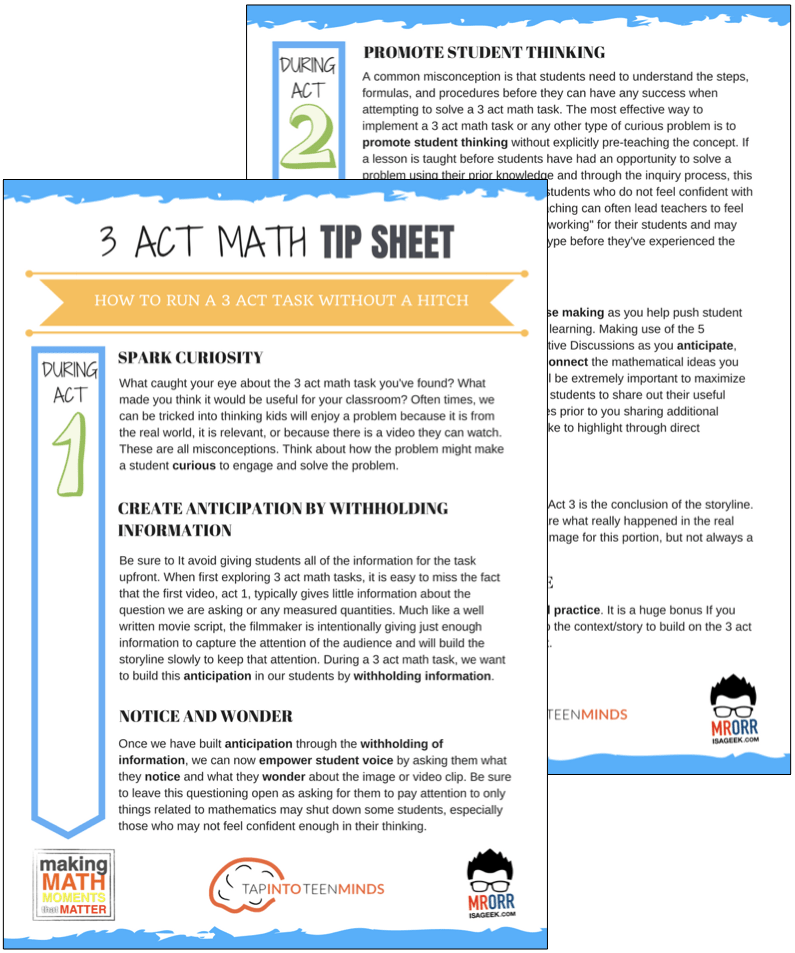
DOWNLOAD THE 3 ACT MATH TASK TIP SHEET SO THEY RUN WITHOUT A HITCH!
Download the 2-page printable 3 Act Math Tip Sheet to ensure that you have the best start to your journey using 3 Act math Tasks to spark curiosity and fuel sense making in your math classroom!
LESSONS TO MAKE MATH MOMENTS
Each lesson consists of:
Each Make Math Moments Problem Based Lesson consists of a Teacher Guide to lead you step-by-step through the planning process to ensure your lesson runs without a hitch!
Each Teacher Guide consists of:
- Intentionality of the lesson;
- A step-by-step walk through of each phase of the lesson;
- Visuals, animations, and videos unpacking big ideas, strategies, and models we intend to emerge during the lesson;
- Sample student approaches to assist in anticipating what your students might do;
- Resources and downloads including Keynote, Powerpoint, Media Files, and Teacher Guide printable PDF; and,
- Much more!
Each Make Math Moments Problem Based Lesson begins with a story, visual, video, or other method to Spark Curiosity through context.
Students will often Notice and Wonder before making an estimate to draw them in and invest in the problem.
After student voice has been heard and acknowledged, we will set students off on a Productive Struggle via a prompt related to the Spark context.
These prompts are given each lesson with the following conditions:
- No calculators are to be used; and,
- Students are to focus on how they can convince their math community that their solution is valid.
Students are left to engage in a productive struggle as the facilitator circulates to observe and engage in conversation as a means of assessing formatively.
The facilitator is instructed through the Teacher Guide on what specific strategies and models could be used to make connections and consolidate the learning from the lesson.
Often times, animations and walk through videos are provided in the Teacher Guide to assist with planning and delivering the consolidation.
A review image, video, or animation is provided as a conclusion to the task from the lesson.
While this might feel like a natural ending to the context students have been exploring, it is just the beginning as we look to leverage this context via extensions and additional lessons to dig deeper.
At the end of each lesson, consolidation prompts and/or extensions are crafted for students to purposefully practice and demonstrate their current understanding.
Facilitators are encouraged to collect these consolidation prompts as a means to engage in the assessment process and inform next moves for instruction.
In multi-day units of study, Math Talks are crafted to help build on the thinking from the previous day and build towards the next step in the developmental progression of the concept(s) we are exploring.
Each Math Talk is constructed as a string of related problems that build with intentionality to emerge specific big ideas, strategies, and mathematical models.
Make Math Moments Problem Based Lessons and Day 1 Teacher Guides are openly available for you to leverage and use with your students without becoming a Make Math Moments Academy Member.
Use our OPEN ACCESS multi-day problem based units!
Make Math Moments Problem Based Lessons and Day 1 Teacher Guides are openly available for you to leverage and use with your students without becoming a Make Math Moments Academy Member.
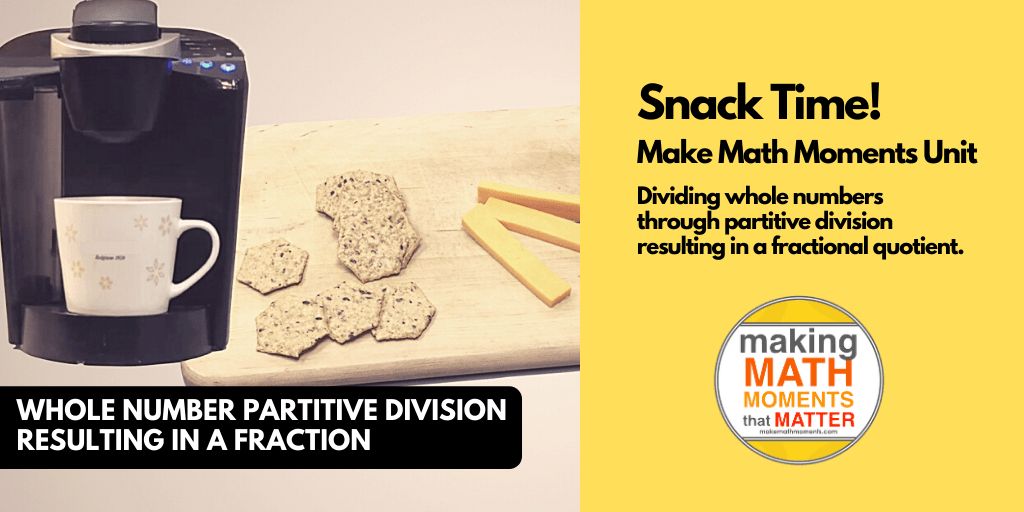
Partitive Division Resulting in a Fraction
Equivalence and Algebraic Substitution
Represent Categorical Data & Explore Mean
Downloadable resources including blackline masters, handouts, printable Tips Sheets, slide shows, and media files do require a Make Math Moments Academy Membership.
ONLINE WORKSHOP REGISTRATION
Pedagogically aligned for teachers of K through Grade 12 with content specific examples from Grades 3 through Grade 10.
In our self-paced, 12-week Online Workshop, you'll learn how to craft new and transform your current lessons to Spark Curiosity, Fuel Sense Making, and Ignite Your Teacher Moves to promote resilient problem solvers.
0 Comments