Episode #510: How Vertical Non-Permanent Surfaces Changed the Math Classroom
LISTEN NOW HERE...
WATCH NOW...
In this episode, Jon Orr talks with Frank Bouchard, co-founder of Wipebook, the Canadian company behind the whiteboard flip charts found on classroom walls and in PD sessions across North America. Frank shares how a laminated notebook he made to practice engineering math became a surprise Kickstarter success, and how a request from an Ottawa school district led to the flip charts so many math teachers now use.
Jon and Frank discuss how Building Thinking Classrooms and vertical surfaces grew together, why students returned from remote learning craving social and collaborative learning, and how the same approach can transform professional development. Jon connects the conversation to the Results Pyramid and the role experiences play in shifting teacher beliefs, and Frank closes with his math moment and a playful take on AI in education.
In this episode, you'll explore:
- How Frank’s experience as a kinesthetic learner shaped his passion for engaging learning
- How a laminated notebook built for engineering problems turned into a business
- Why a school district’s request led to giant whiteboard flip charts
- How teachers were cutting up shower board to create whiteboard space
- How Building Thinking Classrooms and vertical surfaces helped each other grow
- Why the return from remote learning renewed the focus on social, collaborative math
- How whiteboard surfaces can make professional development more interactive
- Why the Results Pyramid suggests teacher beliefs change through experiences
- Frank’s math moment, and what it taught him about the teacher’s role
- How playing with new AI tools may open up fresh ways to engage students
Think about your next math lesson or PD session and ask: Where are students or teachers sitting and listening when they could be standing, collaborating, and thinking together? Choose one task where small groups could work on a vertical surface instead. Then notice what changes in the conversation, and consider what that experience might do to shift beliefs about what learning math can look like.
Attention District Math Leaders:
K-12 Math Leaders: Download our free Math Coherence Compass to help your teammates, system leaders, and educators create aligned instructional practices—without adding another initiative.
K-12 Math Leaders: Not sure what matters most when designing math improvement plans? Take this assessment and get a free customized report: https://makemathmoments.com/grow/
K-12 Math Leaders: Ready to design your math improvement plan with guidance, support and using structure? Learn how to partner with us and follow our 4 stage process. https://growyourmathprogram.com
Looking to supplement your curriculum with problem based lessons and units? Make Math Moments Problem Based Lessons & Units
Be Our Next Podcast Guest!
Join as an Interview Guest or on a Mentoring Moment Call
Apply to be a Featured Interview Guest
It will take less than two (2) minutes to book your Math Mentoring Moment call.
Book a Mentoring Moment Coaching Call
Take two (2) minutes to book your Math Mentoring Moment call and let's work together to shake that math pebble out of your shoe!
Are You an Official Math Moment Maker?
Ensure that you follow, rate and review on Apple Podcasts, Spotify and other platforms to show your support and ensure other math educators can find the show.


FULL TRANSCRIPT
Jon Orr: Hey there, Frank. Welcome to the Making Math Moments That Matter podcast. It's, you know, it's I guess it's been a long time coming 'cause, you know, we've chatted on and off and at conferences here and there and had a drink here and there together over the last six or seven years. But welcome. We're excited to have you and chat with your story and get some insights on teaching and learning mathematics.
Frank: Right on, Wol. Thanks for having me, Jon.
Jon Orr: Of course, of course. Fill us in, like where you're coming from. Tell us a little bit of backstory on yourself, and then we'll get into what that looks like in terms of what math education is looking for like for you and what you're doing in the community.
Frank: Yeah. Long story short, I've always worked basically in the education space. Even pre-White Book, I was running educational programs at the University of Ottawa because I was always passionate about just improving the educational experience of youth just in general. And I think that kind of stemmed from my own difficulties in school in general. I'm more of a kinesthetic learner. So I've always had trouble learning in conventional classrooms. So making environments that were very hands-on, highly engaging for students was always something that I was always very passionate about because I was learning more through extracurricular kind of programs I was taking on, like programming and all that kind of stuff, than what I was actually learning in school themselves. So I always wanted to give back and contribute, make sure that these educational experiences that we're providing students are as useful and engaging as can be.
Jon Orr: Yeah, yeah. Amazing. I'm curious about this because like if the folks who are listening to this right now are no strangers to the flip charts, the White Book product itself, because I think you know, I had them in my classroom for years and years and years. We've, you know, you've been a major contributor and promoter of our summit over the years. This year we're gonna have the eighth annual virtual summit. You know, when I go into school districts, when Make Math Moments goes to school districts, like White Books are already there. Like they're on the walls, they're in the PD sessions, like White Book is everywhere, it seems.
And I'm curious, tell us, because if you're listening to this right now, like it's likely you also have used White Books in your classroom or in the work that you've been doing to support teachers or to support your kids. And therefore let's get into the backstory a little bit because we've got these great whiteboards that make it easy for us to have white dry erase surfaces in our rooms. But give us a story. Like where does this come from? Like we got this Canadian company start up, we got these two Canadian kids that say, you know, the Canadian-ness is also the draw here, right? But fill us in, where did this come from? Tell us the backstory.
Frank: Yeah. So the backstory is, you know, back in twenty thirteen, I was doing my master's in engineering management. And as an engineer, you do a lot of math. And that was one of my struggles. Not because the complexity of math was challenging for me, but math, you basically always have to rely on the fundamentals. So I have a very bad long-term memory. So I have to constantly relearn the fundamentals. So I was always studying in university with, you know, just lined paper, doing practice problems with this big rubber eraser, just constantly like rubbing through and erasing these line sheets. And it was such an experience, I was full of friction that I thought one day, okay, well, I remember my dad back in the day, he used to have these VHS tapes and he used to put these like plastic labels on them and use like a wet erase like marker to just like relabel them every time you recorded a different show.
And it's like, okay, what if I just like laminated a notebook so I can just like work on problems, use it almost like a small personal whiteboard. It had lots of pages so I could flip through it and not worry that I have to erase the entire sheet over and over again. I could just like flip it through and keep on working. So this became such an essential tool for me in school that I would bring it in all my classes. I started taking notes on it. I would submit my assignments by scanning the book and like reprinting it out.
And then I took an entrepreneurship class where I basically met Toby, my co-founder. And the whole premise was to validate a very simple idea and to see if there's a market for it. So all these different groups, kind of the way it worked is the professor basically said, if you have an idea, stand up. And you're going to do your pitch for your idea. And all the other classmates are basically going to go and join the groups that they think are the most innovative or whatnot. So everybody's pitching these like super high-tech products. I remember there's one group, it was a high-tech menopause blanket that would cool women in menopause down. And like they got like half the class to join their group.
And then here I am with my plastic laminated notebook saying, hey guys, super cool idea here. But the thing that we had that all the other groups didn't is it was such a simple idea that we could go to market and validate basically very, very easily. And we basically teamed up with a couple of classmates and we each pitched in, I think, a thousand dollars to basically make a first batch of these things. And we gave ourselves six months to see if we could knock on doors, start selling them to bookstores, student associations, and whatnot. And really that didn't material. I think we sold maybe half the books we bought, but after like in month five, we had like a couple weeks left until we were gonna say, hey, this is done. We're not gonna pursue this idea.
I basically said, okay, I'm gonna take all the marketing materials, throw them together, and make this Kickstarter campaign. And it was like a Friday morning I was at work, because I worked at the University of Ottawa at the time. So I remember I basically was throwing together the video, the content all together. I basically came up with it in an hour or two. And then I clicked launch and just went to work. And I was doing a presentation of these students showing them how to use 3D printers. And then my phone was just like vibrating and vibrating and vibrating. And I'm like, okay, people know I'm at work right now. Why are they constantly calling me? And I pick up my phone and nobody's calling me. I'm just getting these notifications for pre-orders from Kickstarter just flowing in.
It's flowing in, flowing in. And just for some context, we tried to raise four thousand dollars to try to just basically repay this batch of White Book notebooks. And within the first hour, we raised four thousand dollars. And I think within the first 30 days, we ended up raising half a million dollars. We weren't even incorporated as a company at all. And so we were like, okay, holy shit, what do we do here? So we basically went down this journey and created White Book basically from this intrinsic need.
Jon Orr: And that's, I guess I forgot about the books themselves.
Frank: Yeah, yeah.
Jon Orr: Right, like I had a book in the early days. Probably 'cause you guys sent me one, but it was like I had the book that I flipped in be in the classroom, I never actually used that. Makes sense for like the use case for you're looking at in terms of maybe university. But I was always drawn to the charts, but that makes sense because I remember always thinking, guys, why didn't you name this thing Wipe Book? It's a chart on the wall. Like why aren't they
Frank: White Book, yeah, yeah.
Jon Orr: why, and so that makes a lot of sense. So I think if people are like nothing, I get it now, like they were books but like but then so tell me this, how did it transition into the charts and then where does math fit into this because it sounds like you were like we're doing this more for people who might be like us who are looking for, you know, white dry erase surfaces to doodle their notes on at university
Frank: A workout problem. Exactly. Yeah. So it came about because like we were really huge on the notebook front. And then like you said, it was the original product. We ended up going to Dragon's Den. We started selling them in big box retail, retail Shark Tank, Canadian shark tank. Yeah.
Jon Orr: Dragon's Den for everyone in America is the very is the first version of Shark Tank. It was Dragon's Den in the UK actually, I think, and then Canada adopted Dragon's Den and then Shark Tank took off. But go ahead, sorry, I interjected.
Frank: No, no. So yeah, we were selling them in big box retail stores like Staples, Walmart, and Costco. And then we really had an issue with like just it was a new product category. If you're going straight to retail, it's such a challenge to do. And we were also just like newbie entrepreneurs at that point. We're trying to sell the product to every different type of customer in the world. And we knew we had to focus on one group in particular. And we really had to do some soul searching to really think, okay, not just like financially what matters, but like intrinsically, what impact do you want to have? And who do you want to really serve as a customer base?
And we had a school district here in Ottawa, I think it was the public English French board, and they were purchasing our products, the notebooks because they were looking for like their eco certification or ISO. I forget what kind of certification they were looking for. And they were purchasing a ton of our flip charts based solely on the premise that this was a reusable paper product and they were basically lowering their paper use. And it was a really there was a good ROI on it because they don't have to buy all these sheets and reprint them out. They could just give these notebooks to their students and they would work up problems and reuse them over and over again.
And I had a meeting at the school district with one of the directors of education. And she was saying, hey, like, we love your notebooks, but could you make like this really giant version? Because we have this problem specifically with teachers. They're looking to set up whiteboards in their classrooms. The problem there is like there's very little real estate for whiteboards in a classroom. And they're super expensive. So we have these teachers that are going to Home Depot and they're cutting up like melamine shower board.
Jon Orr: Exactly.
Frank: Yeah, exactly. And yeah.
Jon Orr: I cut up marker board. Like I I think I was talking with Al Overwick, I think you know, who is from Ottawa and he in back in probably twenty fourteen, we were saying, how do we get whiteboard space in our room? And you're right, I went to Home Depot and bought these two by eight feet or six feet boards and cut them, kept them long and I had those for years before I saw the flip charts.
Frank: Yep. And then that was a problem for facilities at that district because they were seeing that these teachers were bypassing facilities, trying to mount them to the walls. And if they go through facilities, then it's going to take them months and months and months. They'll never get the whiteboards installed when they need them like now. So we basically said, yeah, we could make this giant flip chart for you guys. And that's basically how the product was launched. We did a Kickstarter campaign for that one and it basically flopped. Like we made very little money on it, but like the audience that we were targeting was still those engineers and professionals.
Jon Orr: Yeah. Right, exactly. They're not, they're K Kickstarter or they're searching already. Like you got educators aren't like flocking to Kickstarter.
Frank: That's exactly right. But we were seeing that year over year as we were doing very focused marketing campaigns to the education, to the educators themselves. It was just like snowballing little by little by little. And a lot of the things that were happening is I think at the same time a lot of the schools were adopting the Building Thinking Classrooms framework. And I remember Peter, he was doing some sessions for OCSB, I think, like the Ottawa Catholic Board in Ottawa here. And I remember talking, I think it was Rob. And he just invited me to one of the sessions with Peter. And I kind of learned more about what educators were trying to accomplish in their classroom. So I learned more about BTC. And I think that that also helped facilitate the use because the problem with BTC was that you couldn't really start it unless you had whiteboards in your classroom.
And then we provided this really simple tool where literally you do a session with Peter or your school district runs a PD on BTC, the next Monday, you could literally start and try it out yourself very easily by purchasing a pack of our flip charts. And you just tape them up to the walls, the doors, the windows, wherever, and you could get started very, very easily. So I think there was a lot of synergy there where there was kind of like a catalyst for BTC and White Book at the same time where we kind of both helped each other kind of grow the adoption of having these much more engaging classroom environments where students are really just doing what you do in the workforce when you're trying to solve a problem. You get in front of a whiteboard and you're hashing out your problems. So that's basically how the flip charts kind of came to be.
Jon Orr: Yeah, and that's where I first saw them too, 'cause I had like I said, I had those big boards in my room or I had found this very expensive website that would send me basically a giant thick whiteboard, but it was a sticker, right? It was like but it was like massive. It covered my whole wall and I was okay with that, but it was like it was hundreds of dollars. I remember our department was like, we can cover this but and it stuck on the wall and it just basically covered up half my wall, which was fine with. And then I remember flying to Ottawa for a session with Peter and we it was at I don't know was at like a conference center or something and you and your guys yeah it was like OAME leadership or something way back then. And we remember walking into the room and you guys had your signature or, you know Peter had just pasted all of the flip charts around the room side by side over this massive conference room, right? And it's it was like you probably had eighty, eighty flip charts around or a hundred flip charts around and it's like very visual, right? And we were like, what is this? And we were like, this is relatively inexpensive for what I already have paid for. And it does exactly, it was like, sign me up to buy packs of these. And I think and I did. And I duct taped them to my walls at that time. And I remember then and they're I'm sure I've moved classrooms since then, but if I walked into that classroom right now, they're still there.
Frank: Yeah. Yeah. And the other thing too is it's not just like a cost effective thing. The fact that there was graph on the whiteboard, like it's bizarre, but like Clo that was a big hit, right?
Jon Orr: That was a I liked I liked that it was flipped, you know. It was one side you were you had graph and one side you know you had blank. And I used to I did them side by side. So I had each station in my room was two flip charts, one graph, one blank, so that we could, you know, do whatever we needed to do on them. And so then every so I think I had seven or eight stations in my room. So basically what, 14, 16 different flip charts, you know, spaced across the room. So that was my setup for eight to ten years of basically having students up at the walls doing work on these flip charts.
Frank: Until you're retired from the education space. Or public education, yeah.
Jon Orr: Yeah, yeah. Until I until till moving to supporting teachers across North America for sure.
Frank: Yeah. Yeah.
Jon Orr: Tell me tell me what you're seeing, you know, like moving into the space at the same time, Building Thinking Classrooms is on, you know, the book probably I don't know back then the book, his book hadn't been written. And then you know, Peter publishes his book in 2020 and we're back into classrooms after COVID. Tell me what you're seeing and what you're hearing from teachers, right? So people who are using the product, like I can test, you know, I can give you the testimonials I know that I have over the years to say, hey guys, like I use these things and they were great. What else are you hearing from teachers? What are you hearing from kids who are using this surface and and I don't also wanna I wanna put the caveat here is we all know that it's not the actual surface that's making the difference here, right? Like it's it's this is the vehicle that allows us to do things we probably weren't, but it's an easy vehicle to step into and shift something small in my classroom that allows a significant change in the culture of the room. And I think that's the big win. It was the big win for me. But what else are you hearing from teachers?
Frank: Well, one of the big things that became obvious and I think obvious to teachers as well is when COVID hit, we had just pivoted from the notebooks to the flip charts and we kinda had a heart attack selling these classroom projects when everybody was going virtual. And we did this big experiment going virtual where students were basically in front of a computer all day, basically doing remote learning. And coming out of that, I think everybody felt this sense of, okay, learning is not just being plugged in front of a Chromebook or computer or a tablet. There is this communal aspect to learning and the social environment aspect to learning that really engages students, right? So I think everybody felt that was missing significantly during COVID, that when COVID ended and we went back to classrooms, people were really looking for that.
So having these classrooms that were really social, interactive, collaborative, really helped students get re-engaged when they had previously been basically disconnected. So it's almost like we're there was this big emphasis for ed tech having a Chromebook for every student in the classroom pre-COVID. And then post-COVID, what I was seeing is okay, we're going back to basics, right? Like learning is collaborative. It's social. You have to engage students for them to care. You have to give them relevant problems that you know they're interested in learning in the classroom, right? So I think that was the big shift that really, and that it's a shift I think is essential. Like I was saying at the beginning, for me, as a kinesthetic learner, that's such an essential component to be hands-on with the learning instead of just being told information, especially nowadays with all AI where you can get the answers for anything. It becomes more about the educational experience that you have while you're learning, right?
So our products really just facilitate this different mode of learning in a classroom that facilitates really that highly engaging atmosphere where you're getting, especially in a BTC setting where you're randomizing students that maybe high performers, low performers, but they're still like randomly together, all collaborating at the same time. So you're basically helping everybody succeed at the same time and having everybody really enjoy their educational experience. And if you really want people to succeed in education, they have to enjoy education, right? So that's always what I've been seeing post-COVID, that trend back to really trying to engage students in a classroom where you're competing against that cell phone that might go off in their pockets too, right?
Jon Orr: Right. Yeah. For sure. For sure. I think the rise of ed tech in the classroom did hit it seemed to be hit a peak and then it kind of plateaued and we're at this kind of plateau right now saying like it's not actually the be all end all because we spent two years as one hundred percent doing that. And getting back to what really matters in terms of, you know, thinking about mathematics and the experiences we're creating for our students.
Let's pivot for a sec to say the professional development side of things. So what I see when I go to say conferences and I'm at NCTM or at NCSM's national conferences and annual conferences, I'm seeing White Books there. Like what are you seeing folks use, like clearly we're putting this surface tool to use in the same way we want kids to be using it, which is slightly changing how we're experiencing PD, but what else are you hearing from teachers who are utilizing those flip charts in professional development? How are they using it? What does that look like to you and what kind of reports are you getting back from teachers who are using
Frank: Yeah, yeah, like we're having a I think we're having a very similar impact as a traditional classroom in the PD sector, right? You think of your traditional PDs, you have PD events that were just basically listening to a PowerPoint presentation, or you have these very highly collaborative sessions where, you know, you're highly engaged with your colleagues, right? So we've offered for years and years and years a great program, the or whitebook.com slash donation. We will donate free flip charts for professional development sessions. Where if you just wanna basically engage your cohorts and educators, you can basically have a flip chart set up. You can set them up all over the walls. You can give them up to different peer groups, have them tackle tough challenges in their classrooms or make the PD environment way more interactive.
So I think we've posted a lot of good content about how that's impacted PD sessions in general, like on social media. And it's been a very, very successful program so far. I think year over year we've been donating probably 10,000 or so flip charts a year to different PD sessions across North America, Australia. A little bit in Europe, but less. Because it's been such an impactful program. And people are just requesting them over and over again because they know the value and we don't mind because that's how we get the word out. If you use our products, you automatically understand the value that it would have in a student learning environment because you're basically doing it yourself. So yeah, that's been a I think we've had a pretty good impact by offering that program to educators as well.
Jon Orr: For sure, for sure. And I think what it, you know, what it is super helpful then in the work that we're doing with districts and schools when we go into help a school think about and redesign their PLCs and maybe it's a PD sessions throughout the year. Like we don't go in and just go do one session, we go in and do multiple sessions with a team and help them with their goals and structures and thinking about all these pieces that fit into long term sustainable improvement. And it and it you know, what I think where this work impacts is and we read this book that we've very much highly recommend, which is not an education book, but it's called Change the Culture, Change the Game by Roger Connors, Tom Smith. It's a kind of a leadership book. Which is basically saying like there's we need to think about culture change in our school systems. And when we think about professional development, I think sometimes we lose the way that we should be teaching people.
So we focus a lot about teaching kids and how do we doing that, but when it comes to adults, it's sometimes we forget about the pieces that go into like well, people learn the same way, and therefore the things we're trying to practice with kids, we should be practicing with adults. And so in that book they introduce something called results pyramid. And a lot of times when PD we're looking at we want results to change. We might want teachers' practice to change. We want maybe somebody's looking at scores. And so the results pyramid looks like this is that we have to start at the bottom of the pyramid, which is experience and experiences. Because experiences are what affect belief.
And I think a lot of people when they first book a call with me and they say, hey, we're looking at trying to redesign something. We're looking at needing some support. And we want to see teacher buy-in, or we wanna see buy-in for the effective teaching practices. We're just not seeing that buy-in, which is a and you're saying like we're battling existing beliefs. And so the beliefs part is in the middle of the pyramid. And then above that is action. So it's like we if we believe this is the right thing, then we take action and if the actions affect results, right? And so but the bottom of the pyramid is experience. Experiences. And a lot of times I think what we're not doing is we do want to change beliefs, but we have to step back in the pyramid and say, what experiences are we creating for the people that we want to impact their beliefs or shift belief so that that can shift action and then that can shift results.
And I think that's the thing that we're really talking about here is and that's what we end up doing is helping design experiences for professional development so that beliefs are changed. Because I think we come at it backwards. We say we want beliefs to change, but we're not really creating any experiences to make that happen. And so you know, obviously, if I'm looking for more thinking in my classroom and I'm looking for more reasoning to happen and more collaboration and appropriate mathematical discourse, having my kids stand at the walls and collaborate or work with dry erase material can be a great piece of that. And that's an experience we want to create. We want to do that with teachers too. We gotta create those experiences so that they have those beliefs because I know you've seen this in action where teachers change practice because of the experience they sat in when they were asked to do, you know, go to the board and work together with two other people. You might didn't want to at the beginning, but when you did it, you're like, hmm, there was some value here and I actually now want to try that in my classroom. And the barrier is I don't have any dry erase boards to do that.
Frank: That's it. What was the book called again? I'm gonna pick that one up.
Jon Orr: It's called Change the Culture, Change the Game. Yeah, it's a it's a leadership book, for organizations, right? So it's not necessarily it's more like probably written the art the obviously the audience is for any sort of people running organizations. So typically I think it's a business book. But it works on so many levels for sure.
Frank: Well, education is all about, you know, everybody always complains about the bureaucracy and having to change and improve it. But what you said really resonated with me a hundred percent. That experience has to be first and foremost.
Jon Orr: Yeah. Frank, before we say our goodbyes here today, there's one question we ask every guest, which is their math moment. And we'll leave, you know, leave the audience here with your math moment. When I say math class, there's usually an image that flashes in your mind from when you were young. It can be negative, it can be positive, like but there's something there that kind of you you can't choose it. It just shows up, right? It's just it's impacted you somewhere along the line. So when I say math class, what is that moment that pops into your mind for you?
Frank: I think it's grade eleven, I think, calculus or algebra. We had this teacher that was very very poor teacher. Nobody was doing very good in his class. But that was the one class where I realized, oh, everything is just in the textbook. All you need to do is read the textbook and you're gonna get good. You don't have to rely on the teacher. So I don't know if that's what people want to hear. But that's what comes to mind. I think the information is there, but the teacher's role is not necessarily to just hand out the information, it's to create an atmosphere that is really conducive for learning. So I think that that's probably one of the most memorable because everybody else, I think the class average was like 69. And for the first time I had like 95 in the class because everybody's always relying on a really good teacher. But when you don't have that really good teacher, you know, what are you gonna do? Right. So that's definitely a very memorable math moment for me.
Jon Orr: Awesome. Awesome. If there was only one big takeaway you know, teachers and educators listening could take away today, what would you say that would be from our conversation?
Frank: Yeah, I think education is it's I think it's a very exciting time, but it's probably a very scary time at the same time for educators. A lot of I'm really interested in the whole AI bubble and space. I think it's gonna have a huge impact of education. We just don't know how it's gonna work, right?
So I think there's gonna be a lot of chaos, but I think there's a lot of interesting, fun opportunities for kids. I'll just give you like a very small anecdote. I mean I have little ones in school now, and one of the things I was able to just do is, you know, within 10 minutes, I just asked an AI, make me an app to practice syllable reading for my daughter. And I took pictures of my daughter and her face goes from like sad to happy, the more points she gets. Within ten minutes, I did this little app that every night I kind of just practice with her and she loves it, right? And I think there's all these little tidbits and things like that that I think in the education space we're gonna slowly learn that there are fun, new, engaging ways to do education with new tools that are available. So for me, I think it's you know, have fun, play around with some of these tools because you never know what interesting things you can come up with and how you can really improve and engage students in the classroom today. So that I think that would be the last little tidbit that I would have to say just have fun.
Jon Orr: Right. White Book AI coming your way soon.
Frank: White Book AI, well, we've had the app for years and years and years. I think a lot of people really like the low tech aspect, but we definitely have the app. But yeah, AI is we're always thinking about that. How can we incorporate that, you know, within that classroom environment?
Jon Orr: For sure. Right. Right. Frank, it's always a pleasure and thanks again for joining us.
Frank: Yeah, thanks, Jon.
Your Customized Improvement Plan For Your Math Classroom.
Take the 12 minute assessment and you'll get a free, customized plan to shape and grow the 6 parts of any strong mathematics classroom program.
District leader/math coach? Take the District Assessment
Thanks For Listening
- Book a Math Mentoring Moment
- Apply to be a Featured Interview Guest
- Leave a note in the comment section below.
- Share this show on Twitter, or Facebook.
To help out the show:
- Leave an honest review on iTunes. Your ratings and reviews really help and we read each one.
- Subscribe on iTunes, Google Play, and Spotify.
The Making Math Moments That Matter Podcast with Kyle Pearce & Jon Orr
Weekly interviews, strategy, and advice for building a math classroom that you wish you were in.
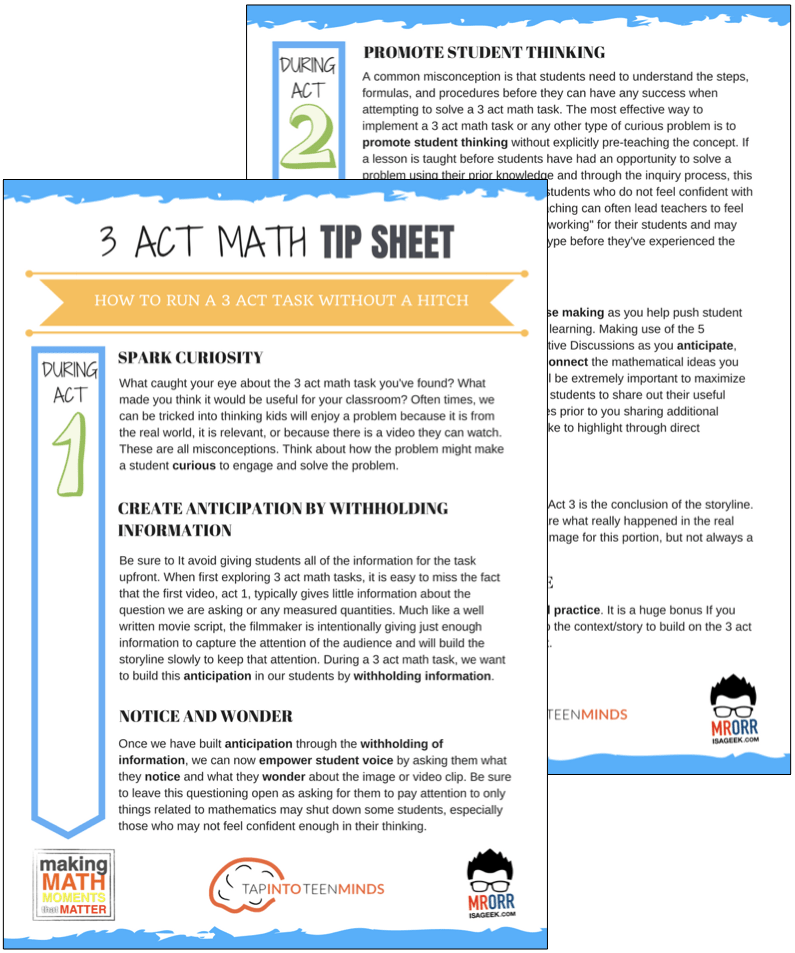
DOWNLOAD THE 3 ACT MATH TASK TIP SHEET SO THEY RUN WITHOUT A HITCH!
Download the 2-page printable 3 Act Math Tip Sheet to ensure that you have the best start to your journey using 3 Act math Tasks to spark curiosity and fuel sense making in your math classroom!
LESSONS TO MAKE MATH MOMENTS
Each lesson consists of:
Each Make Math Moments Problem Based Lesson consists of a Teacher Guide to lead you step-by-step through the planning process to ensure your lesson runs without a hitch!
Each Teacher Guide consists of:
- Intentionality of the lesson;
- A step-by-step walk through of each phase of the lesson;
- Visuals, animations, and videos unpacking big ideas, strategies, and models we intend to emerge during the lesson;
- Sample student approaches to assist in anticipating what your students might do;
- Resources and downloads including Keynote, Powerpoint, Media Files, and Teacher Guide printable PDF; and,
- Much more!
Each Make Math Moments Problem Based Lesson begins with a story, visual, video, or other method to Spark Curiosity through context.
Students will often Notice and Wonder before making an estimate to draw them in and invest in the problem.
After student voice has been heard and acknowledged, we will set students off on a Productive Struggle via a prompt related to the Spark context.
These prompts are given each lesson with the following conditions:
- No calculators are to be used; and,
- Students are to focus on how they can convince their math community that their solution is valid.
Students are left to engage in a productive struggle as the facilitator circulates to observe and engage in conversation as a means of assessing formatively.
The facilitator is instructed through the Teacher Guide on what specific strategies and models could be used to make connections and consolidate the learning from the lesson.
Often times, animations and walk through videos are provided in the Teacher Guide to assist with planning and delivering the consolidation.
A review image, video, or animation is provided as a conclusion to the task from the lesson.
While this might feel like a natural ending to the context students have been exploring, it is just the beginning as we look to leverage this context via extensions and additional lessons to dig deeper.
At the end of each lesson, consolidation prompts and/or extensions are crafted for students to purposefully practice and demonstrate their current understanding.
Facilitators are encouraged to collect these consolidation prompts as a means to engage in the assessment process and inform next moves for instruction.
In multi-day units of study, Math Talks are crafted to help build on the thinking from the previous day and build towards the next step in the developmental progression of the concept(s) we are exploring.
Each Math Talk is constructed as a string of related problems that build with intentionality to emerge specific big ideas, strategies, and mathematical models.
Make Math Moments Problem Based Lessons and Day 1 Teacher Guides are openly available for you to leverage and use with your students without becoming a Make Math Moments Academy Member.
Use our OPEN ACCESS multi-day problem based units!
Make Math Moments Problem Based Lessons and Day 1 Teacher Guides are openly available for you to leverage and use with your students without becoming a Make Math Moments Academy Member.
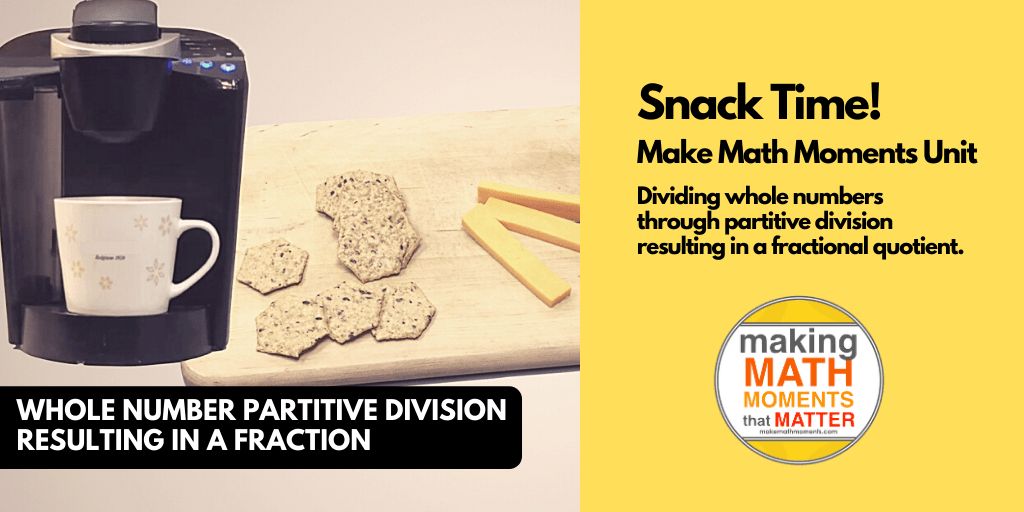
Partitive Division Resulting in a Fraction
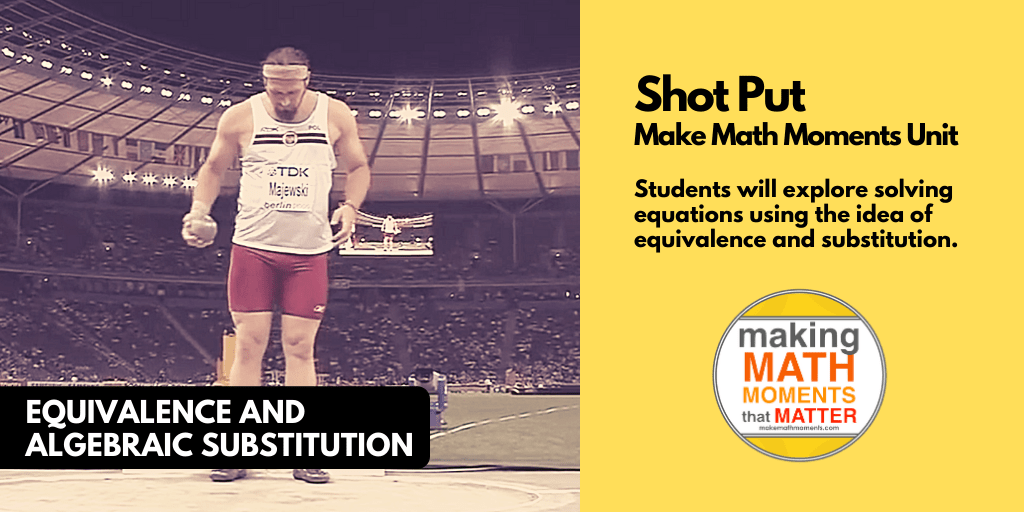
Equivalence and Algebraic Substitution
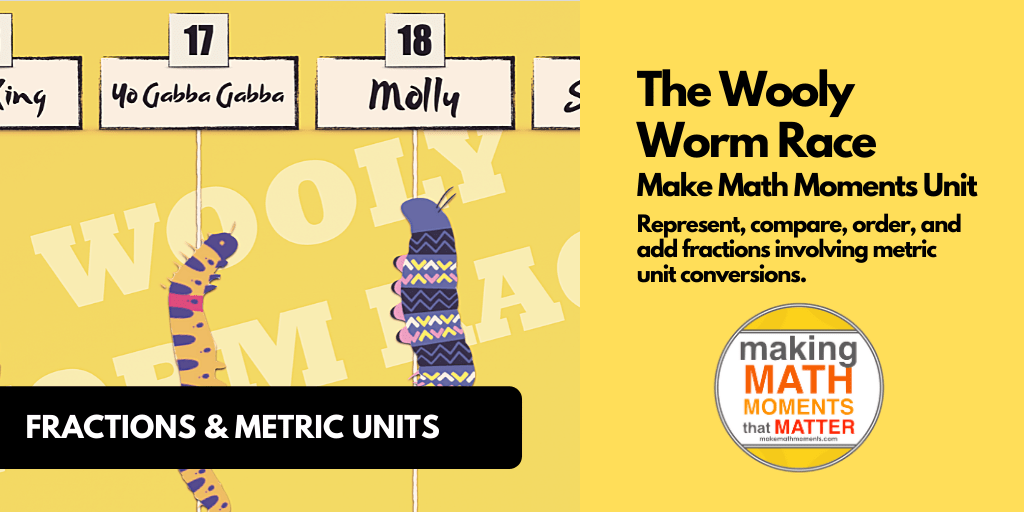
Represent Categorical Data & Explore Mean
Downloadable resources including blackline masters, handouts, printable Tips Sheets, slide shows, and media files do require a Make Math Moments Academy Membership.
ONLINE WORKSHOP REGISTRATION
Pedagogically aligned for teachers of K through Grade 12 with content specific examples from Grades 3 through Grade 10.
In our self-paced, 12-week Online Workshop, you'll learn how to craft new and transform your current lessons to Spark Curiosity, Fuel Sense Making, and Ignite Your Teacher Moves to promote resilient problem solvers.
0 Comments